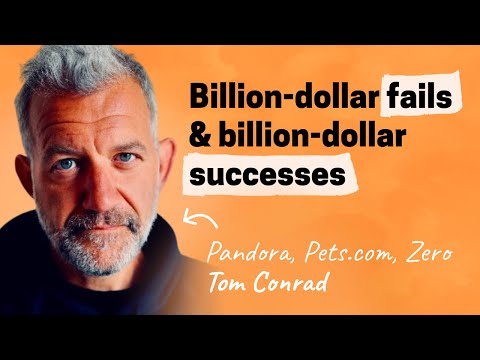
Billion dollar failures, and billion dollar success | Tom Conrad (Quibi, Pandora, Pets.com, Zero)
Tom Conrad (guest), Lenny Rachitsky (host), Narrator
In this episode of Lenny's Podcast, featuring Tom Conrad and Lenny Rachitsky, Billion dollar failures, and billion dollar success | Tom Conrad (Quibi, Pandora, Pets.com, Zero) explores from Pets.com to Quibi: Tom Conrad’s Hard-Won Product Lessons Tom Conrad, veteran product and engineering leader (Apple, Pandora, Snap, Quibi, Pets.com), reflects on decades of successes and high-profile failures and how they shaped his approach to product, careers, and company-building.
From Pets.com to Quibi: Tom Conrad’s Hard-Won Product Lessons
Tom Conrad, veteran product and engineering leader (Apple, Pandora, Snap, Quibi, Pets.com), reflects on decades of successes and high-profile failures and how they shaped his approach to product, careers, and company-building.
He argues that careers are made as much by failures as by wins, and emphasizes understanding the ‘math formula’ of a business, not just building great products, as a core responsibility for modern product leaders.
Conrad contrasts different company cultures (Apple, Pandora, Snap, Quibi, Zero) to draw lessons on risk-taking, founder dynamics, leadership style, and the value of joining the right team over being a founder at all costs.
Now CEO of Zero, a consumer health app, he shares how focusing on unit economics, metabolic health outcomes, and balanced work culture informs his current leadership and his views on burnout and sustainable careers.
Key Takeaways
Don’t optimize only for product; understand the business ‘math formula’.
Conrad says companies are equations that turn investment into returns. ...
Get the full analysis with uListen AI
Failures can become powerful career assets, not just setbacks.
Experiences at Pets. ...
Get the full analysis with uListen AI
Trust your gut about people and culture when choosing jobs.
He argues most people can sense cultural mismatches during interviews but talk themselves out of it. ...
Get the full analysis with uListen AI
Unit economics and capital discipline beat growth-at-all-costs, especially in consumer subscription.
At Zero, Conrad and the founder chose to grow by improving LTV and retention on organic traffic rather than buying growth, which he contrasts with pandemic-era health apps that burned capital on paid acquisition and later suffered when the market turned.
Get the full analysis with uListen AI
Not everyone should be a founder; joining the right team can be better.
Conrad believes many smart, semi-visionary people would create more impact—and have better careers—by bringing their skills to teams with sound business fundamentals instead of raising a seed round for a weak idea just to be ‘a founder’.
Get the full analysis with uListen AI
Leadership style must adapt to stage; detail-obsessed CEOs can both unlock and block progress.
At scale, founders like Evan Spiegel or Brian Chesky sometimes need to cut through indecision by dictating product direction. ...
Get the full analysis with uListen AI
Sustainable careers require balance, not performative overwork.
Conrad rejects “hashtag hustle” culture, recalling how a quiet, 8:30–5:00 engineer at Apple actually contributed more than his own visible late nights. ...
Get the full analysis with uListen AI
Notable Quotes
“There’s this belief that everybody needs to be a founder. I think our industry would be much better off if there were fewer founders.”
— Tom Conrad
“Companies are also kind of like a math problem that describes how you take investment and pour it into the equation, and out the other side comes returns.”
— Tom Conrad
“If the equation is fundamentally broken, no amount of iteration and execution can get you out of the failed outputs of the broken equation.”
— Tom Conrad
“The details are not the details, they make the design.”
— Tom Conrad, quoting Charles Eames
“Whatever the thing is that gets you out of bed every morning, you can achieve that in collaboration with others. You don’t have to be the person that raises the seed round.”
— Tom Conrad
Questions Answered in This Episode
How can a mid-level product manager practically build and maintain the kind of full-business financial model (LTV, CAC, funnels) Conrad describes at Zero?
Tom Conrad, veteran product and engineering leader (Apple, Pandora, Snap, Quibi, Pets. ...
Get the full analysis with uListen AI
If you suspect the ‘math formula’ of your company is broken, what concrete steps can you take from a product role to influence leadership or de-risk the model?
He argues that careers are made as much by failures as by wins, and emphasizes understanding the ‘math formula’ of a business, not just building great products, as a core responsibility for modern product leaders.
Get the full analysis with uListen AI
In hindsight, what specific signals at Quibi or Pets.com would Conrad now treat as hard red flags before joining or investing?
Conrad contrasts different company cultures (Apple, Pandora, Snap, Quibi, Zero) to draw lessons on risk-taking, founder dynamics, leadership style, and the value of joining the right team over being a founder at all costs.
Get the full analysis with uListen AI
How should ambitious product leaders decide between trying to found something versus finding a high-upside team with a better ‘equation’ to join?
Now CEO of Zero, a consumer health app, he shares how focusing on unit economics, metabolic health outcomes, and balanced work culture informs his current leadership and his views on burnout and sustainable careers.
Get the full analysis with uListen AI
What are the first 3–5 product and culture moves Conrad would make if he were stepping into a struggling consumer subscription app today?
Get the full analysis with uListen AI
Transcript Preview
There's this belief that everybody needs to be a founder. I think, in some ways, our industry would be much better off if there were fewer founders. There's an entire category of smart, creative, hardworking, talented, you know, borderline visionary people who can raise that two million dollar seed and go off and build some stupid company that's never gonna go anywhere. That would be so much better off finding a, a team that needs their skillset and that, and working on a problem that has a mathematical formula that's going to win on any metric, whatever me- metric you care about. You want, like, the acclaim of your peers, you want financial reward, you want outsized impact on culture, like, whatever, whatever the thing is that gets you out of bed every morning, you can, you can achieve that in collaboration with others. You don't have to be the person that raises the seed round.
(instrumental music) Today, my guest is Tom Conrad. Tom was an engineer at Apple, CTO of Pandora, which he helped take from zero to 80 million users. He's also VP of product at Snap, where he was the right-hand man to Evan Spiegel for two years. He's been on the board of Sonos for over seven years. He's also part of two infamous product failures, Quibi, where he was chief product officer, which raised over two billion dollars and died less than a year after launch. He was also a senior engineering leader at pets.com, which famously went from nothing to a public company to completely out of business in 19 months. Today, Tom is the CEO of Zero Longevity Science, which is on a mission to extend the lifespan and the healthspan of the human race. In our conversation, we dig into what Tom's learned from these famous product failures, also what he's learned from the many product successes. Tom also shares what he's learned about how to pick where to go work and what to avoid, how important understanding the math formula of the business model is, also lessons on burnout and health and leadership, and Contrarian Corner. With that, I bring you Tom Conrad, after a short word from our sponsors. This episode is brought to you by Coda. You've heard me talk about how Coda is the doc that brings it all together, and how it can help your team run smoother and be more efficient. I know this firsthand, because Coda does that for me. I use Coda every day to wrangle my newsletter content calendar, my interview notes for podcasts, and to coordinate my sponsors. More recently, I actually wrote a whole post on how Coda's product team operates, and within that post, they shared a dozen templates that they use internally to run their product team, including managing the roadmap, their OKR process, getting internal feedback, and essentially, their whole product development process is done within Coda. If your team's work is spread out across different documents and spreadsheets and a stack of workflow tools, that's why you need Coda. Coda puts data in one centralized location, regardless of format, eliminating roadblocks that can slow your team down. Coda allows your team to operate on the same information and collaborate in one place. Take advantage of this special limited time offer just for startups. Sign up today at coda.io/lenny and get $1,000 startup credit on your first statement. That's C-O-D-A dot I-O slash Lenny to sign up, and get a startup credit of $1,000. Coda.io/lenny. You fell in love with building products for a reason, but sometimes the day-to-day reality is a little different than you imagined. Instead of dreaming up big ideas, talking to customers, and crafting a strategy, you're drowning in spreadsheets and roadmap updates and you're spending your days basically putting out fires. A better way is possible. Introducing Jira Product Discovery, the new prioritization and roadmapping tool built for product teams by Atlassian. With Jira Product Discovery, you can gather all your product ideas and insights in one place and prioritize confidently, finally replacing those endless spreadsheets. Create and share custom product roadmaps with any stakeholder in seconds, and it's all built on Jira, where your engineering teams are already working, so true collaboration is finally possible. Great products are built by great teams, not just engineers. Sales, support, leadership, even Greg from finance. Anyone that you want can contribute ideas, feedback, and insights in Jira Product Discovery for free, no catch. And it's only $10 a month for you. Say goodbye to your spreadsheets and the never-ending alignment efforts. The old way of doing product management is over. Rediscover what's possible with Jira Product Discovery. Try it for free at atlassian.com/lenny. That's atlassian.com/lenny. Tom, thank you so much for being here, and welcome to the podcast.
Install uListen to search the full transcript and get AI-powered insights
Get Full TranscriptGet more from every podcast
AI summaries, searchable transcripts, and fact-checking. Free forever.
Add to Chrome