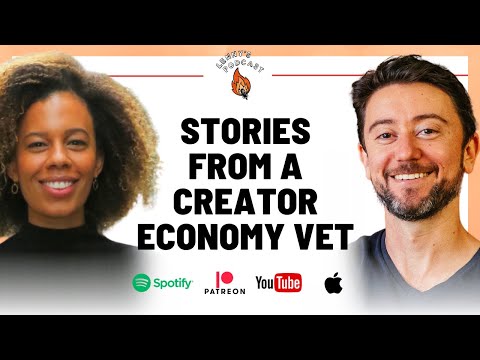
Monetizing passions, scaling marketplaces, and stories from a creator economy vet | Camille Hearst
Camille Hearst (guest), Lenny Rachitsky (host)
In this episode of Lenny's Podcast, featuring Camille Hearst and Lenny Rachitsky, Monetizing passions, scaling marketplaces, and stories from a creator economy vet | Camille Hearst explores inside the creator economy: monetizing fandom, marketplaces, and momentum Spotify’s Head of Fan Monetization, Camille Hearst, shares lessons from years building products for creators at Apple, YouTube, Hailo, Kit, Patreon, and now Spotify.
Inside the creator economy: monetizing fandom, marketplaces, and momentum
Spotify’s Head of Fan Monetization, Camille Hearst, shares lessons from years building products for creators at Apple, YouTube, Hailo, Kit, Patreon, and now Spotify.
She explains how platforms can turn fan passion into sustainable income for artists through merch, events, and new monetization tools—while also grappling with creators’ reluctance to charge and the “hamster wheel” of constant content.
Camille unpacks how to succeed as a creator (consistency, collaboration, curators), why supply-side focus is critical in marketplaces, and what it’s actually like to build and sell a startup in the creator economy.
Along the way, she contrasts Apple’s product culture with Google’s, tells a rare in-person Steve Jobs story, and reflects on how her “radical Buddhist artist technologist” upbringing shaped her path.
Key Takeaways
Fan passion is under-monetized, and platforms can unlock that value.
Fans are eager to financially support artists they love—through merch, exclusive access, and experiences—but many don’t even know these options exist on platforms like Spotify. ...
Get the full analysis with uListen AI
Creators struggle emotionally with charging for their work, limiting their earnings.
Many artists, especially musicians, feel guilty charging fans or doubt their work’s value, which clashes with the need for a sustainable income. ...
Get the full analysis with uListen AI
Consistency and collaboration are two of the strongest predictors of creator success.
From early YouTube days to now, the creators who win show up regularly with quality content and deliberately collaborate with peers to cross-pollinate audiences. ...
Get the full analysis with uListen AI
Curators themselves are powerful creators and leverage in a crowded content world.
As content explodes, trusted curators (individuals or brands) who filter and recommend become critical distribution nodes. ...
Get the full analysis with uListen AI
In two-sided marketplaces, obsess over supply first—or nothing else works.
Camille’s work at Hailo (Uber competitor) reinforced that beautiful UX and heavy marketing mean little if there’s no supply: no cars, no rides; no creators, no content; no hosts, no rooms. ...
Get the full analysis with uListen AI
If you may one day sell your company, start laying groundwork early.
Treat M&A like fundraising: build a pipeline, manage a structured process, and cultivate relationships with potential acquirers long before you need them. ...
Get the full analysis with uListen AI
De-risk your biggest bets first using dual-track discovery and delivery.
Borrowing from Marty Cagan’s dual-track agile, Camille advocates continuously running discovery and delivery in parallel and intentionally tackling the highest-risk, highest-impact ideas early. ...
Get the full analysis with uListen AI
Notable Quotes
“We call it the hamster wheel of content creation—you get on because you love it, and then how do you get off?”
— Camille Hearst
“Fans want to support the artists they love; they want to open up their wallets.”
— Camille Hearst
“It doesn’t matter how nice the user experience is if, when someone opens the app, there are no cars available.”
— Camille Hearst
“A lot of times people go and they ask for a picture or an autograph, but this idea of just thanking someone for something they’ve done that impacted you is something my parents encouraged me to do.”
— Camille Hearst
“Start preparing to sell your company from the moment you found it… You never know what the future holds.”
— Camille Hearst
Questions Answered in This Episode
How can platforms better support creators in taking breaks without losing income or audience, given the ‘hamster wheel’ nature of content creation?
Spotify’s Head of Fan Monetization, Camille Hearst, shares lessons from years building products for creators at Apple, YouTube, Hailo, Kit, Patreon, and now Spotify.
Get the full analysis with uListen AI
What new monetization formats—beyond merch and listening parties—could most meaningfully change the economics for mid-tier artists and creators?
She explains how platforms can turn fan passion into sustainable income for artists through merch, events, and new monetization tools—while also grappling with creators’ reluctance to charge and the “hamster wheel” of constant content.
Get the full analysis with uListen AI
How can creators overcome the psychological barriers around charging for their work and pricing it confidently?
Camille unpacks how to succeed as a creator (consistency, collaboration, curators), why supply-side focus is critical in marketplaces, and what it’s actually like to build and sell a startup in the creator economy.
Get the full analysis with uListen AI
In a world dominated by a few giant platforms, where is there still real whitespace for new creator-focused startups?
Along the way, she contrasts Apple’s product culture with Google’s, tells a rare in-person Steve Jobs story, and reflects on how her “radical Buddhist artist technologist” upbringing shaped her path.
Get the full analysis with uListen AI
What should marketplace founders do differently if their supply side is emotionally driven (artists, creators) rather than purely economically driven (drivers, hosts)?
Get the full analysis with uListen AI
Transcript Preview
... though Steve Jobs' lore was that if you were in an elevator with him, you'd better be prepared to talk about what you do at the company because he had a habit of getting in the elevator and looking at you and saying, "What do you do? What do you do here?" And there were also rumors that people who had not given him a good answer, that ended up being their last day at Apple. (laughs) So there was someone I... Who I didn't know personally but, uh, worked in my department before I got there who got in an elevator and looked up and Steve was approaching him and so he went to press the button to open the door and accidentally pressed the one to close the door. (laughs)
(laughs)
And was like doing this... Press... You can't see me if you, if you're listening on podcast but, like, frantically pressing the button trying to open the door but accidentally pressing the close door button and the elevator going to its destination and apparently he got off and just bolted, like, ran straight up, ran down the hallway.
(laughs)
So...
He'll never remember my face.
Yeah, exactly.
And disappear.
(laughs)
(intro music plays) Welcome to Lenny's Podcast where I interview world-class product leaders and growth experts to learn from their hard-won experiences building and growing today's most successful products. Today my guest is Camille Hearst. Camille is Head of Fan Monetization at Spotify. Before that she was Head of Product for Creators at Patreon, she was Product Marketing Manager at YouTube and the second PM on iTunes. She's also a former founder. She started a company called Kit that she sold to Patreon and this episode is for anyone who's curious about the creator space, either from the creator side or the platform side, or if you'd just like to hear a bunch of fun stories from an awesome product leader. We chat about the future of creator platforms, how to be successful as a creator and also as a new creator platform, the downsides of creator life, plus frameworks, stories from Steve Jobs, ways to monetize being a creator, and so much more. Enjoy this episode with Camille Hearst after a short word from our sponsors. This episode is brought to you by Merge. Every product manager knows how slow product development can get when developers have to build and maintain integrations with other platforms. Merge's unified API can fully remove this blocker from your roadmap. With one API, your team can add over 180 HR, accounting, ATS, ticketing, CRM, file storage and marketing automation integrations into your product. You can get your first integration into production in a matter of days and save countless weeks building custom integrations, letting you get back to building your core product. Merge's integrations speed up the product development process for customers like Ramp, Drata, and many other fast-growing and established companies, allowing them to test their features at scale without having to worry about a never-ending integrations roadmap. Save your engineers countless hours, hit your growth targets, and expedite your sales cycle by making integration offerings your competitive advantage with Merge. Visit merge.dev/lenny to get started and integrate up to three customers for free. This episode is brought to you by Coda. You've heard me talk about how Coda is the doc that brings it all together and how it can help your team run smoother and be more efficient. I know this firsthand because Coda does that for me. I use Coda every day to wrangle my newsletter content calendar, my interview notes for podcasts, and to coordinate my sponsors. More recently, I actually wrote a whole post on how Coda's product team operates and within that post, they shared a dozen templates that they use internally to run their product team including managing their roadmap, their OKR process, getting internal feedback, and essentially their whole product development process is done within Coda. If your team's work is spread out across different documents and spreadsheets and a stack of workflow tools, that's why you need Coda. Coda puts data in one centralized location regardless of format, eliminating roadblocks that can slow your team down. Coda allows your team to operate on the same information and collaborate in one place. Take advantage of this special limited time offer just for startups. Sign up today at coda.io/lenny and get $1,000 starter credit on your first statement. That's C-O-D-A dot I-O slash Lenny to sign up and get a starter credit of $1,000. Coda.io/lenny. (instrumental music plays) Camille, thank you so much for being here. Welcome to the podcast.
Install uListen to search the full transcript and get AI-powered insights
Get Full TranscriptGet more from every podcast
AI summaries, searchable transcripts, and fact-checking. Free forever.
Add to Chrome