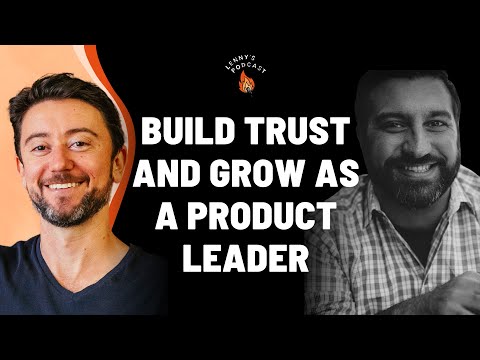
How to build trust and grow as a product leader | Fareed Mosavat (Reforge, Slack, Instacart, Pixar)
Fareed Mosavat (guest), Lenny Rachitsky (host), Jon (Amplitude representative) (guest), Narrator
In this episode of Lenny's Podcast, featuring Fareed Mosavat and Lenny Rachitsky, How to build trust and grow as a product leader | Fareed Mosavat (Reforge, Slack, Instacart, Pixar) explores from IC to Leader: Building Trust and Scope in Product Management The conversation traces Fareed Mosavat’s journey from engineer and Pixar technologist to growth/product leader at Slack and Instacart, and now Chief Development Officer at Reforge. He explains why product management is uniquely hard to get good at: there’s no real pre-training, and improvement comes mainly from doing real work on real products. Fareed outlines a learning loop for PMs—execute, generalize, communicate, and scale opportunities—and shows how this underpins both strong IC careers and the transition into management. He also explores the “product leader canyon,” common failure modes when moving from IC to manager, and the emerging trend of senior operators shifting into portfolio-style advisory and creator careers.
From IC to Leader: Building Trust and Scope in Product Management
The conversation traces Fareed Mosavat’s journey from engineer and Pixar technologist to growth/product leader at Slack and Instacart, and now Chief Development Officer at Reforge. He explains why product management is uniquely hard to get good at: there’s no real pre-training, and improvement comes mainly from doing real work on real products. Fareed outlines a learning loop for PMs—execute, generalize, communicate, and scale opportunities—and shows how this underpins both strong IC careers and the transition into management. He also explores the “product leader canyon,” common failure modes when moving from IC to manager, and the emerging trend of senior operators shifting into portfolio-style advisory and creator careers.
Key Takeaways
Real product management skill comes from shipping real products repeatedly.
Courses, books, and mentorship are accelerators, but they sit on top of hands‑on experience solving real problems for real customers with real data. ...
Get the full analysis with uListen AI
Use a deliberate learning loop: execute, generalize, communicate, then scale.
First ship work, then extract generalizable lessons from it (patterns, mental models), communicate those learnings so others see your impact, and leverage that visibility to earn broader, hairier, more ambiguous problems to solve.
Get the full analysis with uListen AI
Sponsorship, not just mentorship, is critical for PM career inflection points.
Key leaps in Fareed’s career came when senior leaders trusted him with larger scopes, not because they coached every move, but because he’d proven judgment and communicated clearly enough that they were willing to ‘go to bat’ for him.
Get the full analysis with uListen AI
To get sponsorship, understand two levels up and two levels down, plus left and right.
Great PMs build a mental model of how the whole company works: they know their boss’s and their boss’s boss’s priorities, the technical and operational details beneath them, and how adjacent teams (sales, marketing, core product, finance) fit into the system.
Get the full analysis with uListen AI
Avoid the manager death spiral by shifting from doer to editor.
New managers often hoard the most important projects and dive into every detail, burning out and stunting their team’s growth. ...
Get the full analysis with uListen AI
Product leaders must manage a portfolio across four types of work.
Fareed and Casey Winters define four product work types: feature work, growth work, product‑market‑fit expansion, and scaling work. ...
Get the full analysis with uListen AI
As a leader, you own outcomes, not just output within given constraints.
ICs optimize within the resources they’re given; leaders must define what resources and cross-functional support are required to hit business outcomes—and clearly articulate trade-offs when resourcing is insufficient.
Get the full analysis with uListen AI
Portfolio careers for senior operators are rising—but come with trade‑offs.
More senior PMs and product leaders are becoming advisors, fractional heads, and creators, leveraging deep, specific knowledge across many companies. ...
Get the full analysis with uListen AI
Notable Quotes
“You can't do homework, you can't do exercises, you can't do fake stuff. You have to work on real products, at real companies, with real customers, with real data to get better at product management.”
— Fareed Mosavat
“What's in your strategy doc isn't that important. It's actually just an input into the end experience that you're trying to deliver for customers.”
— Fareed Mosavat
“No one knows what you're thinking if you don't tell them.”
— Fareed Mosavat
“As a leader, it's not just your job to get what you can get done with the resources in front of you. It's your job to marshal resources both inside your org and across your organization.”
— Fareed Mosavat
“You have to shift from doer to editor. Your job is to make the work better, not to do all the work yourself.”
— Fareed Mosavat
Questions Answered in This Episode
How can a PM working on a narrow feature area practically start building the ‘two levels up, two levels down’ understanding of their company without burning out?
The conversation traces Fareed Mosavat’s journey from engineer and Pixar technologist to growth/product leader at Slack and Instacart, and now Chief Development Officer at Reforge. ...
Get the full analysis with uListen AI
What are some concrete signals that it’s time for an IC PM to step into management versus continuing on a senior IC path?
Get the full analysis with uListen AI
How should a new product leader decide the right portfolio mix across feature work, growth work, product‑market fit expansion, and scaling work for their specific business stage?
Get the full analysis with uListen AI
For PMs interested in a future portfolio/advisory career, when is the right time to start diversifying into advising, writing, or teaching without undermining their current role?
Get the full analysis with uListen AI
In a fully or mostly remote environment, what are the most effective ways to build the kind of trust and sponsorship Fareed describes, given the loss of hallway conversations and informal visibility?
Get the full analysis with uListen AI
Transcript Preview
You can't do homework, you can't do exercises, you can't do fake stuff. You have to work on real products, at real companies, with real customers, with real data to get better at product management. And so any kind of, like, training, mentorship, reading, et cetera that you do is just a layer on top of that. The real acceleration happens from doing it and getting more reps. There are ways that I think great PMs use to go faster on this loop, but you still have to do the work. At the core is, you have to actually execute and deliver great products, and you have to do it over and over and over again.
(instrumental music) Fareed Mosavat is the chief development officer at Reforge, where he's been for over two and a half years. Before that, he spent three and a half years at Slack, leading a lot of their growth efforts. About a year at Instacart, leading a number of their key growth analytics and product efforts. He was a GM at Zynga, he was VP of product at Runkeeper, and something that I only learned during our chat is that he spent six years at Pixar doing character simulation, rigging, and building 3D animation tools. In our conversation, we focus on the journey of becoming a great PM, including crossing the canyon from IC to manager, the importance of expanding your scope, and how to create opportunities where you get more responsibility as a PM. Fareed is such an A+ human, full of so much insight, and I'm really excited for you to learn from him. With that, I bring you Fareed Mosavat. This episode is brought to you by Coda. Coda's an all-in-one doc that combines the best of documents, spreadsheets and apps in one place. I actually use Coda every single day. It's my home base for organizing my newsletter writing, it's where I plan my content calendar, capture my research, and write the first drafts of each and every post. It's also where I curate my private knowledge repository for paid newsletter subscribers, and it's also how I manage the workflow for this very podcast. Over the years, I've seen Coda evolve, from being a tool that makes teams more productive to one that also helps bring the best practices across the tech industry to life with an incredibly rich collection of templates and guides in the Coda doc gallery, including resources from many guests on this podcast, including Shreyas, Gokul, and Shishir, the CEO of Coda. Some of the best teams out there, like Pinterest, Spotify, Square, and Uber, use Coda to run effectively, and have published their templates for anyone to use. If you're ping-ponging between lots of documents and spreadsheets, make your life better and start using Coda. You can take advantage of a special limited time offer just for startups. Head over to coda.io/lenny to sign up and get a thousand dollar credit on your first statement. That's C-O-D-A dot IO slash Lenny to sign up and get a thousand dollars in credit on your account. I'm excited to chat with my friend Jon Cutler from podcast sponsor Amplitude. Hey, Jon.
Install uListen to search the full transcript and get AI-powered insights
Get Full TranscriptGet more from every podcast
AI summaries, searchable transcripts, and fact-checking. Free forever.
Add to Chrome