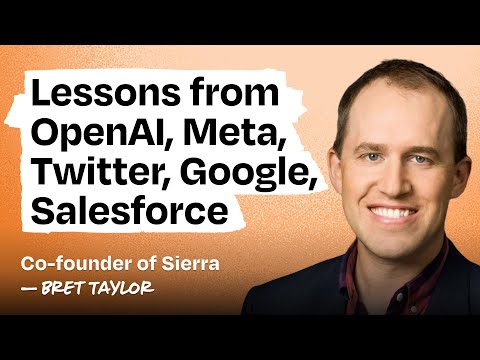
He saved OpenAI, invented the “Like” button, and built Google Maps: Bret Taylor (Sierra)
Lenny Rachitsky (host), Bret Taylor (guest), Narrator, Christina Cacioppo (guest)
In this episode of Lenny's Podcast, featuring Lenny Rachitsky and Bret Taylor, He saved OpenAI, invented the “Like” button, and built Google Maps: Bret Taylor (Sierra) explores bret Taylor on AI agents, failure, and reinventing software’s future Bret Taylor, legendary product builder behind Google Maps, FriendFeed, Quip, Salesforce, and now Sierra, traces how early failure with Google Local shaped his product philosophy and eventually led to Google Maps.
Bret Taylor on AI agents, failure, and reinventing software’s future
Bret Taylor, legendary product builder behind Google Maps, FriendFeed, Quip, Salesforce, and now Sierra, traces how early failure with Google Local shaped his product philosophy and eventually led to Google Maps.
He argues the AI market will be dominated by agents and outcomes-based pricing, with frontier models owned by a few hyperscalers and most startup opportunity in applied AI and tooling.
Taylor shares mindsets that enabled him to succeed across roles (engineer, PM, CTO, CEO, board chair), emphasizing flexible identity, obsession with impact, intellectual honesty, and high-quality advice-seeking.
He predicts coding will shift from writing code to operating code-generating systems, explains why computer science and systems thinking still matter, and details how AI agents are already delivering large, measurable productivity gains, especially in customer service.
Key Takeaways
Differentiate by creating native, new experiences—not digital copies of old ones.
Taylor’s failure with Google Local (a ‘me too’ Yellow Pages clone) and subsequent success with Google Maps taught him that simply digitizing existing workflows rarely wins; reassembling the “Lego set” into a fundamentally new, native experience does.
Get the full analysis with uListen AI
Anchor your career around impact, not a fixed professional identity.
Prompted by direct feedback from Sheryl Sandberg, Taylor shifted from doing what he enjoyed (hands-on product/engineering) to asking daily, “What is the most impactful thing I can do today? ...
Get the full analysis with uListen AI
Beware “single-issue” thinking and incorrect internal storytelling.
Founders tend to see every problem through their own strength (engineering, design, BD) and quickly turn hypotheses (“we lost because of price”) into “facts. ...
Get the full analysis with uListen AI
Computer science remains crucial as we move from coding to operating AI code-generators.
Even as AI writes more code, understanding algorithms, complexity, systems, and constraints will be critical for safely orchestrating large, complex systems and constraining powerful models to produce correct, scalable software.
Get the full analysis with uListen AI
The AI market will consolidate at the model layer and explode at the agent layer.
Taylor expects frontier models to be built by a few hyperscalers (due to massive CapEx needs), a risky-but-real tooling layer close to the “sun,” and a huge, SaaS-like wave of applied AI companies building specialized agents that deliver clear business outcomes.
Get the full analysis with uListen AI
Agents enable true productivity gains and naturally fit outcomes-based pricing.
Unlike traditional “productivity software,” agents autonomously complete jobs, making value both real and measurable. ...
Get the full analysis with uListen AI
Pick go-to-market based on who your buyer is—not just what’s trendy.
Developer-led, PLG, and direct sales each work in specific contexts. ...
Get the full analysis with uListen AI
Notable Quotes
“The whole market is going to go towards agents. I think the whole market is going to go towards outcomes-based pricing.”
— Bret Taylor
“The actual act of engineering or product design…what I really liked is impact.”
— Bret Taylor
“Rather than literally digitizing what came before, if you can create an entirely new experience, it answers the question for a new customer: ‘Why should I give this the time of day?’”
— Bret Taylor
“One of the dangers for founders is incorrect storytelling. If you tell yourself the wrong story about why people don’t like your product, and build around it, your company is going to fail.”
— Bret Taylor
“The best way to predict the future is to invent it.”
— Bret Taylor (quoting Alan Kay)
Questions Answered in This Episode
If agents become the default interface to software, what happens to traditional SaaS products and UX design as we know them?
Bret Taylor, legendary product builder behind Google Maps, FriendFeed, Quip, Salesforce, and now Sierra, traces how early failure with Google Local shaped his product philosophy and eventually led to Google Maps.
Get the full analysis with uListen AI
How can early-stage founders practically build the habit of intellectual honesty and avoid the ‘single-issue voter’ trap around their own strengths?
He argues the AI market will be dominated by agents and outcomes-based pricing, with frontier models owned by a few hyperscalers and most startup opportunity in applied AI and tooling.
Get the full analysis with uListen AI
What would a truly AI-native programming system look like in practice, and how would it change how teams structure engineering work?
Taylor shares mindsets that enabled him to succeed across roles (engineer, PM, CTO, CEO, board chair), emphasizing flexible identity, obsession with impact, intellectual honesty, and high-quality advice-seeking.
Get the full analysis with uListen AI
How should schools and universities redesign assessments in a world where every student has access to a ‘superintelligent’ tutor like ChatGPT?
He predicts coding will shift from writing code to operating code-generating systems, explains why computer science and systems thinking still matter, and details how AI agents are already delivering large, measurable productivity gains, especially in customer service.
Get the full analysis with uListen AI
For an AI startup today, how do you decide whether to build tooling versus a vertical agent product—and how close to the “sun” (model providers) is too close?
Get the full analysis with uListen AI
Transcript Preview
You were CTO of Meta. You were co-CEO of Salesforce. You're chairman of the board at OpenAI. How do you think the AI market is gonna play out?
The whole market is going to go towards agents. I think the whole market is going to go towards outcomes-based pricing. That's just so obviously the correct way to build and sell software.
This makes me think about it, I had Marc Benioff on the podcast, you guys were co-CEOs. He was extremely agent-pilled.
It's so hard to sell productivity software, which I learned (laughs) the hard way.
What's a story that comes to mind when you think about your biggest mistake?
I was the product manager for what was called Google Local. Had a pretty tough product review with Marissa and Larry. And to not do that well with a link from the Google homepage is like kind of embarrassing.
I think it's really empowering for people to hear it's possible to succeed in spite of a massive failure like this.
They sort of gave me another shot to do the V2 of it that resulted in Google Maps. We got about 10 million people use it on the first day.
What mindset contributed to you being successful in such a variety of roles?
Waking up every morning, "What is the most impactful thing I can do today?"
Today my guest is Bret Taylor. Bret is an absolute legendary builder and founder. He co-created Google Maps at Google. He co-founded the social network FriendFeed, which invented the like button and the real-time newsfeed, which he sold to Facebook. He then became CTO at Facebook. He then started a productivity company called Quip, which he sold to Salesforce for $750 million. He then became co-CEO of Salesforce. He's also currently chairman of the board at OpenAI. At one point he was chairman of the board at Twitter. Today he's co-founder and CEO of Ciara, an AI startup building agents to help companies with customer service, sales, and more. In our conversation, we cover so much ground, including what skills and mindsets have most helped Bret be so successful in so many roles, why we're all still sleeping on the impact that agents are gonna have on the business world, how coding is going to change in the coming years, where the biggest opportunities remain for startups, lessons on pricing and go-to market in AI, the story behind the like button, and so much more. This is a truly epic conversation with a legendary builder. If you enjoy this podcast, don't forget to subscribe and follow it in your favorite podcasting app or YouTube. Also, if you become an annual subscriber of my newsletter, you get a year free of a bunch of incredible products, including Replit, Lovable, Bolt, n8n, Linear, Superhuman, Descript, Whisperflow, Gamma, Perplexity, Warp, Granola, Magic Patterns, Raycast, ChatPR, Dmob, and more. Check it out at lennysnewsletter.com and click "bundle." With that, I bring you Bret Taylor. This episode is brought to you by CodeRabbit, the AI code review platform transforming how engineering teams ship faster with AI without sacrificing code quality. Code reviews are critical, but time-consuming. CodeRabbit acts as your AI co-pilot, providing instant code review comments and potential impacts of every pull request. Beyond just flagging issues, CodeRabbit provides one-click fix suggestions and lets you define custom code quality rules using AST GREP patterns, catching subtle issues that traditional static analysis tools might miss. CodeRabbit also provides free AI code reviews directly in the IDE. It's available in VSCode, Cursor, and Windsurf. CodeRabbit has so far reviewed more than 10 million PRs, installed on one million repositories, and is used by over 70,000 open source projects. Get CodeRabbit for free for an entire year at coderabbit.ai using code LENNY. That's coderabbit.ai. This episode is brought to you by Basecamp. Basecamp is the famously straightforward project management system from 37signals. Most project management systems are either inadequate or frustratingly complex, but Basecamp is refreshingly clear. It's simple to get started, easy to organize, and Basecamp's visual tools help you see exactly what everyone is working on and how all work is progressing. Keep all your files and conversations about projects directly connected to the projects themselves so that you always know where stuff is and you're not constantly switching contexts. Running a business is hard. Managing your projects should be easy. I've been a longtime fan of what 37Signals has been up to and I'm really excited to be sharing this with you. Sign up for a free account at basecamp.com/lenny. Get somewhere with Basecamp. Bret, thank you so much for being here, and welcome to the podcast.
Install uListen to search the full transcript and get AI-powered insights
Get Full TranscriptGet more from every podcast
AI summaries, searchable transcripts, and fact-checking. Free forever.
Add to Chrome