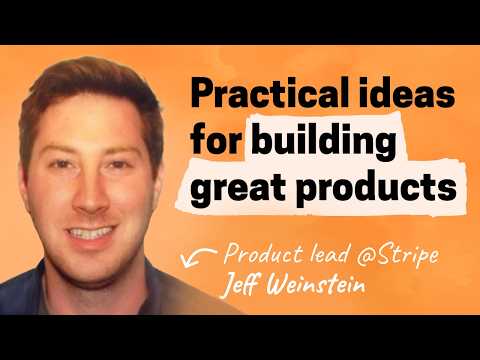
Building product at Stripe: craft, metrics, and customer obsession | Jeff Weinstein (Product lead)
Lenny Rachitsky (host), Jeff Weinstein (guest), Narrator
In this episode of Lenny's Podcast, featuring Lenny Rachitsky and Jeff Weinstein, Building product at Stripe: craft, metrics, and customer obsession | Jeff Weinstein (Product lead) explores stripe’s Jeff Weinstein on metrics, craft, and obsessive customer intimacy Jeff Weinstein, long-time product lead at Stripe and current Atlas leader, breaks down how he builds high-impact products by combining relentless customer focus, sharp metrics, and a bias toward action with long-term thinking.
Stripe’s Jeff Weinstein on metrics, craft, and obsessive customer intimacy
Jeff Weinstein, long-time product lead at Stripe and current Atlas leader, breaks down how he builds high-impact products by combining relentless customer focus, sharp metrics, and a bias toward action with long-term thinking.
He explains his “go, go, go + long-term compounding” philosophy, how to select a few customer-centric metrics that truly represent value, and why talking directly (and constantly) to customers is non‑negotiable.
Jeff shares concrete practices such as his ‘users having a bad day’ metric, only prioritizing feedback from paying customers, and internal programs like Study Groups that force teams to experience their own products like real users.
Much of the conversation centers on Stripe Atlas—how they automated incorporation and 83(b) elections to near one click, made Atlas economically viable, and what it takes to get zero-to-one (and beyond) initiatives done inside a large company.
Key Takeaways
Anchor everything in burning customer problems, not clever ideas or polished UX.
Jeff learned the hard way that beautiful, well-crafted products still fail if they don’t solve a top-tier, urgent problem. ...
Get the full analysis with uListen AI
Talk directly to customers fast, often, and personally—and reward their effort.
He treats any unsolicited customer message as a ‘P0 gift,’ responds immediately (even just to acknowledge), and builds text-message relationships with 5–10 archetypal customers. ...
Get the full analysis with uListen AI
Use money as a truth serum: prioritize feedback from people who actually pay.
Jeff discounts friend and free-user feedback to zero and forces a ‘would you pay $X right now? ...
Get the full analysis with uListen AI
Define a few vivid, customer-centric metrics and obsess over them.
For Atlas, they used ‘companies with zero support tickets’ as a north star and drove it from 15% to 85%, which closely mirrored market-share gains. ...
Get the full analysis with uListen AI
Instrument ‘users having a bad day’ as a universal, cross-team health metric.
Stripe emits a log event whenever something happens that would make a user’s day worse (e. ...
Get the full analysis with uListen AI
Simulate real customers inside the company to expose UX rot and blind spots.
Jeff’s ‘Study Groups’ put 4–8 random employees in character as a fictional customer company, with strict rules: you don’t work at Stripe and you’re not there to file bugs, just to experience. ...
Get the full analysis with uListen AI
Combine quick, scrappy steps with long-term infrastructure bets for compounding impact.
His ‘go, go, go ASAP’ bias gets proof-of-existence fast (e. ...
Get the full analysis with uListen AI
Notable Quotes
“People don’t really get out of bed for their second problem.”
— Jeff Weinstein
“The product manager’s responsibility is to produce product-market fit.”
— Jeff Weinstein
“The fact that someone took their finite time to talk about your dumb product is an unbelievable gift.”
— Jeff Weinstein
“If it’s not on Go Metrics, I’m not going to look at it.”
— Jeff Weinstein
“You are one of the best people I’ve ever worked with at solving problems three through 100. But I need you stuck on problems one and two.”
— John Collison (as recalled by Jeff Weinstein)
Questions Answered in This Episode
How would your roadmap change if you only listened to feedback from paying, high-intent customers instead of friends, free users, or internal stakeholders?
Jeff Weinstein, long-time product lead at Stripe and current Atlas leader, breaks down how he builds high-impact products by combining relentless customer focus, sharp metrics, and a bias toward action with long-term thinking.
Get the full analysis with uListen AI
What one metric—defined from your customer’s perspective—could your team rally around for the next 12–18 months, and how would you name it so it’s emotionally meaningful?
He explains his “go, go, go + long-term compounding” philosophy, how to select a few customer-centric metrics that truly represent value, and why talking directly (and constantly) to customers is non‑negotiable.
Get the full analysis with uListen AI
If you instrumented ‘users having a bad day’ in your product, what events would go on that chart and which bar would you prioritize burning down first?
Jeff shares concrete practices such as his ‘users having a bad day’ metric, only prioritizing feedback from paying customers, and internal programs like Study Groups that force teams to experience their own products like real users.
Get the full analysis with uListen AI
What might you learn if you ran a Study Group tomorrow where your team role-plays as a specific customer trying to achieve a concrete outcome using your current product?
Much of the conversation centers on Stripe Atlas—how they automated incorporation and 83(b) elections to near one click, made Atlas economically viable, and what it takes to get zero-to-one (and beyond) initiatives done inside a large company.
Get the full analysis with uListen AI
In your own work, what are problems one and two—and what would it take to stop optimizing problems three through 100 and focus almost exclusively on those?
Get the full analysis with uListen AI
Transcript Preview
Watching you operate on Twitter, you're just breaking this wall between the PM and the customer.
The moment the customer felt compelled enough to go out of their way to talk about some problem, that's a unbelievable gift. I will leave a meeting to just get one message back to them. If you're text-message friendly with five or ten of those, you are going to have so much direct signal that is infectious.
Many people told me they needed to ask you about picking metrics.
Well, what was the value that we're trying to produce for the customer and can we measure it from their perspective? And okay, how do you know you have product-market fit? Charts that showcase things are going up into the right on one hand, and then tweets on the other.
You started at Stripe something called study groups.
We show up, four to eight people total, pretend to be some company with some outcome problem. Rule one is you do not work at Stripe, and rule two is we're not here to solve any problems. This is just about practicing empathy for the customer.
(instrumental music) Today my guest is Jeff Weinstein. Over the course of his six-plus years at Stripe, Jeff was the product lead for Stripe's payment infrastructure teams where he helped scale Stripe payments to hundreds of billions of dollars in volume a year. He also led PMs and teams on a number of zero to one bets at Stripe, and most recently took on the scaling of Stripe Atlas, which as of the day this podcast launches, allows you to incorporate a new company in a single day, including handling 83b elections, incorporation documents, getting your EIN, share purchases, and all the things that used to take weeks or months before a company could begin operating. At this point, one in six new Delaware corporations are started on Stripe Atlas, which blows my mind. This episode ended up being the longest in my podcast history, because I wanted to basically do an archeology of an incredibly effective and admired product leader. We spent the entire conversation digging deep into the many skills that Jeff has built that enable him to consistently build successful and beloved products. We get into his go, go, go plus optimism long-term compounding philosophy of building products, how to think about and operationalize product craft and quality. He shares a popular program that he started at Stripe called Stripe Study Groups that I think you should steal. We also talk about how to effectively talk to customers, how to know if you have product-market fit for your new product, how to pick great metrics for your team, what he's learned about getting shit done at a big company, also advice that he's gotten from the founders of Stripe, and so much more. This episode is for anyone who's looking to level up their product building chops in every way. If you enjoy this podcast, don't forget to subscribe and follow it in your favorite podcasting app or YouTube. It's the best way to avoid missing future episodes, and it helps the podcast tremendously. With that, I bring you Jeff Weinstein. Jeff, thank you so much for being here, and welcome to the podcast.
Install uListen to search the full transcript and get AI-powered insights
Get Full TranscriptGet more from every podcast
AI summaries, searchable transcripts, and fact-checking. Free forever.
Add to Chrome