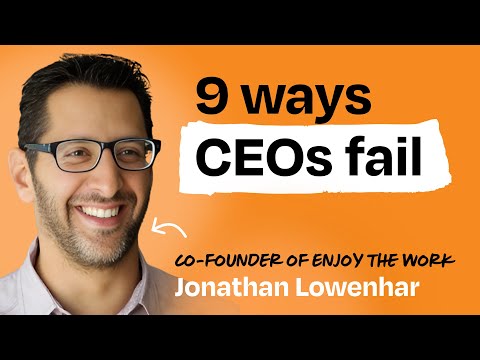
How a great founder becomes a great CEO | Jonathan Lowenhar (co-founder of Enjoy The Work)
Lenny Rachitsky (host), Jonathan Lowenhar (guest), Christina (OneSchema) (guest)
In this episode of Lenny's Podcast, featuring Lenny Rachitsky and Jonathan Lowenhar, How a great founder becomes a great CEO | Jonathan Lowenhar (co-founder of Enjoy The Work) explores from inspired founder to skilled CEO: mastering startup leadership craft Jonathan Lowenhar, co-founder of Enjoy The Work, explains why being a great founder and being a great CEO are fundamentally different jobs—one is an attitude, the other is a craft that must be learned.
From inspired founder to skilled CEO: mastering startup leadership craft
Jonathan Lowenhar, co-founder of Enjoy The Work, explains why being a great founder and being a great CEO are fundamentally different jobs—one is an attitude, the other is a craft that must be learned.
He outlines common CEO failure archetypes, emphasizes structured planning over “ready-fire-aim” improvisation, and shares practical frameworks for hiring, go-to-market, and company-building rhythms.
Jonathan also walks through the Magic Box Paradigm for startup exits, showing how the best acquisitions come from seducing a champion buyer around a shared “fantasy” of the future rather than running a traditional sale process.
Throughout, he stresses working backward from clear milestones, trusting well-developed intuition, and deliberately developing CEO skills so founders can keep their jobs and build enduring companies.
Key Takeaways
Treat “founder” and “CEO” as two different, equally important roles.
Being a founder is about vision, courage, and starting from nothing; being a CEO is about learned skills—hiring, planning, finance, management, and scaling. ...
Get the full analysis with uListen AI
Identify and fix your dominant CEO failure modes early.
Archetypes like the robot, pleaser, perfectionist, angry, laissez-faire, micromanager, and “ready–fire–aim” CEO lead to predictable breakdowns in culture, execution, and retention. ...
Get the full analysis with uListen AI
Use the Magic Box Paradigm to drive better exits: seduce, don’t sell.
Instead of running an auction-style sale, find a champion at a larger company, learn their “fantasy” of what your product could do for them, prove it with tailored evidence, and quantify the upside so they can sell the deal internally based on future value, not past financials.
Get the full analysis with uListen AI
Hire by working backwards from outcomes, not from job descriptions.
Define what success looks like 12 months after the hire (what will be true in the business), then look for candidates who have already done those specific things, have a history of being “pulled” from job to job by former bosses, and clearly embody your company’s core values.
Get the full analysis with uListen AI
Build go-to-market as a simple, explicit system.
Break GTM into four parts: ideal customer profile (who you sell to and who you don’t), positioning and marketing (why you’re different), demand generation (how you reach them across channels), and sales playbooks (how you run discovery, demos, and close). ...
Get the full analysis with uListen AI
Replace improvisation with light, bottoms-up planning.
At any moment you’re working backward from one of four things—exit, next fundraise, profitability, or wind-down. ...
Get the full analysis with uListen AI
Learn to hear and trust your quiet inner voice.
The best decisions around co-founder splits, key hires/fires, exits, and strategic shifts usually echo a deep intuition founders have long before they act. ...
Get the full analysis with uListen AI
Notable Quotes
“To be a founder is a state of being. To be a CEO is a craft.”
— Jonathan Lowenhar
“Founder mode felt like we were giving founders permission not to learn the job.”
— Jonathan Lowenhar
“More companies die from suicide than homicide.”
— Jonathan Lowenhar
“You’re never for sale. In fact, you have seduced a buyer. They see the fantasy, they fall in love.”
— Jonathan Lowenhar
“If you keep doing what you’re doing, you’ll keep getting what you’re getting.”
— Jonathan Lowenhar (quoting a former boss)
Questions Answered in This Episode
How can a first-time founder systematically assess where they are strong as a founder but weak as a CEO, and prioritize which skills to develop first?
Jonathan Lowenhar, co-founder of Enjoy The Work, explains why being a great founder and being a great CEO are fundamentally different jobs—one is an attitude, the other is a craft that must be learned.
Get the full analysis with uListen AI
Which of the CEO archetype failure modes do you see most commonly *after* Series B, and how do they differ from the earliest stages?
He outlines common CEO failure archetypes, emphasizes structured planning over “ready-fire-aim” improvisation, and shares practical frameworks for hiring, go-to-market, and company-building rhythms.
Get the full analysis with uListen AI
What are some real-world examples where the Magic Box Paradigm clearly outperformed a traditional banker-led sale process in terms of outcome or founder experience?
Jonathan also walks through the Magic Box Paradigm for startup exits, showing how the best acquisitions come from seducing a champion buyer around a shared “fantasy” of the future rather than running a traditional sale process.
Get the full analysis with uListen AI
How should a founder adjust their ideal customer profile and go-to-market system as they discover their initial market is smaller or less responsive than expected?
Throughout, he stresses working backward from clear milestones, trusting well-developed intuition, and deliberately developing CEO skills so founders can keep their jobs and build enduring companies.
Get the full analysis with uListen AI
What practical routines or habits can founders adopt to reliably access and trust their intuition without confusing it with fear or ego-driven impulses?
Get the full analysis with uListen AI
Transcript Preview
You basically spend all your time working with founders and through that, studying. You create frameworks and training, and you use that in your work. I think that's what many, many founders are looking for is, "How do I avoid pain?"
(instrumental music) To be a founder is a state of being. It's an attitude. To be a CEO is a craft. The more founders who can accept that those are two separate things and they're both equally important to build an ascendant startup, the better all of us will be.
I'm kind of tired of talking about Founder Mode, but it feels like what you're describing is Founder Mode and Manager Mode.
Founder Mode gets me angry. That article just got me hot. It really felt like an excuse. We were giving founders a permission to not learn the job. It's not Manager Mode is bad. It's the greatest CEOs know when to calibrate which one is needed.
Something you talk about are kind of these two phases to a startup journey, and most people focus on the first phase.
Phase one is build something people want to buy. Phase two, the one we don't talk about, is now you have to build a company around that thing people want to buy. Building a company is always the same. I don't care if it's medtech or fintech or hardware or consumer.
You've come up with this methodology that you call the Magic Box Paradigm that helps founders think about how to lead to a successful exit long term.
This is a traditional sales process. You build a list of the companies that might want to acquire you. You ping them and you hope you get a deal. Magic Box argues that the best outcomes for early stage startups don't happen that way. You're never for sale. In fact, you have seduced a buyer. They see the fantasy, they fall in love. (instrumental music)
Today my guest is Jonathan Lowenher. Jonathan runs a firm called Enjoy the Work, which I've heard amazing things about from so many people over the years. Their firm has a singular mission, to help founders become great CEOs. They do this through a blend of mentoring and advising services, which are rooted in their study of how the best startups operate. They take these lessons and fold them into frameworks and advice and training that they offer their CEOs. Their insight, which you'll hear in our conversation, is that most founders don't come into the job knowing how to be a CEO, which includes learning how to do hiring, how to manage financials, figure out growth strategy, road mapping, planning, people management, and so many other skills that nobody teaches a founder. In our conversation, Jonathan shares the most common CEO failure modes that he and his team have seen, the Magic Box Paradigm for successfully selling your startup, a bunch of advice for finding and hiring the best talent, a framework for building a repeatable go-to-market motion, why and how you should learn to trust your intuition more as a founder, and so much more. We could have gone on for so many more hours. Maybe he'll be back to share more advice. If you're a founder or hope to be a founder one day, this episode is for you. If you enjoy this podcast, don't forget to subscribe and follow it in your favorite podcasting app or YouTube. It's the best way to avoid missing future episodes and it helps the podcast tremendously. With that, I bring you Jonathan Lowenher. Jonathan, thank you so much for being here welcome to the podcast.
Install uListen to search the full transcript and get AI-powered insights
Get Full TranscriptGet more from every podcast
AI summaries, searchable transcripts, and fact-checking. Free forever.
Add to Chrome