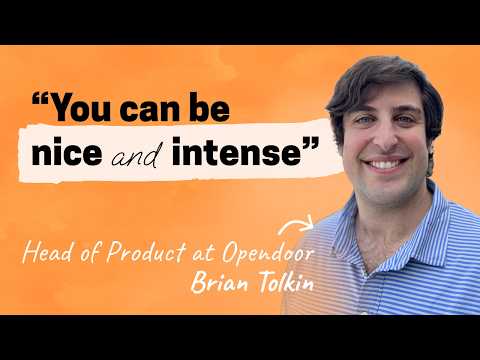
Lessons from scaling Uber and Opendoor | Brian Tolkin (Head of Product at Opendoor, ex-Uber)
Lenny Rachitsky (host), Brian Tolkin (guest), Narrator
In this episode of Lenny's Podcast, featuring Lenny Rachitsky and Brian Tolkin, Lessons from scaling Uber and Opendoor | Brian Tolkin (Head of Product at Opendoor, ex-Uber) explores scaling Uber and Opendoor: Marrying Product, Ops, and Calm Leadership Brian Tolkin, now Head of Product and Design at Opendoor and early Uber employee, shares how deep operational experience made him a better product leader at two highly operational tech companies. He explains how Uber and Opendoor treat product and operations as a "twin-turbine jet"—each powerful alone but maximized together—and how that insight led to Uber’s pioneering product operations function. The conversation dives into running effective product reviews, applying jobs-to-be-done in a low-frequency, high-stakes market like real estate, and balancing data with intuition when A/B testing is constrained. Tolkin also reflects on intense launch stories, navigating Zillow’s failed competitive move into iBuying, and the importance of staying calm under pressure to lead teams through chaos.
Scaling Uber and Opendoor: Marrying Product, Ops, and Calm Leadership
Brian Tolkin, now Head of Product and Design at Opendoor and early Uber employee, shares how deep operational experience made him a better product leader at two highly operational tech companies. He explains how Uber and Opendoor treat product and operations as a "twin-turbine jet"—each powerful alone but maximized together—and how that insight led to Uber’s pioneering product operations function. The conversation dives into running effective product reviews, applying jobs-to-be-done in a low-frequency, high-stakes market like real estate, and balancing data with intuition when A/B testing is constrained. Tolkin also reflects on intense launch stories, navigating Zillow’s failed competitive move into iBuying, and the importance of staying calm under pressure to lead teams through chaos.
Key Takeaways
Deep operational experience creates stronger, more grounded product leaders.
Working in ops forced Tolkin to understand how the business truly works—talking to customers daily, managing local metrics, and seeing real-world constraints—giving him a far better foundation for deciding what to build and how to build it scalably.
Get the full analysis with uListen AI
Treat product and operations as equal partners, not competing functions.
Uber and Opendoor use the "twin-turbine jet" metaphor: product and ops can each run alone for a while, but the system performs best when both power the plane together, with ops providing fast iteration and qualitative insight and product turning those into scalable systems.
Get the full analysis with uListen AI
Build structured feedback loops between centralized product and distributed ops.
At Uber, a formal product operations function sat with product but reported into ops, owning the two-way pipeline: rolling out new features globally and channeling market insights back into the roadmap, closing the gap between HQ and local markets.
Get the full analysis with uListen AI
In ops-heavy businesses, be ruthlessly clear on where tech leverage matters most.
Early Uber engineering focused almost exclusively on dispatching and pricing, consciously deprioritizing tooling and growth systems until the core matching and pricing engine worked; similar discipline helped Opendoor decide what to automate and what to leave manual for longer.
Get the full analysis with uListen AI
Product reviews should feel like collaboration, not a firing squad.
Tolkin designs reviews around two explicit goals—accountability and making the product better—keeps groups small, uses templates that emphasize problem and customer context, and is deliberate about presenting leadership ideas as hypotheses, not mandates.
Get the full analysis with uListen AI
Jobs-to-be-done is useful when used flexibly and culturally, not dogmatically.
Opendoor embeds JTBD in planning and product review templates as a way to force deeper customer empathy and context—e. ...
Get the full analysis with uListen AI
When A/B testing is constrained, broaden your evidence toolkit and accept intuition where necessary.
In low-volume, high-value flows, Opendoor runs power analyses up front, accepts longer experiments only when warranted, and supplements or replaces A/B tests with interviews, observational data, diff-in-diff, city comparisons, and, when needed, principled intuition plus clear feedback loops.
Get the full analysis with uListen AI
Notable Quotes
“The people closest to the problems also have the best context to solve that problem.”
— Brian Tolkin
“Uber always had this mentality of a twin turbine jet plane… it’s operating most efficiently and effectively if both [product and ops] are working together.”
— Brian Tolkin
“Computers are deterministic but humans aren’t, so building products that have a little bit more flex or fail-safes becomes paramount.”
— Brian Tolkin
“You’re never as good as you think you are, you’re never as bad as you think you are.”
— Brian Tolkin
“Product is finding the kernel of truth in a sea of ambiguity and signals.”
— Brian Tolkin
Questions Answered in This Episode
How can a company without strong local operations teams still capture the kind of qualitative insight that Uber and Opendoor get from the field?
Brian Tolkin, now Head of Product and Design at Opendoor and early Uber employee, shares how deep operational experience made him a better product leader at two highly operational tech companies. ...
Get the full analysis with uListen AI
What are the early warning signs that your product–ops relationship is misaligned, and how would you course-correct?
Get the full analysis with uListen AI
In a low-volume, high-stakes business, how do you decide when to wait for more data versus when to act on intuition?
Get the full analysis with uListen AI
What practical steps can a stressed leader take in the moment to avoid transmitting anxiety to their team during a crisis?
Get the full analysis with uListen AI
If you were starting a new ops-heavy startup today, what would you intentionally keep manual at first and what would you invest in automating from day one?
Get the full analysis with uListen AI
Transcript Preview
You've worked at two businesses that have done incredibly well combining product and ops.
Uber always have this mentality, and Opendoor does too, of the product operations twin turbine jet plane where you can, like, fly the plane on one engine for a little bit if you need to, but it's operating most efficiently and effectively if both are working together.
What has having been in ops done to make you a better product leader?
Give a really deep understanding of how the business actually works is a pretty good foundation for them going on to say, "Okay, what do we actually want to build in a more, uh, scalable technology way?"
Something else I've heard that you're very good at is staying very calm under pressure.
I've slept on the floor in China before launching UberPOOL, and, like, when you reflect the stress onto your teams, everybody tenses up. It counterintuitively doesn't produce better outcomes.
(instrumental music) Today my guest is Brian Tolkin. Brian is currently head of product and design at Opendoor. Before that, he spent nearly five years at Uber, where he joined as employee 100 before Uber had UberX or UberPOOL or any kind of shared rides. He actually started on the ops team at Uber, moved into product, ended up leading product and launch of UberPOOL and then taking it global. He also started the product operations function at Uber before that function was really even a thing, which I didn't know until the chat that we had. In our conversation, Brian shares a ton of lessons about building products with a heavy operational component, also how to run great product reviews, how he implements the jobs to be done framework at Opendoor successfully, the story behind Zillow trying to compete with Opendoor, failing, and then partnering instead, plus a ton of great stories from the early days of Uber and Opendoor, and so much more. If you enjoy this podcast, don't forget to subscribe and follow it in your favorite podcasting app or YouTube. It's the best way to avoid missing future episodes, and it helps the podcast tremendously. With that, I bring you Brian Tolkin. Brian, thank you so much for being here, and welcome to the podcast.
Thank you. Appreciate it. Thanks for having me.
First of all, just a huge thank you to Keyvan Baigpour for connecting us, introducing us. He said all kinds of amazingly nice things about you. He also gave me some very hard questions to ask you. I hope you've come prepared.
Terrific. Put me in the hot seat.
Okay. I want to spend a bunch of time talking about product and ops. You started your career in operations at Uber. You actually started on the ops team, and you moved into product. You've also worked at both Uber and at Opendoor, which have both huge operational components. I think it's really rare that people, one, see a company scale to the heights of Uber and Opendoor with such a heavy operational component that are still tech companies. And, also, it's really where someone starts in ops and then moves into product and ends up where you are, where you're chief product officer at really successful company. So, I have a bunch of questions here. Maybe the first is just, what has having been in ops done to make you a better product leader? How does that change the way that you operate as a product leader?
Install uListen to search the full transcript and get AI-powered insights
Get Full TranscriptGet more from every podcast
AI summaries, searchable transcripts, and fact-checking. Free forever.
Add to Chrome