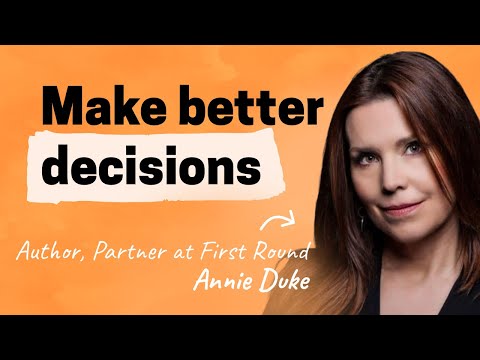
This will make you a better decision maker | Annie Duke (Thinking In Bets, former pro poker player)
Annie Duke (guest), Lenny Rachitsky (host)
In this episode of Lenny's Podcast, featuring Annie Duke and Lenny Rachitsky, This will make you a better decision maker | Annie Duke (Thinking In Bets, former pro poker player) explores annie Duke Reveals Practical Systems For Sharper Decisions And Quitting Annie Duke, former pro poker player and author, shares concrete ways individuals and organizations can dramatically improve decision quality by making implicit judgments explicit, structuring how groups think, and shortening feedback loops. She describes lessons from Daniel Kahneman, emphasizing intellectual humility, adversarial collaboration, and the power of asking “why am I wrong?”
Annie Duke Reveals Practical Systems For Sharper Decisions And Quitting
Annie Duke, former pro poker player and author, shares concrete ways individuals and organizations can dramatically improve decision quality by making implicit judgments explicit, structuring how groups think, and shortening feedback loops. She describes lessons from Daniel Kahneman, emphasizing intellectual humility, adversarial collaboration, and the power of asking “why am I wrong?”
In organizations, she argues meetings should only be for discussion—not for discovering opinions or deciding—and shows how independent, asynchronous input and clear decision ownership produce better outcomes. She also explains why there is effectively no such thing as a 10‑year feedback loop: you can always define and track nearer-term leading indicators.
Drawing on her work with First Round Capital, she illustrates how structured rubrics, explicit forecasts, and post-hoc analysis expose when intuition is accurate versus misleading. Finally, she reframes pre‑mortems as tools for defining “kill criteria” and shows why, behaviorally, if you’re seriously thinking about quitting something, you’re likely already late.
Key Takeaways
Make implicit judgments explicit to expose when intuition is wrong.
We all apply hidden mental models (e. ...
Get the full analysis with uListen AI
Redesign meetings so they are only for discussion, not discovery or decisions.
Have people submit their views, rankings, estimates, and rationales independently and asynchronously before the meeting, then use the live session solely to compare models and focus on disagreements; make the actual decision outside the room (ideally by a clearly designated decision-maker or independent vote).
Get the full analysis with uListen AI
Get opinions independently to avoid loud, confident voices dominating.
Use ‘nominal groups’: collect inputs via forms or private messages where no one sees others’ answers first; this reveals the true spread of beliefs (including junior or contrarian views) and prevents early anchoring and conformity.
Get the full analysis with uListen AI
Stop chasing ‘alignment’; aim for people feeling heard and overruled “nevertheless.”
Total agreement is unrealistic and coerces people into conformity; instead, ensure each person’s view is clearly reflected back (“I hear you; nevertheless, here’s the decision”), so they feel psychologically invested even when they disagree.
Get the full analysis with uListen AI
There are no inherently long feedback loops—only unchosen leading indicators.
For long-horizon bets (like startup investing), you can shorten learning cycles by forecasting and tracking intermediate signals (e. ...
Get the full analysis with uListen AI
Pre-mortems are only powerful if they create concrete kill criteria with actions.
Listing failure modes by itself rarely changes behavior; you must translate those signals into explicit ‘if X happens, then we will Y’ rules (e. ...
Get the full analysis with uListen AI
If you’re seriously thinking about quitting, you’re likely already late.
Sunk costs, identity, and fear of being ‘wrong’ make us continue far past the rational point; recognizing this bias and using pre-committed kill criteria help you free resources sooner for better opportunities—like Slack emerging only after Stewart Butterfield shut down Glitch.
Get the full analysis with uListen AI
Notable Quotes
“It’s so incredibly necessary in improving decision quality to take what’s implicit and make it explicit.”
— Annie Duke
“The only thing that’s ever supposed to happen in a meeting is the discussion part.”
— Annie Duke
“There is no such thing as a long feedback loop. You choose how long the feedback loop is.”
— Annie Duke
“Our intuition is sometimes right and sometimes wrong. If you don’t make it explicit, you don’t get to find out when it’s wrong.”
— Annie Duke
“Most people won’t quit until it actually isn’t a decision.”
— Annie Duke (via Richard Thaler)
Questions Answered in This Episode
How could my team redesign our recurring meetings to separate ‘discover, discuss, decide’ and reduce groupthink?
Annie Duke, former pro poker player and author, shares concrete ways individuals and organizations can dramatically improve decision quality by making implicit judgments explicit, structuring how groups think, and shortening feedback loops. ...
Get the full analysis with uListen AI
What are the most important leading indicators we should forecast and track for our biggest long-term bets?
In organizations, she argues meetings should only be for discussion—not for discovering opinions or deciding—and shows how independent, asynchronous input and clear decision ownership produce better outcomes. ...
Get the full analysis with uListen AI
Which strongly held assumptions or ‘table-pounding’ criteria in our hiring or investing might actually be non-predictive?
Drawing on her work with First Round Capital, she illustrates how structured rubrics, explicit forecasts, and post-hoc analysis expose when intuition is accurate versus misleading. ...
Get the full analysis with uListen AI
Where in my own life or business am I likely persisting too long because of sunk costs or identity concerns?
Get the full analysis with uListen AI
How can we systematically use pre-mortems to define kill criteria and pre-commit to specific actions when red flags appear?
Get the full analysis with uListen AI
Transcript Preview
(instrumental music) It's so incredibly necessary in improving decision quality to take what's implicit and make it explicit. It's not that intuition is crap. Your intuition is sometimes right, but if you don't make it explicit, then you don't get to find out when it's wrong.
When you look at companies that have read your book, what do you find are the frameworks or tactics that really stick?
People generally think the purpose of a meeting is for three things: discover, discuss, decide. The only thing that's ever supposed to happen in a meeting is the discussion part.
Something that comes up in product a lot is this idea of pre-mortems.
So a pre-mortem is great only if you set up kill criteria. Commit to actions that you're going to take if you see those signals.
You have a very interesting framework for how to think about decision quality when the outcome is very long term.
There is no such thing as a long feedback loop. And the way you choose to shorten the feedback loop is to say, "What are the things that are correlated with the outcome that I eventually desire?" (instrumental music)
Today my guest is Annie Duke. Annie is the author of the best-selling book Thinking in Bets, and also her more recent book, Quit: The Power of Knowing When to Walk Away. She's also a special partner at First Round Capital, which we spent some time on, and is incredibly fascinating. Prior to this part of her career, she was a professional poker player. She's won over four million dollars in tournaments, including winning a World Series of Poker bracelet, and she's the only woman who's won the World Series of Poker Tournament of Champions, and the National Poker Heads-Up Championship. Currently, she spends her time helping companies make better decisions. In our conversation, we cover the many lessons that she's learned from her friend Daniel Kahneman, who recently passed away, what simple change she's found has the most impact on a company's ability to make better decisions, how to make better quick decisions when the feedback loop is very long, and also why she doesn't actually believe in long feedback loops, how she changed the way that the partners at First Round Capital make decisions, which is incredibly interesting, plus why when you're thinking about quitting, that probably means you've already waited too long and you should have quit a while ago. I learned a ton from this conversation, and this is definitely going to change the way I think about a lot of things. With that, I bring you Annie Duke after a short word from our sponsors. And if you enjoy this podcast, don't forget to subscribe and follow it in your favorite podcasting app or YouTube. It's the best way to avoid missing future episodes, and it helps the podcast tremendously. This episode is brought to you by Vanta. When it comes to ensuring your company has top-notch security practices, things get complicated fast. Now you can assess risk, secure the trust of your customers, and automate compliance for SOC 2, ISO 27001, HIPAA, and more, with a single platform, Vanta. Vanta's market-leading trust management platform helps you continuously monitor compliance, alongside reporting and tracking risks. Plus, you can save hours by completing security questionnaires with Vanta AI. Join thousands of global companies that use Vanta to automate evidence collection, unify risk management, and streamline security reviews. Get $1,000 off Vanta when you go to vanta.com/lenny. That's vanta.com/lenny. This episode is brought to you by User Testing. Get fast feedback from real people throughout the development process so that you can build the right thing the first time. Companies are being asked to do more with less. They need to move more quickly while building experiences that mean changing customer expectations, all while minimizing risk and costly rework. With User Testing, you have a trusted partner who provides user research teams with the skills, tools, and data to be able to articulate the value of user research to the business so that you can make an impact and build the best experiences with confidence. Get started today at usertesting.com/lenny. (instrumental music) Annie, thank you so much for being here, and welcome to the podcast.
Install uListen to search the full transcript and get AI-powered insights
Get Full TranscriptGet more from every podcast
AI summaries, searchable transcripts, and fact-checking. Free forever.
Add to Chrome