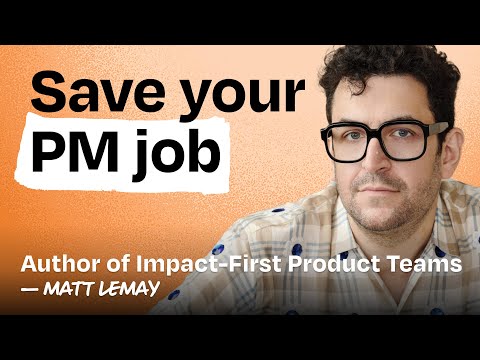
The one question that saves product careers | Matt LeMay
Matt LeMay (guest), Lenny Rachitsky (host)
In this episode of Lenny's Podcast, featuring Matt LeMay and Lenny Rachitsky, The one question that saves product careers | Matt LeMay explores one question every product manager must answer to stay indispensable Matt LeMay argues that most product teams underestimate how directly their work must tie to business-critical outcomes, especially in an era of frequent PM layoffs.
One question every product manager must answer to stay indispensable
Matt LeMay argues that most product teams underestimate how directly their work must tie to business-critical outcomes, especially in an era of frequent PM layoffs.
He introduces the idea of asking, “If you were the CEO, would you fully fund your own team?” as a forcing function to escape the ‘low‑impact PM death spiral’ of cosmetic, low‑stakes work.
LeMay outlines three practical steps for any individual team—regardless of company maturity or structure—to align goals, day‑to‑day decisions, and prioritization directly to company-level impact.
He also shares tactics for pushing back on low-impact executive requests without saying a hard no, instead framing options and trade-offs grounded in business results.
Key Takeaways
Ask yourself if you’d fund your own team as CEO.
Regularly pose, “If I were the CEO, would I fully fund this team? ...
Get the full analysis with uListen AI
Set team goals no more than one step away from company goals.
Avoid endlessly cascading OKRs and intermediate metrics; instead, define a team goal that connects to the company goal via a single ‘why’ or a simple numeric relationship (e. ...
Get the full analysis with uListen AI
Keep impact visible at every stage of the product process.
From strategy decks to epics and prioritization sessions, continuously reference the core impact goal; don’t let it vanish into OKR season artifacts that nobody revisits or ties back to business outcomes.
Get the full analysis with uListen AI
Prioritize work by estimated contribution to your impact goal, not generic ‘impact’.
When using frameworks like RICE/ICE, quantify impact in the same unit as your team goal (e. ...
Get the full analysis with uListen AI
Escape the low-impact death spiral by tackling harder, higher-impact work.
Continuously shipping ‘rhinestone’ features that are safe and cosmetic makes the product heavier, coordination harder, and truly impactful changes more difficult—so deliberately seek work that affects the commercial engine, even if it’s riskier and more cross-functional.
Get the full analysis with uListen AI
Use options and trade-offs instead of hard yes/no when pushing back.
Rather than telling executives “no,” present multiple options with clear trade-offs versus your current impact goal (e. ...
Get the full analysis with uListen AI
Understand the business model to guide both tactics and ethics.
Dig into how your company actually makes money, what investors or the board care about, and what’s been promised externally; this not only sharpens your product decisions but also helps you decide whether you want to help this company succeed at all.
Get the full analysis with uListen AI
Notable Quotes
“If you were the CEO of this company, would you fully fund your own team?”
— Matt LeMay
“Low impact work begets low impact work. The more low impact work you do, the harder it is to do high impact work.”
— Matt LeMay
“You can follow all the best practices, but if your company goes out of business, they’re not going to keep writing your paycheck because all of your OKRs were at 0.6 or 0.7.”
— Matt LeMay
“What I’m actually saying is that the things you think you’re fighting against are usually the things that are giving your work shape if you let them be.”
— Matt LeMay
“If you’re doing product management really well, you never have to say yes and you never have to say no. You’re giving people options and helping them understand the trade-offs.”
— Matt LeMay
Questions Answered in This Episode
How would my team’s goals change if we had to express them in the same metrics the CEO and CFO care about most?
Matt LeMay argues that most product teams underestimate how directly their work must tie to business-critical outcomes, especially in an era of frequent PM layoffs.
Get the full analysis with uListen AI
Where is my team currently adding ‘rhinestones’ instead of working on the engine, and what would it take to flip that?
He introduces the idea of asking, “If you were the CEO, would you fully fund your own team? ...
Get the full analysis with uListen AI
If we had to justify our budget on a single slide to the board, what numbers and story would we use?
LeMay outlines three practical steps for any individual team—regardless of company maturity or structure—to align goals, day‑to‑day decisions, and prioritization directly to company-level impact.
Get the full analysis with uListen AI
What’s one brave, high-impact initiative we’re avoiding because of dependencies, scrutiny, or fear of failure?
He also shares tactics for pushing back on low-impact executive requests without saying a hard no, instead framing options and trade-offs grounded in business results.
Get the full analysis with uListen AI
How can we start presenting stakeholders with options and quantified trade-offs instead of simply accepting or rejecting their requests?
Get the full analysis with uListen AI
Transcript Preview
More product managers and teams are getting laid off. The problem is the message that Daniel Ek from Spotify sent out with their layoffs in 2024, we still have too many teams doing work around the work.
Even if you are told to build a thing that the execs are really excited about, you're still going to get fired eventually.
If you were the CEO of this company, would you fully fund your own team? Frankly, most of the people I ask that question to don't know the answer right away.
Which is something called the low-impact PM death spiral.
It's the dynamic in which every medium to large company I've ever worked with finds itself in one way or another. It starts with adding little features here and there, making little cosmetic improvements, until the next round of layoffs.
You have three steps to become more of an impact for a product team.
So the first is in setting team goals no more than one step away from company goals. Don't let it get cascaded into oblivion.
You're an ICPM. It's up to you. No excuses.
You can follow all the best practices, but if your company goes out of business, they're not going to keep writing your paycheck for two years because all of your OKRs were at .6 or at .7.
Today my guest is Matt LeMay. Matt is a longtime product leader, author of one of the most popular and practical books in the field of product management called Product Management in Practice. And over the course of his consulting practice, he's worked with hundreds of product teams, helping them improve how they operate and drive more impact more consistently. From that experience, he wrote and recently published a new book called Impact-First Product Teams that I could not agree more with. In our conversation, Matt shares why it is so essential to align all of your work with business critical outcomes, especially if you fear layoffs at your company. We talk about the low-impact death spiral that many product teams fall into, what steps an individual product team can take to align their work to business critical outcomes regardless of how their organization approaches product development, tips for how to push back on stupid ideas that execs ask you to build, and so much more. The message in this episode is one that I believe every product manager needs to hear, especially if you don't work at a high-flying Silicon Valley tech company. A huge thank you to Martin Eriksson, Adrian Jozello, and Dan Corbin for suggesting topics and questions for this conversation. If you enjoy this podcast, don't forget to subscribe and follow it in your favorite podcasting app or YouTube. Also, if you become an annual subscriber of my newsletter, you get a year free of a bunch of incredible products, including Replit, Lovable, Bolt, N8N, Linear, Superhuman, Descript, Whisperflow, Gamma, Perplexity, Warp, Granola, Magic Patterns, Raycast, JetPRD, Mobben, and more. Check it out at lennysnewsletter.com and click bundle. With that, I bring you Matt LeMay. This episode is brought to you by Interpret. Interpret is a customer intelligence platform used by leading CX and product orgs like Canva, Notion, Perplexity, Strava, Hinge, and Linear to leverage the voice of the customer and build best in class products. Interpret unifies all customer conversations in real time from Gong recordings to Zendesk tickets to Twitter threads and makes it available for your team for analysis and for action. What makes Interpret unique is its ability to build and update a customer-specific knowledge graph that provides the most granular and accurate categorization of all customer feedback and connects that customer feedback to critical metrics like revenue and CSAT. If modernizing your voice of customer program to a generational upgrade is a 2025 priority like customer-centric industry leaders like Canva, Notion, Perplexity, and Linear, reach out to the team at interpret.com/lenny. That's E-N-T-E-R-P-R-E-T.com/lenny. This episode is brought to you by Pragmatic Institute, a trusted leader in product training and the go-to source for teams driving real results. This fall, they're back with the biggest event of the year, the Future of Product Management Summit. On October 16th, join thousands of product managers, marketers, and leaders for a free virtual experience built to tackle today's toughest challenges and explore the future of product. You'll hear from trusted voices like Teresa Torres and Matt LeMay, along with Pragmatic's expert instructors and other innovators who are transforming how teams tackle AI, prioritization, and product strategy. Whether you're building products, leading teams, or leveling up your career, this summit delivers practical insights designed to move your team forward. Registration is open but spots are limited. Save your seat at pragmaticinstitute.com/lenny. That's pragmaticinstitute.com/lenny. Matt, thank you so much for being here and welcome to the podcast.
Install uListen to search the full transcript and get AI-powered insights
Get Full TranscriptGet more from every podcast
AI summaries, searchable transcripts, and fact-checking. Free forever.
Add to Chrome