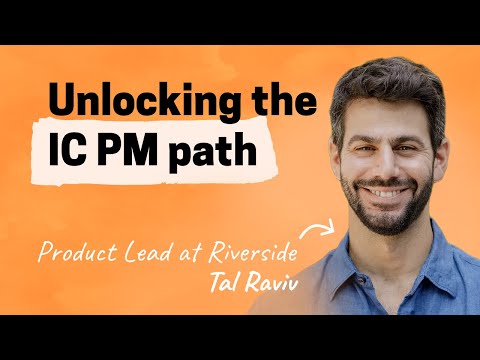
Becoming a super IC: Lessons from 12 years as a PM individual contributor | Tal Raviv (Riverside)
Lenny Rachitsky (host), Tal Raviv (guest)
In this episode of Lenny's Podcast, featuring Lenny Rachitsky and Tal Raviv, Becoming a super IC: Lessons from 12 years as a PM individual contributor | Tal Raviv (Riverside) explores how Tal Raviv Became a High-Impact ‘Super IC’ Product Manager Tal Raviv, a veteran PM with 12+ years as an individual contributor, explains why he’s deliberately avoided people management to stay close to the work he loves while still having outsized impact. He lays out how IC PMs can command strong compensation, design real IC career ladders, and become “super ICs” by leveraging AI, deep focus, and highly self-reliant teams.
How Tal Raviv Became a High-Impact ‘Super IC’ Product Manager
Tal Raviv, a veteran PM with 12+ years as an individual contributor, explains why he’s deliberately avoided people management to stay close to the work he loves while still having outsized impact. He lays out how IC PMs can command strong compensation, design real IC career ladders, and become “super ICs” by leveraging AI, deep focus, and highly self-reliant teams.
Tal shares specific systems for PM productivity, including ruthless Slack discipline, ‘product scrapbooking,’ and turning AI (ChatGPT + Whisper) into a force-multiplier for specs and Scrum overhead. He also introduces his ‘two departments that really matter’ lens for understanding how a company truly wins, and why product is not always (or even usually) that department.
A big portion of the conversation is devoted to failures and near-firings—wasted quarters of experimentation, pricing disasters, ruined sales demos, and public Twitter pile-ons—to normalize that high performers fail a lot and to extract lessons on research, stakeholder management, and street‑smart decision-making.
Throughout, Tal argues there is no single “right” way to run product: the real learning comes from doing hard, ambiguous work at great companies, developing judgment, and building cultures where product is a team sport, not a role.
Key Takeaways
You can build a high-impact, well-paid career as a long-term IC PM.
Tal has stayed IC for 12+ years by optimizing for work he’s excited to wake up for, not for titles. ...
Get the full analysis with uListen AI
AI can turn a single PM into what used to be an entire org’s capacity.
Tal uses ChatGPT plus Whisper dictation to turn spoken kickoffs into detailed user stories and Gherkin-formatted Jira tickets, cutting out days of writing and allowing one IC to manage scopes that previously required multiple PMs or a director-level structure.
Get the full analysis with uListen AI
Designing your day around deep work requires aggressive communication boundaries.
He blocks mornings for deep work and has not opened Slack before noon for ~8 years, instead queuing messages in his to‑do list. ...
Get the full analysis with uListen AI
Build self-reliant teams by making ‘product’ a team identity, not a job title.
Tal constantly redirects DMs into public channels, encourages engineers and designers to own ‘PM work,’ and celebrates when others take things off his plate—explicitly aiming to be valuable but not needed, and to make himself ‘obsolete’ as a dependency.
Get the full analysis with uListen AI
To choose the right company and role, identify the two departments that actually matter.
Across companies, Tal sees that only one or two functions (e. ...
Get the full analysis with uListen AI
Street-smart decision-making means weighting perception and narrative as heavily as logic.
He recounts pricing and UX changes that were analytically sound but blew up due to customer perception (e. ...
Get the full analysis with uListen AI
Every impressive PM resume hides multiple failures, near-firings, and missteps.
Tal shares wasting quarters of growth work through misused research, triggering a Twitter mob calling for his firing, nearly being let go three times, and accidentally tanking payments—arguing that what matters is owning mistakes fast, communicating earnestly, and building enough trust that people see how seriously you take the work.
Get the full analysis with uListen AI
Notable Quotes
“Product isn’t a role, it’s a team.”
— Tal Raviv
“I seek to not be needed, but be valuable.”
— Tal Raviv
“You can imagine what might have taken a director-level organization 10 years ago can now be achieved by an IC with AI.”
— Tal Raviv
“We’re all just making it up as we go along in tech—and that’s the beauty of it.”
— Tal Raviv
“I work really hard so I can increase the amount of bullshit I can get away with without being fired.”
— Tal Raviv (quoting friends joking about him)
Questions Answered in This Episode
How can I assess whether my current company truly values IC PMs at senior levels, or if management is the only real path to impact and compensation?
Tal Raviv, a veteran PM with 12+ years as an individual contributor, explains why he’s deliberately avoided people management to stay close to the work he loves while still having outsized impact. ...
Get the full analysis with uListen AI
What specific AI workflows, beyond user stories and specs, could I adopt to 5–10x my output as a PM in the next quarter?
Tal shares specific systems for PM productivity, including ruthless Slack discipline, ‘product scrapbooking,’ and turning AI (ChatGPT + Whisper) into a force-multiplier for specs and Scrum overhead. ...
Get the full analysis with uListen AI
In my company, which one or two departments are actually the primary drivers of long-term success—and what would change about my career choices if I accepted that?
A big portion of the conversation is devoted to failures and near-firings—wasted quarters of experimentation, pricing disasters, ruined sales demos, and public Twitter pile-ons—to normalize that high performers fail a lot and to extract lessons on research, stakeholder management, and street‑smart decision-making.
Get the full analysis with uListen AI
Where am I relying too much on ‘book-smart’ logic and data, and ignoring how customers, sales, or the market will emotionally perceive a change?
Throughout, Tal argues there is no single “right” way to run product: the real learning comes from doing hard, ambiguous work at great companies, developing judgment, and building cultures where product is a team sport, not a role.
Get the full analysis with uListen AI
If I wanted to build a genuinely self-reliant, ‘product is a team’ culture, what behaviors would I need to start (and stop) tomorrow in how I use Slack, run meetings, and respond to teammates?
Get the full analysis with uListen AI
Transcript Preview
(instrumental music) I've had thousands of people tag my CEO on Twitter, (laughs) calling on him to fire me. I was actually on vacation and I got bored, and I was like, "I haven't logged into Twitter, I haven't posted anything to Twitter for a while. What's, uh, what's going on in Twitter?" And I see that the, uh, notifications number is, like, maxed out. It's like 999 plus or whatever (laughs) .
(laughs) .
And I was like, "Wait, what?" And I clicked the notifications tab, and I see the first tweet is, has at CEO handle fired at Tal Raviv. And I saw that that has, like, a ton of retweets. And I just keep scrolling down and I start to piece together the story.
(instrumental music) Today my guest is Tal Raviv. This is a very special episode for me because Tal was one of the first and most active community members when I was just starting my newsletter Slack community, and is a PM I've admired from afar for a very long time. He's got some really unique and insightful takes on how to be a great product leader. And interestingly, he's decided to stay an IC product manager throughout his entire career up to this point, which is over 12 years as an IC PM. I've never met anyone that's stayed an IC for this long. He's been a PM at Patreon, at Wix, at AppsFlyer, and most recently joined Riverside as their first ever product manager. Riverside, by the way, is the platform that I use to record my podcast, so this was kind of a meta experience for both of us. He's also a former founder, and outside of tech he volunteers as a surf instructor for people with disabilities. In our conversation we talk in depth about the IC career path, a bunch of tactical advice on how to be more productive as a PM, including a killer example of how he uses ChatGPT to scale himself. Tal also explains why every tech company has just two departments that matter, the difference between book-smart decisions and street-smart decisions. We also spend the most time I've ever spent in failure corner, where Tal shares all of the times that he's failed in his career, and how those experiences made him stronger. And it was really important for him to share these things, because he wants people to understand that successful people fail a lot, and those failures make you better. If you want to learn more from Tal, he's actually about to launch a course on Maven that's called Build Your PM Productivity System, which based on the conversation that we had, I am confident is going to be awesome. If you enjoy this podcast, don't forget to follow it and subscribe in your favorite podcasting app or YouTube. It's the best way to avoid missing future episodes, and helps the podcast tremendously. With that, I bring you Tal Raviv.
Install uListen to search the full transcript and get AI-powered insights
Get Full TranscriptGet more from every podcast
AI summaries, searchable transcripts, and fact-checking. Free forever.
Add to Chrome