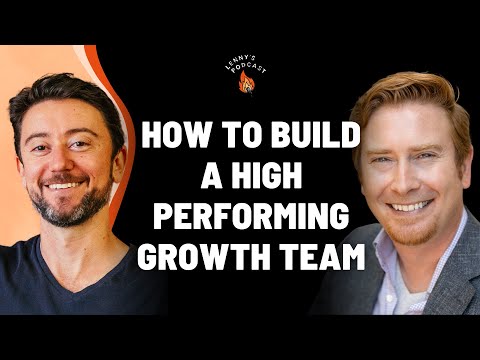
How to build a high-performing growth team | Adam Fishman (Patreon, Lyft, Imperfect Foods)
Adam Fishman (guest), Lenny Rachitsky (host)
In this episode of Lenny's Podcast, featuring Adam Fishman and Lenny Rachitsky, How to build a high-performing growth team | Adam Fishman (Patreon, Lyft, Imperfect Foods) explores building High-Impact Growth Teams, Onboarding Engines, and Careers with PMF Adam Fishman, former growth/product leader at Lyft, Patreon, and Imperfect Foods, shares a structured growth competency model to help companies hire and develop growth talent and help candidates position themselves. He breaks growth skills into four core buckets—growth execution, customer knowledge, growth strategy, and communication/influence—and explains how to use them for hiring, feedback, and career planning.
Building High-Impact Growth Teams, Onboarding Engines, and Careers with PMF
Adam Fishman, former growth/product leader at Lyft, Patreon, and Imperfect Foods, shares a structured growth competency model to help companies hire and develop growth talent and help candidates position themselves. He breaks growth skills into four core buckets—growth execution, customer knowledge, growth strategy, and communication/influence—and explains how to use them for hiring, feedback, and career planning.
He argues that onboarding is one of the most underleveraged growth levers because it is the only experience 100% of users go through, shapes expectations set by the brand, and is where users are most motivated. Through examples from Patreon and Lyft, he shows how intelligent onboarding and opinionated defaults can materially improve retention and long-term revenue.
Finally, Adam introduces a “PMF for candidates” framework (People, Mission, Financials) for choosing companies, emphasizing rigorous evaluation of leadership dynamics, mission alignment, and fiscal discipline—especially in a turbulent market. He shares hard-earned lessons from both great and poor company picks and offers concrete tactics for doing real diligence as a candidate.
Key Takeaways
Use a structured growth competency model instead of hiring for a ‘unicorn’ profile.
Break growth into four buckets—growth execution, customer knowledge, growth strategy, and communication/influence—then hire and develop against specific competencies rather than pattern-matching on a single archetype or senior resume.
Get the full analysis with uListen AI
Prioritize growth execution and customer knowledge when hiring earlier-career growth talent.
For first or more junior growth hires, look for people who can reliably execute experiments and deeply understand users; higher-order strategy and influence can be layered on with mentorship, whereas basic execution and customer fluency are much harder to teach.
Get the full analysis with uListen AI
Treat onboarding as a primary retention and habit-formation lever, not just a conversion funnel.
Onboarding is the only part of the product every user experiences and the first moment where the brand promise meets reality; improving it can shift retention curves by double digits, even if it slightly reduces raw sign-up conversion.
Get the full analysis with uListen AI
Leverage human-led interventions to discover what works, then productize those learnings.
At Patreon, high-touch onboarding with select creators boosted early revenue by ~25%; the team then encoded those human best practices into product features and “opinionated defaults,” turning a non-scalable win into a scalable system.
Get the full analysis with uListen AI
Design ‘opinionated defaults’ or ‘smart defaults’ to guide users toward proven-success paths.
Use defaults and gentle friction to make it easy to do the right thing and harder to do the wrong thing (e. ...
Get the full analysis with uListen AI
Use proxy metrics and qualitative reviews to evaluate long-term retention impacts quickly.
Instead of waiting 90 days to read retention, track leading indicators like time to first value or early revenue thresholds, and sample actual user flows/pages qualitatively to assess whether onboarding changes are attracting the right users.
Get the full analysis with uListen AI
Apply ‘PMF for candidates’—People, Mission, Financials—when choosing where to work.
Evaluate whether you respect and can productively disagree with the leadership team, whether scaling the mission makes the world better for customers (not just insiders), and whether the company has realistic, disciplined financial planning; cutting corners on any dimension often leads to burnout or misalignment.
Get the full analysis with uListen AI
Notable Quotes
“Onboarding is the only part of your product experience that 100% of people are ever gonna touch.”
— Adam Fishman
“Your brand is the promise that you're making and your product experience is your delivery of that promise.”
— Adam Fishman
“Executing a growth strategy takes time and patience, and they didn't really have it.”
— Adam Fishman
“If you join a company and do your job well, a lot of people out in the world should have a better outcome because that company exists.”
— Adam Fishman
“When you're interviewing at a company, you're investing an even more scarce resource than money—you're investing your time.”
— Adam Fishman
Questions Answered in This Episode
How can early-stage startups practically assess their current team against Adam’s growth competency model and prioritize which gaps to fill first?
Adam Fishman, former growth/product leader at Lyft, Patreon, and Imperfect Foods, shares a structured growth competency model to help companies hire and develop growth talent and help candidates position themselves. ...
Get the full analysis with uListen AI
What are specific examples of experiments a small team can run to improve onboarding-driven retention without a dedicated growth or data science function?
He argues that onboarding is one of the most underleveraged growth levers because it is the only experience 100% of users go through, shapes expectations set by the brand, and is where users are most motivated. ...
Get the full analysis with uListen AI
How do you decide when to introduce friction in onboarding (e.g., extra questions, verifications) versus when to optimize purely for speed and simplicity?
Finally, Adam introduces a “PMF for candidates” framework (People, Mission, Financials) for choosing companies, emphasizing rigorous evaluation of leadership dynamics, mission alignment, and fiscal discipline—especially in a turbulent market. ...
Get the full analysis with uListen AI
For candidates without prior ‘growth’ titles, how can they credibly demonstrate strengths in growth execution and customer knowledge during interviews?
Get the full analysis with uListen AI
What concrete signals in leadership behavior or board dynamics should be considered red flags when evaluating the ‘People’ and ‘Financials’ dimensions of a potential employer?
Get the full analysis with uListen AI
Transcript Preview
Onboarding is the only part of your product experience that 100% of people are ever gonna touch. Good luck getting 100% feature adoption of anything else in your product, right? But onboarding is the thing that you have to go through in order to use the product. It's also the first opportunity that you have as a company to kind of deliver on the promise that you made out in the marketplace. So I like to think of, like, your brand is the promise that you're making and your product experience is your delivery of that promise. And those two things have to be in lockstep with each other or you're gonna have mismatched expectations and some really disappointed customers. So this is the first chance that a customer has to be really excited or really disappointed in what they thought they were getting. So don't mess that up.
(instrumental music) Adam Fishman was the first growth and marketing hire at Lyft where he spent two and a half years leading their growth efforts. Then he went on to lead product and growth at Patreon where he spent over four years building one of the most successful and lasting creator platforms out there. And most recently, he was CPO at Imperfect Foods. Today, he spends his time advising companies on product and growth and he's also doing a lot more writing. And in this episode, we cover three things: his growth competency model, which helps you hire and evaluate growth talent and also get a job as a growth person; we go deep into why onboarding is such an underappreciated growth lever and all of the impact that you can have optimizing your onboarding flow; Adam also shares a super cool framework for choosing which company to work at. Adam is hilarious and he's so full of wisdom, and I can't wait for you to hear this episode. With that, I bring you Adam Fishman. This episode is brought to you by Linear. Let's be honest, the issue tracker that you're using today isn't very helpful. Why is it that it always seems to be working against you instead of working for you? Why does it feel like such a chore to use? Well, Linear is different. It's incredibly fast, beautifully designed, and it comes with powerful workflows that streamline your entire product development process, from issue tracking all the way to managing product roadmaps. Linear is designed for the way modern software teams work. What users love about Linear are the powerful keyboard shortcuts, efficient GitHub integrations, cycles that actually create progress, and built-in project updates that keep everyone in sync. In short, it just works. Linear is the default tool of choice among startups and it powers a wide range of large established companies such as Vercel, Retool, and Cash App. See for yourself why product teams describe using Linear as magical. Visit linear.app/lenny to try Linear for free with your team and get 25% off when you upgrade. That's linear.app/lenny. This episode is brought to you by Coda. Coda's an all-in-one doc that combines the best of documents, spreadsheets, and apps in one place. I actually use Coda every single day. It's my home base for organizing my newsletter writing, it's where I plan my content calendar, capture my research, and write the first drafts of each and every post. It's also where I curate my private knowledge repository for paid newsletter subscribers, and it's also how I manage the workflow for this very podcast. Over the years, I've seen Coda evolve from being a tool that makes teams more productive to one that also helps bring the best practices across the tech industry to life with an incredibly rich collection of templates and guides in the Coda doc gallery, including resources from many guests on this podcast, including Shreyas, Gokul, and Shishir, the CEO of Coda. Some of the best teams out there like Pinterest, Spotify, Square, and Uber use Coda to run effectively and have published their templates for anyone to use. If you're ping-ponging between lots of documents and spreadsheets, make your life better and start using Coda. You can take advantage of a special limited time offer just for our startups. Head over to coda.io/lenny to sign up and get a $1,000 credit on your first statement. That's coda.io/lenny to sign up and get a $1,000 in credit on your account. Adam Fishman, welcome to the podcast.
Install uListen to search the full transcript and get AI-powered insights
Get Full TranscriptGet more from every podcast
AI summaries, searchable transcripts, and fact-checking. Free forever.
Add to Chrome