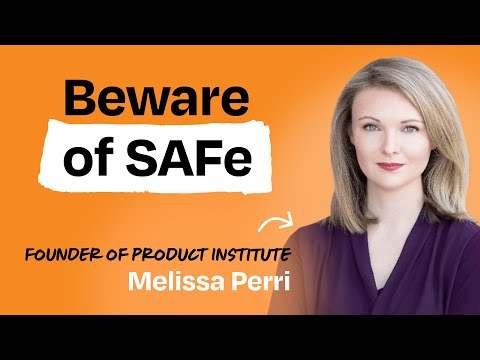
Everything you’ve ever wanted to know about SAFe and the product owner role | Melissa Perri
Lenny Rachitsky (host), Melissa Perri (guest), Kristina (OneSchema) (guest)
In this episode of Lenny's Podcast, featuring Lenny Rachitsky and Melissa Perri, Everything you’ve ever wanted to know about SAFe and the product owner role | Melissa Perri explores why SAFe Fails Product Teams And How Product Owners Can Evolve Melissa Perri explains how the ‘product owner’ role emerged from Scrum and Agile as a narrow, developer-facing function, distinct from end-to-end product management. She argues that frameworks like SAFe and Scrum-by-the-book over-emphasize process and certification while under-investing in discovery, product strategy, and real customer value. Large non–software-native enterprises adopt SAFe because it looks like a plug-and-play operating model, but often end up with bloated ceremonies, order-taking product owners, and little real accountability for outcomes. Perri outlines how leaders can redesign operating models and career paths, and how individual product owners can grow into true product managers focused on strategy, customers, and measurable impact.
Why SAFe Fails Product Teams And How Product Owners Can Evolve
Melissa Perri explains how the ‘product owner’ role emerged from Scrum and Agile as a narrow, developer-facing function, distinct from end-to-end product management. She argues that frameworks like SAFe and Scrum-by-the-book over-emphasize process and certification while under-investing in discovery, product strategy, and real customer value. Large non–software-native enterprises adopt SAFe because it looks like a plug-and-play operating model, but often end up with bloated ceremonies, order-taking product owners, and little real accountability for outcomes. Perri outlines how leaders can redesign operating models and career paths, and how individual product owners can grow into true product managers focused on strategy, customers, and measurable impact.
Key Takeaways
The product owner role was never designed as full product management.
In early Scrum, the product owner existed to prioritize work for developers, not to own market research, experimentation, and strategy. ...
Get the full analysis with uListen AI
SAFe solves coordination and release trains, but not product strategy.
SAFe gives executives a comforting, highly prescriptive map for organizing many teams, but it largely ignores how to do customer discovery, set product strategy, or connect roadmaps to business outcomes—so companies end up shipping a lot without knowing if it matters.
Get the full analysis with uListen AI
Rigid, process-first Agile often crowds out customer-centric work.
When teams sprint back-to-back, fill backlogs for the sake of utilization, and sit in endless ceremonies, product people have no time to talk to customers or measure impact, turning Agile into ‘work about work’ rather than a way to deliver value faster.
Get the full analysis with uListen AI
Great product organizations invest in clear roles, paths, and leaders.
Successful transformations pair internal talent with experienced product leaders, define true product management responsibilities up and down the org, and ensure product managers have access to customers, data, and decision rights—not just a new title.
Get the full analysis with uListen AI
Product owners can and should behave like product managers.
If you’re a product owner, you can push to understand goals, join customer research, frame work in terms of problems and outcomes, and ask what success looks like—then reflect that impact on your resume to move into more strategic PM roles.
Get the full analysis with uListen AI
Certifications rarely prove product management competence.
Two-day CSPO-style courses certify familiarity with a process, not the ability to discover opportunities, influence stakeholders, or ship impactful products. ...
Get the full analysis with uListen AI
Agile should be lowercase: principles, not religion.
If you treat Agile as a fixed rulebook instead of a toolkit for moving quickly and learning from customers, you get bloated processes and stalled products. ...
Get the full analysis with uListen AI
Notable Quotes
“This product owner role did not emerge from product management as we know it today. It was a way to help the developers prioritize what to work on.”
— Melissa Perri
“I do not recommend using SAFe. Every single person I have talked to who likes SAFe, found success with SAFe, they ended up ripping it up and making it into something else.”
— Melissa Perri
“Take Scrum away—you still need product management. Product owner doesn’t exist without Scrum.”
— Melissa Perri
“We’re talking about work about work, but we’re not actually getting into: what are we achieving here?”
— Melissa Perri
“There’s no fast track. We don’t get to just skip over all the hard things.”
— Melissa Perri
Questions Answered in This Episode
If you’re a product owner today, what concrete steps can you take in the next 90 days to get closer to customers and influence product strategy?
Melissa Perri explains how the ‘product owner’ role emerged from Scrum and Agile as a narrow, developer-facing function, distinct from end-to-end product management. ...
Get the full analysis with uListen AI
As a senior leader at a non–software-native company, how would you redesign your operating model so that product managers, not frameworks, drive strategy and outcomes?
Get the full analysis with uListen AI
Where are Agile ceremonies and SAFe constructs in your organization creating ‘work about work’ instead of helping teams learn faster from real users?
Get the full analysis with uListen AI
What skills and experiences should distinguish an associate PM from a PM and senior PM in your org, and how will you help current product owners bridge those gaps?
Get the full analysis with uListen AI
How might your company’s long-term business strategy change if a CPO with deep product experience sat at the same table as the CFO and COO?
Get the full analysis with uListen AI
Transcript Preview
There's this whole concept of SAFe, basically scaled Agile, right?
So, scaled Agile framework came out of the desire to figure out how do we scale Scrum and different processes. I do not recommend using SAFe. Every single person I have talked to who likes SAFe, found success with SAFe, they ended up ripping it up and making it into something else.
You've been up close and personal with a lot of companies working with product owners, scaled Agile, and all these things.
This product owner role did not emerge from product management as we know it today. It was a way to help the developers prioritize what to work on. I ended up going to a ton of Agile conferences and speaking about product management, and I started to learn that there was this product owner role in Scrum.
It feels like it's growing. Like, more and more companies are adopting this as the way to work.
A lot of large companies turn to Scrum or to the frameworks, and it's because they traditionally didn't grow up building software. When you look at Agile methodologies, what we're really saying there is we want to be able to move quickly and deliver great value to- to customers. If you embrace those principles, you're gonna do well.
(instrumental music) Today, my guest is Melissa Perri. Melissa is a legend in the product management community. She's the author of the foundational book, Escaping the Build Trap, and her most recent book, Product Operations. She's also the CEO and founder of The Product Institute, which trains product managers at all levels. She's trained PMs at almost every Fortune 500 company at this point. And in our conversation, we dive deep into a topic that I don't spend a lot of time on on this podcast; product owners, Scrum, scaled Agile, and building product at very large non-tech companies. Melissa shares the history behind these ways of working, what she's seen work and not work when companies roll out these frameworks, and most importantly, what you can do as a leader at one of these companies and as a product owner working in one of these companies to level up your organization and yourself. I learned a ton from this conversation, and I'm really curious to hear what you think since we don't cover this kind of stuff on this podcast too much. If you enjoy this podcast, don't forget to subscribe and follow it in your favorite podcasting app or YouTube. It's the best way to avoid missing future episodes, and it helps the podcast tremendously. With that, I bring you Melissa Perri. Melissa, thank you so much for being here and welcome to the podcast.
Thanks, Lenny. Thanks for having me.
First, let me give a little context on this conversation that we're having. I think it's gonna be a little bit unique. So, I was doing a deep dive on the job market in tech, and I saw something that was really surprising to me, that the product owner role was the third-fastest growing role in tech. And this was just in the US, the data I was looking at, but I think it's probably true broadly. And this was extremely surprising to me because I've never worked with a product owner. I've never... Uh, I don't hear anyone in my circles talking about product owners. I've never wanted to hire a product owner. And it feels like it's just kind of this very different part of the tech ecosystem that you don't hear a lot about on podcasts like this, and it's clearly growing. So, I felt like it'd be really helpful to spend some time helping people and helping me understand this part of the world. And so I asked you to come on to talk about this. You've been up close and personal with a lot of companies working with this way of working with product owners, scaled Agile, and all these things. And so I couldn't think of a better person to have on here to help us understand what's happening here and also just to help people do this better. So, Melissa, thank you again for coming on and- and helping us understand this.
Install uListen to search the full transcript and get AI-powered insights
Get Full TranscriptGet more from every podcast
AI summaries, searchable transcripts, and fact-checking. Free forever.
Add to Chrome