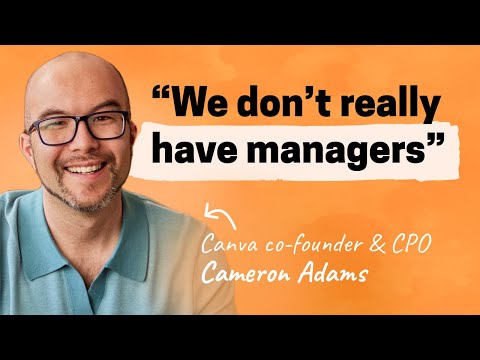
Inside Canva: Coaches not managers, giving away your Legos, and embracing AI | Cameron Adams
Lenny Rachitsky (host), Cameron Adams (guest)
In this episode of Lenny's Podcast, featuring Lenny Rachitsky and Cameron Adams, Inside Canva: Coaches not managers, giving away your Legos, and embracing AI | Cameron Adams explores inside Canva’s Rise: Culture, Coaching, AI, and Product Obsession Canva co-founder and CPO Cameron Adams explains how a deeply product-led, design-obsessed culture has powered Canva’s growth to $2.3B ARR, 60% YoY growth, and long-term profitability.
Inside Canva’s Rise: Culture, Coaching, AI, and Product Obsession
Canva co-founder and CPO Cameron Adams explains how a deeply product-led, design-obsessed culture has powered Canva’s growth to $2.3B ARR, 60% YoY growth, and long-term profitability.
He details Canva’s unique people practices—like “giving away your LEGOs,” a no-manager coaching model, and promotion-from-within—that enable individuals and the organization to continually scale.
The conversation breaks down Canva’s approach to MVPs, freemium, SEO, international expansion, and how they weave AI into the product in service of real user outcomes rather than as a gimmick.
Adams also shares hard-earned lessons from fundraising scares, onboarding breakthroughs, and designing a global, enterprise-ready product while staying true to the mission of democratizing design.
Key Takeaways
Build a product so good it drives organic word-of-mouth.
Canva delayed launch for about a year to ensure the initial experience was genuinely delightful, not just functional—aiming for “eyes light up” reactions that would naturally fuel early growth without heavy marketing spend.
Get the full analysis with uListen AI
Adopt a ‘give away your LEGOs’ mindset to scale yourself.
Employees are encouraged to relinquish favorite responsibilities as the company grows—shifting from doing the work themselves to hiring, system-building, and coaching others—so both the person and the org can move to the next level.
Get the full analysis with uListen AI
Replace traditional managers with role-specific coaches focused on growth.
Everyone at Canva has a coach from their specialty (e. ...
Get the full analysis with uListen AI
Treat onboarding as product-critical, not an afterthought.
Early user tests showed people froze on a blank page, so Canva redesigned onboarding into tiny, playful steps (like “search for a monkey”) that quickly delivered a finished design and the feeling, “I didn’t know I could be a designer.”
Get the full analysis with uListen AI
Tie growth channels tightly to end-to-end user success.
Canva’s famed SEO strategy works because it maps from intent (“Halloween poster”) to a tailored landing page, to a relevant template, to a smooth onboarding flow, ending in a genuinely successful outcome for the user.
Get the full analysis with uListen AI
Internationalize early and deeply to unlock non-obvious growth.
Launching localized experiences in dozens of languages within a few years forced Canva to adapt product (e. ...
Get the full analysis with uListen AI
Use AI as an amplifier of your core mission, not a gimmick.
Canva frames AI as a tool to further democratize design—faster, higher-quality creation—by blending proprietary models, best-in-class partners (like OpenAI, Runway), and third-party apps, always anchored to concrete user goals.
Get the full analysis with uListen AI
Notable Quotes
“Being profitable means that we never have to go to someone for money to ensure the survival of the business.”
— Cameron Adams
“Product is, at the end of the day, the most important thing at Canva, and the thing that's gonna help us stand out and continue to have success.”
— Cameron Adams
“You probably need to give away some of the stuff that you're doing now in order to get to that next level.”
— Cameron Adams
“We still did a ton of user testing... but you're releasing it knowing that the rough edges are gonna be outweighed by the joyful experience.”
— Cameron Adams
“You can't just be a product that's purely built on AI. You still need to think about what it is that people want to do and how you build a product that actually meets that need.”
— Cameron Adams
Questions Answered in This Episode
How could other companies practically adopt a coach-based model instead of traditional managers without causing chaos or confusion?
Canva co-founder and CPO Cameron Adams explains how a deeply product-led, design-obsessed culture has powered Canva’s growth to $2. ...
Get the full analysis with uListen AI
Where is the line between a ‘good enough’ MVP and a polished v1 that truly delights users, and how can teams know they’ve crossed it?
He details Canva’s unique people practices—like “giving away your LEGOs,” a no-manager coaching model, and promotion-from-within—that enable individuals and the organization to continually scale.
Get the full analysis with uListen AI
What specific signals should founders look for to identify their most promising early persona, as Canva did with social media managers?
The conversation breaks down Canva’s approach to MVPs, freemium, SEO, international expansion, and how they weave AI into the product in service of real user outcomes rather than as a gimmick.
Get the full analysis with uListen AI
How can smaller startups realistically replicate Canva’s SEO-and-templates playbook without Canva’s scale or brand authority?
Adams also shares hard-earned lessons from fundraising scares, onboarding breakthroughs, and designing a global, enterprise-ready product while staying true to the mission of democratizing design.
Get the full analysis with uListen AI
As AI capabilities accelerate, how will Canva decide what AI to build in-house versus rely on partners for—and how might that reshape the product over the next decade?
Get the full analysis with uListen AI
Transcript Preview
(instrumental music) Canva is bigger than Figma, and Miro, and Webflow combined. You guys are generating $2.3 billion in ARR, and you're profitable. You're also growing 60% year over year, and it's accelerating.
I run everyone through the culture at Canva, and one of those sections is on giving away your Lego. Finding joy in the other things, and building a team, passing on your experience, helping other people do great writing, or great product building, or great engineering.
When is this coaching concept? I have never heard of this.
We don't really have managers, but everyone at Canva has a coach. They're constantly working with you to look at your skills, but also when it might be time to move on to the next level.
(instrumental music) I'm curious just how you think about product management.
I didn't want to do product management like they did at Google, and that's because of the different cultures. I have seen product managers at other companies who are very independent of teams, and that seems very weird to me. For us, product managers are really connected.
(instrumental music) It feels like Canva's just been this non-stop, up and to the right, all win, all success. In reality, that's never actually the case.
How many failure stories do you want?
(laughs)
We've got plenty.
Today, my guest is Cameron Adams. Cameron is the co-founder and chief product officer at Canva, which is a truly incredible business and company. At the top of the episode, I share a bunch of stats that will probably surprise you about the scale that Canva has reached these days. In our conversation, we cover a ton of ground, including how Canva stays product obsessed, their freemium strategy, lessons about building MVPs, how Cam and the product team think about AI within their product, also a peek into their unique team culture, their SEO and growth strategy, and also a peek into some of the stuff they just launched. This episode is for anyone building or growing a product or company. And I guarantee, by the end of this conversation, you'll be as blown away with Canva as I am. With that, I bring you Cameron Adams. And if you enjoy this podcast, don't forget to subscribe and follow it in your favorite podcasting app or YouTube. It's the best way to avoid missing future episodes, and it helps the podcast tremendously. Cameron, thank you so much for being here, and welcome to the podcast.
It is so great to be here, Lenny. I'm very excited.
I'm even more excited. I have at least a billion questions for you. I'm hoping I get through at least half a billion. There's so much I want to talk to you about. But I want to start with kind of a warm and fuzzy question. Do you ever just take a, a moment to reflect on the insane success of this business that you've built? And before you answer that, I'm going to share some stats about Canva that I think are going to blow people's minds, so think about the answer. So, I was researching Canva. All of this was just, I didn't know any of this actually, and I think it'll surprise a lot of people, just the scale that Canva has reached at this point. Okay, so Canva is bigger than Figma, and Miro, and Webflow combined, both in terms of valuation and in terms of revenue. You guys are generating $2.3 billion in ARR per year, and you're profitable. You've been profitable for about seven years at this point. You're also growing 60% year over year, and it's accelerating faster than last year. I think this is all, uh, quite unheard of at this scale. Uh, do you ever just reflect back on this and like, "Okay, this is... I- I've done well."
Install uListen to search the full transcript and get AI-powered insights
Get Full TranscriptGet more from every podcast
AI summaries, searchable transcripts, and fact-checking. Free forever.
Add to Chrome