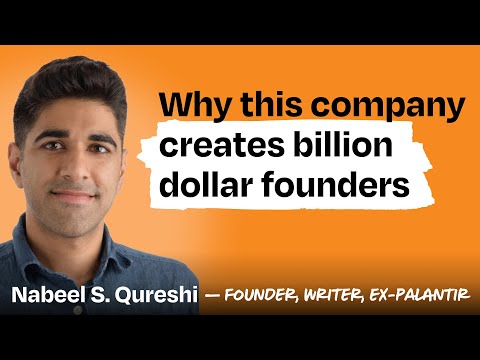
How Palantir built the ultimate founder factory | Nabeel S. Qureshi (founder, writer, ex-Palantir)
Lenny Rachitsky (host), Nabeel Qureshi (guest), Narrator
In this episode of Lenny's Podcast, featuring Lenny Rachitsky and Nabeel Qureshi, How Palantir built the ultimate founder factory | Nabeel S. Qureshi (founder, writer, ex-Palantir) explores inside Palantir’s Founder Factory: Culture, Customers, Data, And Defense Lenny Rachitsky interviews Nabeel Qureshi, ex-Palantir forward‑deployed engineer and current founder, to unpack how Palantir’s culture, org design, and data platform consistently produce top product leaders and founders.
Inside Palantir’s Founder Factory: Culture, Customers, Data, And Defense
Lenny Rachitsky interviews Nabeel Qureshi, ex-Palantir forward‑deployed engineer and current founder, to unpack how Palantir’s culture, org design, and data platform consistently produce top product leaders and founders.
They explore Palantir’s bat-signal mission, intense hiring bar, no-title structure, and the uniquely empowered forward‑deployed engineer role that embeds inside customers like Airbus and the NIH.
Nabeel explains how Palantir evolved from “sparkling Accenture” perceptions into a true software/product company via Foundry and Gotham, built on deep expertise in data ingestion, modeling, and workflows.
They also discuss the ethics of defense work, what makes Palantir PMs unusually strong, and how founders can adapt Palantir’s principles to build better teams, products, and AI‑era companies.
Key Takeaways
Use a strong, polarizing mission as a ‘bat signal’ to attract the right talent.
Palantir openly framed itself around preserving the West and tackling hard defense/intel problems, which repelled many but powerfully attracted independent, competitive, mission-aligned people—similar to how OpenAI/Anthropic attract AI‑maximalists.
Get the full analysis with uListen AI
Embed builders deeply with customers and empower them to ship net-new product.
Forward‑deployed engineers sat onsite (even moving countries) with customers like Airbus and NIH, learned the domain in depth, owned outcomes, and were allowed to build entirely new software—creating fast learning loops and founder-like reps.
Get the full analysis with uListen AI
Turn bespoke solutions into reusable platform primitives, not one-off projects.
Palantir repeatedly abstracted custom work (e. ...
Get the full analysis with uListen AI
Data plumbing is the real bottleneck; productize ingestion, cleaning, and access.
Across large orgs, 90–95% of the work is just getting and cleaning data due to siloed systems, gatekeepers, and messy schemas; Palantir’s core advantage is making that stack (adapters, pipelines, modeling, UI) robust and usable by non‑experts.
Get the full analysis with uListen AI
Hire for extreme ownership and mission-fit more than for credentials.
Nabeel optimizes for people who care intensely about outcomes (e. ...
Get the full analysis with uListen AI
Grow PMs from frontline builders who’ve earned trust in the field.
At Palantir, PMs were almost exclusively promoted from successful forward‑deployed engineers; they’d already proven customer empathy, technical depth, and execution in messy environments, avoiding “Google Doc PM” anti-patterns.
Get the full analysis with uListen AI
Engage with the ethics of technology instead of defaulting to disengagement.
Nabeel argues that working on defense and government can be morally positive when you’re improving precision, saving lives (e. ...
Get the full analysis with uListen AI
Notable Quotes
“They screened really hard for very independent‑minded people who weren’t afraid to push back, had broad intellectual interests, and were intensely competitive.”
— Nabeel Qureshi
“The job of the forward-deployed engineer is not just to deploy software or sell software. It is to actually solve the problem.”
— Nabeel Qureshi
“One lens through which you can view this company is they spent 20 years basically building the mother of all data foundations for every important institution in the world.”
— Nabeel Qureshi
“Disengagement isn’t the answer. Would you rather be in the room and making this better, or not?”
— Nabeel Qureshi
“You have to aim for Chartres. You have to make something that is better than that, not just turn in something that feels good enough.”
— Nabeel Qureshi (paraphrasing Christopher Alexander)
Questions Answered in This Episode
How could a smaller or mid-market SaaS company realistically adapt a ‘forward-deployed engineer’ motion without Palantir-sized contracts?
Lenny Rachitsky interviews Nabeel Qureshi, ex-Palantir forward‑deployed engineer and current founder, to unpack how Palantir’s culture, org design, and data platform consistently produce top product leaders and founders.
Get the full analysis with uListen AI
What are concrete ways to design a ‘bat signal’ culture that’s both strongly differentiated and still healthy and sustainable for employees?
They explore Palantir’s bat-signal mission, intense hiring bar, no-title structure, and the uniquely empowered forward‑deployed engineer role that embeds inside customers like Airbus and the NIH.
Get the full analysis with uListen AI
How should founders decide when a customer-specific build is drifting into pure consulting versus becoming a valuable new platform primitive?
Nabeel explains how Palantir evolved from “sparkling Accenture” perceptions into a true software/product company via Foundry and Gotham, built on deep expertise in data ingestion, modeling, and workflows.
Get the full analysis with uListen AI
Where should product leaders draw their own ethical line around working with defense, surveillance, or governments they disagree with?
They also discuss the ethics of defense work, what makes Palantir PMs unusually strong, and how founders can adapt Palantir’s principles to build better teams, products, and AI‑era companies.
Get the full analysis with uListen AI
In an AI-first world where coding and data work are cheaper, what new types of companies or roles become possible that Palantir couldn’t justify before?
Get the full analysis with uListen AI
Transcript Preview
30% of PMs that leave Palantir start a company. Just give us a picture of what, what the people are like.
I feel like they screen really hard for a few traits in particular. One is, like, very independent-minded people who aren't afraid to push back. Two is people with broader intellectual interests.
What's the difference between, say, a PM at Palantir versus a traditional PM?
They were extremely careful about only making people PMs who had first proven themselves out as forward-deployed engineers. You basically could not become a PM any other way. There's two types of engineer at Palantir. So there's one that works on the core products, and they're a traditional software engineer. There was a different type of engineer which you sent into the field, right? You would spend maybe Monday to Thursday, and you would actually go into the building where the customer worked, and you would work alongside them. You would literally get a desk pass. And so that engineer became known as a forward-deployed engineer.
What's something that you believe that most other people don't?
I think this is a somewhat contrarian view within tech.
(instrumental music) Today, my guest is Nabeel Qureshi. Nabeel is a founder, a writer, a researcher, and an engineer. He was recently a visiting scholar researching AI policy at the Mercatus Center alongside Tyler Cowen. At one point, he worked with the National Institute of Health and major clinical centers to create the largest medical dataset in the world. He worked at the Bank of England for a bit. He was founding member and VP of business development at GoCardless, one of Europe's biggest financial technology unicorns. And most related to the topic of this conversation, Nabeel spent almost eight years at Palantir as a forward-deployed engineer, working on public health projects with U.S. federal agencies, including public health services during the COVID-19 response and applied AI in drug discovery. Whether you are a fan of Palantir or hate everything that they do, they are an important and fast-growing company that is pumping out incredible product leaders, as you'll hear, more than any other company in the world. So, it is worth studying and understanding. I've never heard an in-depth conversation digging into how they operate, build product, hire, and were able to scale from a primarily services business to a software business. So, I am very excited to bring you this inside look. In our conversation, we go deep into: what the heck does Palantir even do?; why getting good at managing lots of data is an underappreciated secret to their success; a look at the unique forward-deployed engineer role that they innovated and what other companies can borrow from their insights here; also, how they hire and how they build amazing product leaders; plus a ton of advice on talking to customers, building products, and starting companies. If you enjoy this podcast, don't forget to subscribe and follow it in your favorite podcasting app or YouTube. Also, if you become an annual subscriber of my newsletter, you get a bunch of amazing products for free for a year, including Superhuman, Notion, Linear, Perplexity, Granola, and more. Check it out at lemmysnewsletter.com and click bundle. With that, I bring you Nabeel Qureshi. This episode is brought to you by WorkOS. If you're building a SaaS app, at some point, your customers will start asking for enterprise features like SAML authentication and SCIM provisioning. That's where WorkOS comes in, making it fast and painless to add enterprise features to your app. Their APIs are easy to understand so that you can ship quickly and get back to building other features. Today, hundreds of companies are already powered by WorkOS, including ones you probably know, like Vercel, Webflow, and Loom. WorkOS also recently acquired Warrant, the fine-grained authorization service. Warrant's product is based on a groundbreaking authorization system called Zanzibar, which was originally designed for Google to power Google Docs and YouTube. This enables fast authorization checks at enormous scale while maintaining a flexible model that can be adapted to even the most complex use cases. If you're currently looking to build role-based access control or other enterprise features like single sign-on, SCIM, or user management, you should consider WorkOS. It's a drop-in replacement for Auth0 and supports up to one million monthly active users for free. Check it out at workos.com to learn more. That's workos.com. This episode is brought to you by Attio, the AI-native CRM. Attio is built to scale with your business from day one. Connect your email and calendar, and Attio instantly builds a CRM that matches your business model with all of your companies, contacts, and interactions enriched with actionable insights. Sync in your product's usage, billing info, or any other data sources, and Attio's flexible data model will handle it all without any rigid templates or workarounds. With Attio, AI isn't just a feature, it's the foundation. You can do things like instantly prospect and route leads with research agents, get real-time insights from AI using customer conversations, and build powerful AI automations for your most complex workflows. Industry leaders like Flatfile, Replicate, and Modal are already experiencing what's next for CRM. Go to attio.com/lenny to get 15% off your first year. That's attio.com/lenny. (instrumental music) Nabeel, thank you so much for being here, and welcome to the podcast.
Install uListen to search the full transcript and get AI-powered insights
Get Full TranscriptGet more from every podcast
AI summaries, searchable transcripts, and fact-checking. Free forever.
Add to Chrome