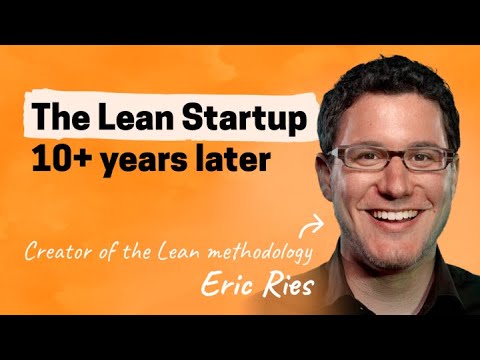
Reflections on a movement | Eric Ries (creator of the Lean Startup methodology)
Eric Ries (guest), Lenny Rachitsky (host), Narrator, Narrator, Narrator
In this episode of Lenny's Podcast, featuring Eric Ries and Lenny Rachitsky, Reflections on a movement | Eric Ries (creator of the Lean Startup methodology) explores eric Ries Rethinks Lean Startups, MVPs, Pivots, AI, And Purpose Eric Ries reflects on the evolution and widespread adoption of the Lean Startup methodology, how its once-controversial ideas (like MVPs and pivots) have become default startup vocabulary, and the many ways they’re still misunderstood. He reframes MVPs as rigorous learning tools rather than low-quality products, explains when and how to pivot versus persist, and stresses that most early work will be thrown away—so founders should minimize wasteful building.
Eric Ries Rethinks Lean Startups, MVPs, Pivots, AI, And Purpose
Eric Ries reflects on the evolution and widespread adoption of the Lean Startup methodology, how its once-controversial ideas (like MVPs and pivots) have become default startup vocabulary, and the many ways they’re still misunderstood. He reframes MVPs as rigorous learning tools rather than low-quality products, explains when and how to pivot versus persist, and stresses that most early work will be thrown away—so founders should minimize wasteful building.
Ries explores how AI will reshape product development and management, arguing it massively increases experimentation speed and forces companies to confront governance, alignment, and long-term responsibility. He urges founders to build organizations structurally committed to human flourishing, not just shareholder returns, and to encode their values into governance before it’s “too late.”
Throughout, he highlights the psychological realities of entrepreneurship—founder mental health, ego, narrative distortion, and the pain of zombie companies that won’t die—while encouraging founders to build companies they’re proud of, even if that means risking failure or getting fired. He closes by calling for a new movement of founders who use their structural power to demand long-term, humane, and trustworthy companies.
Key Takeaways
MVP means fastest way to learn, not lowest-quality product.
Ries emphasizes that a Minimum Viable Product is whatever lets you most efficiently validate a core hypothesis in your specific context—sometimes that’s a beautiful brochure, a single high-quality feature, or a pre-order test, not a buggy, half-broken app.
Get the full analysis with uListen AI
Founders dramatically overbuild before testing core assumptions.
Most teams are off by one to two orders of magnitude in how much they think they must build to learn; Ries’s simple heuristic is: list required features, cut in half, then cut in half again and ship that to start learning.
Get the full analysis with uListen AI
If you’re debating whether to pivot, you likely already know you should.
Ries argues that truly having product–market fit leaves no time for existential questions; persistent doubt is usually a signal to run a time-boxed, all-in experiment on the current idea, then a similarly focused test on a new idea, or shut down and reset the cap table.
Get the full analysis with uListen AI
Most of your early work will be thrown away, so optimize for learning speed.
Because pivots and major strategic changes are so common, investing heavily in fully polished products too early often results in beautifully crafted but useless artifacts; the real goal is to quickly discover what customers actually value.
Get the full analysis with uListen AI
Craft and experimentation are complements, not opposites.
Ries distinguishes genuine craft (clear taste, deliberate tradeoffs, thoughtful simplicity) from using “craft” as an excuse to avoid feedback; if you truly care about craft, you should test everything else even more aggressively so your carefully crafted core is pointed at the right problem.
Get the full analysis with uListen AI
The worst outcome isn’t failure; it’s being trapped in a company you hate.
He warns of “zombie” companies that stagger on without real prospects, slowly destroying founders’ mental health and values; shutting down, pivoting hard, or even getting fired for your principles is often healthier than clinging to a dead or misaligned business.
Get the full analysis with uListen AI
Governance must encode values or your company will drift toward exploitation.
Intentions aren’t enough: Ries urges founders to structurally embed human-flourishing goals into charters, share classes, foundations, and board pledges (e. ...
Get the full analysis with uListen AI
Notable Quotes
“People act like having a startup fail is the worst thing that can happen to you. I'm like, 'Man, that's not even in the top 10.'”
— Eric Ries
“MVP is simply, for whatever hypothesis we're trying to test, what is the most efficient way to get the validation we need?”
— Eric Ries
“If you’re asking whether you should pivot or not, you probably know the answer already.”
— Eric Ries
“No individual person can ever make promises on behalf of an organization. You’re replaceable. The promises have to be embodied in the structure of the organization itself.”
— Eric Ries
“We are the manufacturers of the thing the system requires for its basic survival. We get to set the terms by which this is done.”
— Eric Ries
Questions Answered in This Episode
How would you redefine MVP for your specific product and market if you treated it purely as a learning tool rather than a small first version of your final product?
Eric Ries reflects on the evolution and widespread adoption of the Lean Startup methodology, how its once-controversial ideas (like MVPs and pivots) have become default startup vocabulary, and the many ways they’re still misunderstood. ...
Get the full analysis with uListen AI
Looking honestly at your current metrics and trajectory, are you on the flat part of a hockey stick that will never bend—and what experiment could you run in the next 4–6 weeks to decisively find out?
Ries explores how AI will reshape product development and management, arguing it massively increases experimentation speed and forces companies to confront governance, alignment, and long-term responsibility. ...
Get the full analysis with uListen AI
If you and your co-founders could start fresh today, what company or product would you actually want to build—and what’s stopping you from pivoting toward that now?
Throughout, he highlights the psychological realities of entrepreneurship—founder mental health, ego, narrative distortion, and the pain of zombie companies that won’t die—while encouraging founders to build companies they’re proud of, even if that means risking failure or getting fired. ...
Get the full analysis with uListen AI
In what concrete ways are your company’s governance documents, cap table, and board structure currently misaligned with the values you say you care about?
Get the full analysis with uListen AI
Given the acceleration AI brings to experimentation and communication, how should your organization change its management practices so that this power is used ethically and in service of human flourishing, not just efficiency?
Get the full analysis with uListen AI
Transcript Preview
... people act like having a startup fail is the worst thing that can happen to you. I'm like, "Man, that's not even in the top 10." Like it's b- it's bad. I mean I've d- I've done it. It's awful, okay? It's really bad. But far worse is to be in a company that won't die, a zombie undead company that you hate but you can't leave. Oof, have I met people like that. And like, we're having a mental health crisis among founders that's like not talked about enough. You know, people have started to talk about like the downside mental health risks. Obviously the stress of being a founder is hard, but like look what's happening to the people that are so-called successes. Like, I, when you build a company and you sell it out and it becomes something that you find abhorrent, like yeah, maybe you get rich but it's, it's not, it's not good. And so building a company you hate that, that becomes a malign force in the world, you know, that you have to go pretend you weren't involved with or that like you feel complicit in what ... Like, that's way, way worse and I wish more founders would take that more seriously early on.
(instrumental music) Today my guest is Eric Ries. If you're not familiar with his work, I would be shocked. He is most famous for creating the Lean Startup methodology and movement, and also his incredibly influential book, The Lean Startup. He also coined more terms and concepts that are part of the tech culture than anyone I could think of. He currently spends his time advising founders and startups. He was a former founder and CTO, and currently is the founder and executive chairman of The Long-Term Stock Exchange. This is now my favorite episode of the podcast and I can't wait for you to hear it. In our conversation, we cover a lot of ground, including the current state of the Lean Startup movement, where he sees things heading, what Eric would re-do if he could do it over again, misconceptions about the methodology that frustrate him most, how AI will likely impact product development in startups, how to think about MVPs correctly, when to pivot and when to stay the course, also how to build a business with values that are aligned with human flourishing. Also, tons of amazing stories and lessons, and there's just so much gold in this conversation. And so with that, I bring you Eric Ries after a short word from our sponsors. This episode is brought to you by Sanity. Your website is the heart of your growth engine. For that engine to drive big results, you need to be able to move super fast, ship new content, experiment, learn, and iterate. But most content management systems just aren't built for this. Your content teams wrestle with rigid interfaces as they build new pages. You spend endless time copying and pasting across pages and recreating content for other channels and applications. And their ideas for new experiments are squashed when developers can't build them within the constraints of outdated tech. Forward-thinking companies like Figma, Amplitude, Loom, Riot Games, Linear, and more use Sanity to build content growth engines that scale, drive innovation, and accelerate customer acquisition. With Sanity, your team can dream bigger and move faster. As the most powerful headless CMS on the market, you can tailor editorial workflows to match your business, reuse content seamlessly across any page or channel, and bring your ideas to market without developer friction. Sanity makes life better for your whole team. It's fast for developers to build with, intuitive for content managers, and it integrates seamlessly with the rest of your tech stack. Get started with Sanity's generous free plan, and as a Lenny's Podcast listener you can get a boosted plan with double the monthly usage. Head over to sanity.io/lenny to get started for free. That's sanity.io/lenny. You fell in love with building products for a reason, but sometimes the day-to-day reality is a little different than you imagined. Instead of dreaming up big ideas, talking to customers, and crafting a strategy, you're drowning in spreadsheets and roadmap updates and you're spending your days basically putting out fires. A better way is possible. Introducing Jira Product Discovery, the new prioritization and roadmapping tool built for product teams by Atlassian. With Jira Product Discovery, you can gather all your product ideas and insights in one place and prioritize confidently, finally replacing those endless spreadsheets. Create and share custom product roadmaps with any stakeholder in seconds, and it's all built on Jira, where your engineering team is already working, so true collaboration is finally possible. Great products are built by great teams, not just engineers. Sales, support, leadership, even Greg from finance. Anyone that you want can contribute ideas, feedback, and insights in Jira Product Discovery for free, no catch. And it's only $10 a month for you. Say goodbye to your spreadsheets and the never-ending alignment efforts. The old way of doing product management is over. Rediscover what's possible with Jira Product Discovery. Try it for free at atlassian.com/lenny. That's atlassian.com/lenny. Eric Ries, thank you so much for being here. Welcome to the podcast.
Install uListen to search the full transcript and get AI-powered insights
Get Full TranscriptGet more from every podcast
AI summaries, searchable transcripts, and fact-checking. Free forever.
Add to Chrome