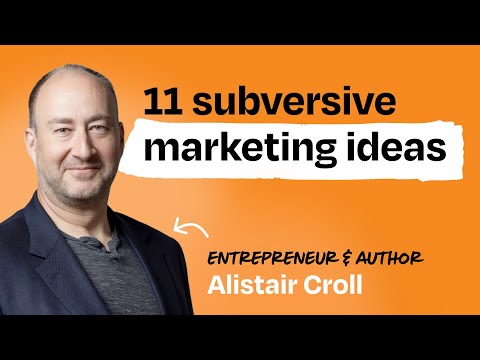
Just evil enough: Subversive marketing strategies for startups | Alistair Croll
Alistair Croll (guest), Lenny Rachitsky (host)
In this episode of Lenny's Podcast, featuring Alistair Croll and Lenny Rachitsky, Just evil enough: Subversive marketing strategies for startups | Alistair Croll explores just Evil Enough: Subversive Startup Tactics For Unfair Attention Advantage Alistair Croll, co-author of *Lean Analytics*, introduces concepts from his new book *Just Evil Enough*, arguing that distribution and attention—not product features—are now the real battleground for startups.
Just Evil Enough: Subversive Startup Tactics For Unfair Attention Advantage
Alistair Croll, co-author of *Lean Analytics*, introduces concepts from his new book *Just Evil Enough*, arguing that distribution and attention—not product features—are now the real battleground for startups.
He defines “subversive marketing” as using systems in ways their creators didn’t intend, without crossing into truly unethical or illegal behavior, and calls these moves “zero‑day marketing exploits.”
Croll and his co-author distilled 160+ case studies into 11 recurring tactics (e.g. turning bugs into features, buyer upgrades, aggregation, arbitrage, reframing, regulation hacks) and a Recon Canvas to systematically find such opportunities across product, medium, and market.
Throughout, he emphasizes cultivating system awareness, novelty, and constructive disagreeability, then rigorously stress‑testing ideas so they’re “just evil enough” to stand out without damaging users, brand, or society.
Key Takeaways
Treat distribution as a first‑class product problem, not an afterthought.
Most product teams obsess over features and ignore go‑to‑market, yet the companies that win usually have a unique way to capture attention and convert it into demand—what Croll calls an “unfair advantage.”
Get the full analysis with uListen AI
Develop a subversive mindset built on system awareness, novelty, and disagreeability.
To find unconventional growth levers, you must understand the broader system you’re in, be willing to try novel approaches within it, and be disagreeable enough to question the rules instead of just playing the game as given.
Get the full analysis with uListen AI
Search for zero‑day marketing exploits tailored to your product and context.
Copy‑paste growth hacks quickly become either standard marketing or illegal; instead, systematically look for overlooked loopholes and underused channels specific to your product, medium, and market.
Get the full analysis with uListen AI
Use structured frameworks to generate subversive ideas, not just brainstorming.
The Recon Canvas (product–medium–market across objective/collective/subjective lenses) and 11 pattern‑based tactics help teams scan for opportunities like reframing, buyer upgrades, aggregation, or arbitrage in a disciplined way.
Get the full analysis with uListen AI
Reframe weaknesses and mismatches as strategic assets.
Tactics like “bug into feature” and “buyer upgrade” show that a perceived flaw (e. ...
Get the full analysis with uListen AI
Exploit medium mechanics and norms as much as the message itself.
Success stories like Burger King’s old‑tweet liking campaign or Coinbase’s bouncing QR code Super Bowl ad worked because they cleverly used platform behaviors and user expectations, not just creative copy or visuals.
Get the full analysis with uListen AI
Push boundaries without crossing ethical red lines.
“Just evil enough” excludes abuse, dark patterns, assumed consent, regulatory violations, and punching down; the goal is provocative, unexpected tactics that delight or intrigue participants, not exploit or harm them.
Get the full analysis with uListen AI
Notable Quotes
“The only thing that matters is: do you have an unfair advantage? Have you figured out a way to capture attention and turn it into profitable demand?”
— Alistair Croll
“Your startup is a disagreement with the status quo, and the status quo was created by those in power—so they’re naturally not going to like it when you don’t play by their rules.”
— Alistair Croll
“I’m not saying be evil. I’m saying be just evil enough.”
— Alistair Croll
“Two companies with the same product sold to the same market—one wins and the other doesn’t—often because of their medium strategy.”
— Alistair Croll
“Positioning is where you are on a grid. Reframing is drawing the grid.”
— Alistair Croll
Questions Answered in This Episode
How can my team practically build “system awareness” about our industry so we can spot overlooked loopholes and exploits?
Alistair Croll, co-author of *Lean Analytics*, introduces concepts from his new book *Just Evil Enough*, arguing that distribution and attention—not product features—are now the real battleground for startups.
Get the full analysis with uListen AI
Which of the 11 tactics (e.g. bug‑to‑feature, buyer upgrade, arbitrage, aggregation) is most applicable to an early‑stage SaaS product with no existing audience?
He defines “subversive marketing” as using systems in ways their creators didn’t intend, without crossing into truly unethical or illegal behavior, and calls these moves “zero‑day marketing exploits.”
Get the full analysis with uListen AI
Where is the ethical line for “just evil enough” in my specific market—what would clearly go too far for our users or regulators?
Croll and his co-author distilled 160+ case studies into 11 recurring tactics (e. ...
Get the full analysis with uListen AI
How do we balance one‑off stunts or spikes in attention with building a sustainable, repeatable distribution strategy?
Throughout, he emphasizes cultivating system awareness, novelty, and constructive disagreeability, then rigorously stress‑testing ideas so they’re “just evil enough” to stand out without damaging users, brand, or society.
Get the full analysis with uListen AI
What would our zero‑day marketing exploit look like if we forced ourselves to think like a super‑villain for a day and then dialed it back to ethical reality?
Get the full analysis with uListen AI
Transcript Preview
(instrumental music) People overlook this often. Sometimes people are not buying your product 'cause it's only half of the solution. David Ricketts, who's a Harvard Professor of Innovation, uses the example of mac and cheese.
Kraft Macaroni & Cheese Dinner.
So Kraft had figured out powdered cheese to support the war effort, but you can't really sell powdered cheese on its own. And then they found this sales guy who was putting the powdered cheese and a box of macaroni together with an elastic, literally combining them, and now you'd buy it 'cause it was ready-made dinner. I think a lot of us don't look at our product and say, "How is it being used?"
Today my guest is Alistair Croll. Alistair is the author of Lean Analytics, which was one of the most influential early books on how to use data in helping you build your startup. He's also a multi-time founder, runs conferences all over the world on data, AI and technology, and government, and most importantly to me, convinced me to leave a nice cushy job to start a company over a decade ago, then helped me build that startup and eventually sell it to Airbnb, and in many ways was one of the most central figures in my life that led me to doing what I do now. And lucky for us, Alistair is about to release a new book that I am very excited about. It's called Just Evil Enough. And essentially it's a study of loopholes and how to get people to pay attention to what you've built, which increasingly is the hardest part of launching a startup. Alistair shares 11 specific strategies for finding subversive ideas to get your ideas out, how to shift your mindset to think more subversively, why it's so essential for startups and founders to think this way these days, plus dozens of examples and stories that make this advice very real. This episode is for anyone having trouble getting anyone to pay attention to your product, or anyone thinking about starting a company to get your mind starting to think this way. If you enjoy this podcast, don't forget to subscribe and follow it in your favorite podcasting app or YouTube. It's the best way to avoid missing future episodes and it helps the podcast tremendously. With that, I bring you Alistair Croll. Alistair, thank you so much for being here and welcome to the podcast.
Thanks for having me. It's awesome to be here.
It's awesome to have you here. We've known each other for a very long time. You helped me with my startup back in the day. And when I heard you were writing a new book, especially one called Just Evil Enough, I knew that I had to have you on here to talk about it. I thought it'd be good to start with just the story behind this book. Why do you, why did you decide to write this book? Why does this book need to exist?
Install uListen to search the full transcript and get AI-powered insights
Get Full TranscriptGet more from every podcast
AI summaries, searchable transcripts, and fact-checking. Free forever.
Add to Chrome