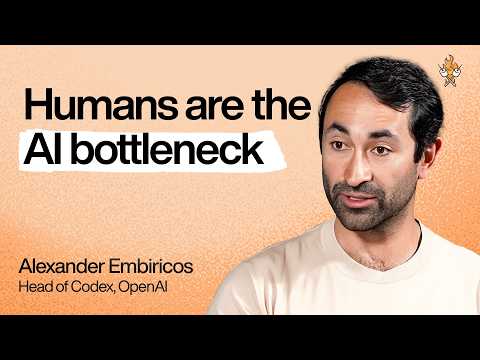
Inside OpenAI: 2026 is the year of agents, AI’s biggest bottleneck, and why compute isn’t the issue
Lenny Rachitsky (host), Alexander Embiricos (guest)
In this episode of Lenny's Podcast, featuring Lenny Rachitsky and Alexander Embiricos, Inside OpenAI: 2026 is the year of agents, AI’s biggest bottleneck, and why compute isn’t the issue explores inside Codex: OpenAI’s coding teammate reshaping software, work, and AGI Alexanderis Embiricos, product lead for Codex at OpenAI, explains how Codex is evolving from an IDE helper into a proactive software engineering teammate and core building block for future AI agents.
Inside Codex: OpenAI’s coding teammate reshaping software, work, and AGI
Alexanderis Embiricos, product lead for Codex at OpenAI, explains how Codex is evolving from an IDE helper into a proactive software engineering teammate and core building block for future AI agents.
He describes OpenAI’s unusually fast, bottoms‑up product culture, how Codex has driven 20x growth and powered projects like the Sora app and Atlas browser, and why writing and reviewing code remain the real bottlenecks—not compute.
The conversation explores why any serious agent will need to be a coding agent, how contextual products like browsers unlock mixed‑initiative assistance, and why 2026–ish could be when agent‑driven productivity hockey‑sticks.
Alexanderis also shares career advice for engineers, his views on AGI timelines, and why OpenAI is heavily investing in making AI‑written code easier to validate, review, and trust.
Key Takeaways
Winning agents must be proactive teammates, not just smarter autocomplete.
Codex’s vision is a software engineering teammate that participates end‑to‑end—from ideation and planning, to implementation, validation, deployment, and maintenance—acting on its own where safe, instead of waiting for explicit prompts.
Get the full analysis with uListen AI
The most powerful agents will be coding agents that use computers via code.
OpenAI has learned that models are far more effective when they can use a computer, and the best way to do that is by writing code (e. ...
Get the full analysis with uListen AI
Real adoption required meeting developers where they are—inside IDEs and CLIs.
Codex’s early cloud‑only, asynchronous model was “too far in the future” for most users; shifting to an IDE extension and terminal‑based agent that runs in a sandbox on the developer’s own machine massively simplified onboarding and unlocked explosive growth.
Get the full analysis with uListen AI
The bottleneck is shifting from writing code to reviewing and validating it.
As agents write more code, engineers increasingly spend their time reviewing AI‑generated changes and ensuring safety and correctness, which is often less fun; Codex is now focused on better automated testing, validation, and code review support to relieve this pressure.
Get the full analysis with uListen AI
Integrated model–API–harness design is critical to durable agent performance.
Features like long‑running workflows and “compaction” (moving work across context windows) only work well when the model, the API, and the tool harness are co‑designed—OpenAI’s tight product–research integration is a key advantage in building robust agents.
Get the full analysis with uListen AI
AI is already radically compressing product timelines inside OpenAI.
Codex helped build the Sora Android app in 18 days (and ship to the public in 28) and significantly accelerated complex work on the Atlas browser, demonstrating that small teams equipped with strong coding agents can deliver production apps at unprecedented speed.
Get the full analysis with uListen AI
Agent-driven productivity will appear first in greenfield systems, then spread.
Alexanderis expects early adopters (e. ...
Get the full analysis with uListen AI
Notable Quotes
“We think of Codex as just the beginning of a software engineering teammate.”
— Alexanderis Embiricos
“If you want to build any agent, maybe you should be building a coding agent.”
— Alexanderis Embiricos
“I think the current underappreciated limiting factor is literally human typing speed or human multitasking speed.”
— Alexanderis Embiricos
“Even if we had no more progress in models, we are way behind on product.”
— Alexanderis Embiricos
“Writing code is actually one of the most fun parts of software engineering… reviewing agent‑written code is where today is less fun.”
— Alexanderis Embiricos
Questions Answered in This Episode
How will companies need to redesign their systems and processes so that agents like Codex can safely act with far more autonomy?
Alexanderis Embiricos, product lead for Codex at OpenAI, explains how Codex is evolving from an IDE helper into a proactive software engineering teammate and core building block for future AI agents.
Get the full analysis with uListen AI
What governance or guardrail mechanisms will make teams comfortable letting a coding agent not just write, but also deploy and monitor production code?
He describes OpenAI’s unusually fast, bottoms‑up product culture, how Codex has driven 20x growth and powered projects like the Sora app and Atlas browser, and why writing and reviewing code remain the real bottlenecks—not compute.
Get the full analysis with uListen AI
At what point does reliance on coding agents change what we consider “core” engineering skills versus higher‑level system and product thinking?
The conversation explores why any serious agent will need to be a coding agent, how contextual products like browsers unlock mixed‑initiative assistance, and why 2026–ish could be when agent‑driven productivity hockey‑sticks.
Get the full analysis with uListen AI
How might the idea of a contextual, mixed‑initiative assistant extend beyond engineering into roles like sales, finance, or operations?
Alexanderis also shares career advice for engineers, his views on AGI timelines, and why OpenAI is heavily investing in making AI‑written code easier to validate, review, and trust.
Get the full analysis with uListen AI
If human review is the current bottleneck, what are the risks—and necessary safeguards—when we start letting agents review and approve each other’s work?
Get the full analysis with uListen AI
Transcript Preview
You lead work on Codex.
Codex is OpenAI's coding agent. We think of Codex as just the beginning of a software engineering teammate. It's a bit like this really smart intern that refuses to read Slack, doesn't check Datadog unless you ask it to.
I remember Karpathy tweeted the gnarliest bugs that he runs into, that he just spends hours trying to figure out, nothing else is solved, he gives it to Codex, lets it run for an hour and it solves it.
Starting to see glimpses of the future where we're actually starting to have Codex be on call for its own training. Codex writes a lot of the code that helps, like, manage its training run, the key infrastructure, and so we have, uh, Codex code review is, like, catching a lot of mistakes. It's actually caught some, like, pretty interesting configuration mistakes. One of the most mind-blowing examples of acceleration is the Sora Android app, like a fully new app. We built it in 18 days and then 10 days later, so 28 days total, we went to the public.
How do you think you win in the space?
One of our major goals with Codex is to get to proactivity. If we're going to build a super assistant, it has to be able to do things. One of the learnings over the past year is that for models to do stuff, they are much more effective when they can use a computer. It turns out the best way for models to use computers is simply to write code. And so we're kind of getting to this idea where if you want to build any agent, maybe you should be building a coding agent.
When you think about progress on Codex, I imagine you have a bunch of evals and there's all these public benchmarks.
A few of us are, like, constantly on Reddit. You know, there's, uh, there's praise up there and there's a lot of complaints. What we can do is, we as a product team just try to always think about how are we building a tool so that it feels like we're maximally accelerating people, rather than building a tool that makes it more unclear what you should do as the human being.
At OpenAI, I can't not ask about how far you think we are from AGI.
The current underappreciated limiting factor is literally human typing speed or human multitasking speed.
Today, my guest is Alexandris Embiricos, product lead for Codex, OpenAI's incredibly popular and powerful coding agent. In the words of Nick Turley, head of ChatGPT and former podcast guest, "Alex is one of my all-time favorite humans I've ever worked with, and bringing him and his company into OpenAI ended up being one of the best decisions we've ever made." Similarly, Kevin Wheel, OpenAI CPO, said, "Alex is simply the best." In our conversation, we chat about what it's truly like to build product at OpenAI, how Codex allowed the Sora team to ship the Sora app, which became the number one app in the App Store in under one month, also the 20X growth Codex is seeing right now and what they did to make it so good at coding, why his team is now focused on making it easier to review code, not just write code, his AGI timelines, his thoughts on when AI agents will actually be really useful, and so much more. A huge thank you to Ed Bayes, Nick Turley, and Dennis Yang for suggesting topics for this conversation. If you enjoy this podcast, don't forget to subscribe and follow it in your favorite podcasting app or YouTube. And if you become an annual subscriber of my newsletter, you get a year free of 19 incredible products, including a year free of Devin, Lovable, Replit, Bolt, n8n, Linear, Superhuman, Descript, WhisperFlow, Gamma, Perplexity, Warp, Granola, Magic Patterns, Raycast, ChatGPT, MobIn, PostHog, and Stripe Atlas. Head on over to lennysnewsletter.com and click Product Pass. With that, I bring you Alexandris Embiricos after a short word from our sponsors. Here's a puzzle for you. What do OpenAI, Cursor, Perplexity, Vercel, Plat, and hundreds of other winning companies have in common? The answer is they're all powered by today's sponsor, WorkOS. If you're building software for enterprises, you've probably felt the pain of integrating single sign-on, SCIM, RBAC, audit logs, and other features required by big customers. WorkOS turns those deal blockers into drop-in APIs with a modern developer platform built specifically for B2B SaaS. Whether you're a seed stage startup trying to land your first enterprise customer or a unicorn expanding globally, WorkOS is the fastest path to becoming enterprise ready and unlocking growth. They're essentially Stripe for enterprise features. Visit workos.com to get started or just hit up their Slack support where they have real engineers in there who answer your questions super fast. WorkOS allows you to build like the best with delightful APIs, comprehensive docs, and a smooth developer experience. Go to workos.com to make your app enterprise-ready today. This episode is brought to you by Fin, the number one AI agent for customer service. If your customer support tickets are piling up, then you need Fin. Fin is the highest performing AI agent on the market with a 65% average resolution rate. Fin resolves even the most complex customer queries. No other AI agent performs better. In head-to-head bake-offs with competitors, Fin wins every time. Yes, switching to a new tool can be scary, but Fin works on any help desk with no migration needed, which means you don't have to overhaul your current system or deal with delays in service for your customers. And Fin is trusted by over 6,000 customer service leaders and top companies like Anthropic, Shutterstock, Synthesia, Clay, Vanta, Lovable, monday.com, and more. Because Fin is powered by the Fin AI engine, which is a continuously improving system that allows you to analyze, train, test, and deploy with ease, Fin can continuously improve your results too. So if you're ready to transform your customer service and scale your support, give Fin a try for only 99 cents per resolution. Plus, Fin comes with a 90-day money back guarantee. Find out how Fin can work for your team at fin.ai/lenny. That's fin.ai/lenny. Alexandris, thank you so much for being here and welcome to the podcast.
Install uListen to search the full transcript and get AI-powered insights
Get Full TranscriptGet more from every podcast
AI summaries, searchable transcripts, and fact-checking. Free forever.
Add to Chrome