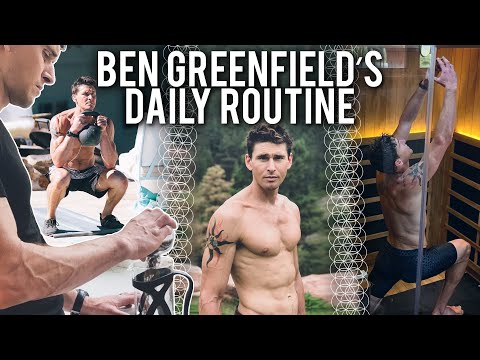
BEN GREENFIELD | The Ultimate Daily Routine | Modern Wisdom Podcast 157
Ben Greenfield (guest), Chris Williamson (host)
In this episode of Modern Wisdom, featuring Ben Greenfield and Chris Williamson, BEN GREENFIELD | The Ultimate Daily Routine | Modern Wisdom Podcast 157 explores ben Greenfield Reveals Hyper-Optimized Daily Routine For Energy, Sleep, Longevity Ben Greenfield walks through his full daily structure from wake-up to bedtime, explaining how he designs each block of the day for energy, productivity, recovery, and family connection.
Ben Greenfield Reveals Hyper-Optimized Daily Routine For Energy, Sleep, Longevity
Ben Greenfield walks through his full daily structure from wake-up to bedtime, explaining how he designs each block of the day for energy, productivity, recovery, and family connection.
His morning centers on low-carb fasting, light management, red-light therapy, “biohacker” hydration, and deep-tissue work, followed by several hours of distraction-free deep work.
Afternoons feature a nutrient-dense low-carb diet, a deliberate nap protocol, and then reactive work before a late-day strength/HIIT session and evening carb backloading for recovery and sleep.
Nights are built around focused family time, strict light hygiene, targeted supplements, and a highly engineered sleep environment, alongside strategies to mitigate EMF exposure and support longevity.
Key Takeaways
Use structured low-carb days with evening carb backloading to support energy and sleep.
Greenfield avoids significant carbs until dinner, staying in mild ketosis for stable daytime energy, then eats carbohydrates after late-afternoon training to refill glycogen, boost serotonin/melatonin, and improve sleep quality.
Get the full analysis with uListen AI
Treat mornings as ‘input time’ for learning, light, and body priming instead of heavy training.
He wakes naturally, journals gratitude, performs Ayurvedic oral care, drinks a mineral–vitamin C–baking soda–hydrogen water ‘tonic,’ does 10–15 minutes of bodywork and breathwork, and uses red light therapy while reading research, saving intense workouts for later.
Get the full analysis with uListen AI
Cycle caffeine and use alternatives to protect sleep and sensitivity.
Rather than drinking coffee daily, he alternates between black coffee and lower-caffeine options like cacao tea with chaga, and periodically switches to decaf for a week to reset adenosine receptors and maintain good sleep.
Get the full analysis with uListen AI
Engineer your workspace to encourage constant low-level movement and minimize distraction.
His office uses a hand-crank standing desk, manual treadmill, balance tools, grounding mat, golf balls for foot rolling, and pull-up bars, alongside strict deep-work blocks with no notifications, enabling productivity while keeping his body active.
Get the full analysis with uListen AI
Build a protected nap window with environmental aids and then ‘re-ramp’ with a mild stimulant.
He naps 20–45 minutes most days in a hyperbaric chamber with relaxation audio, then uses a small dose of caffeine, nicotine gum, or a nootropic afterwards to avoid grogginess and regain focus for the rest of the day.
Get the full analysis with uListen AI
Prioritize evening strength and HIIT for longevity and body composition, not pure performance.
After reactive work, he trains 40–60 minutes with kettlebells or basic lifts in the late afternoon/early evening, saying shorter, intense sessions maintain strength and leanness while being more compatible with long-term health than high-volume endurance training.
Get the full analysis with uListen AI
Aggressively control light, temperature, and EMF exposure to enhance sleep and recovery.
He uses red incandescent bulbs at night, blue-blocking glasses 90–120 minutes before bed, a gravity blanket, a ChiliPAD for cooling, pink noise, magnesium and CBD, and minimizes WiFi/Bluetooth and EMF in his home office and bedroom, arguing these collectively improve deep sleep and mitigate potential EMF-related stress.
Get the full analysis with uListen AI
Notable Quotes
“I don't really have any appreciable amount of carbohydrates until the evening. So I'm typically in a state of fatty acid oxidation or mild ketosis most of the day.”
— Ben Greenfield
“From about 10:00 until around 2:00 or 2:30, I just work like a horse with blinders on… that deep work concept.”
— Ben Greenfield
“I take a nap almost every day for like 20 to 45 minutes and I kind of protect that time quite a bit.”
— Ben Greenfield
“From about 7:30 until 9:00 is just like full-on family time, dinner time… super duper focused and relaxed and fun family time.”
— Ben Greenfield
“Multitasking as far as not being focused and mindful on the task at hand is just a huge issue these days.”
— Ben Greenfield
Questions Answered in This Episode
Which elements of Ben’s routine are most impactful for an average person with a typical 9–5 job, and which are unnecessary or impractical?
Ben Greenfield walks through his full daily structure from wake-up to bedtime, explaining how he designs each block of the day for energy, productivity, recovery, and family connection.
Get the full analysis with uListen AI
How strong is the actual scientific evidence behind practices like red light therapy, grounding mats, EMF mitigation, and hydrogen water compared to more basic habits like sleep consistency and exercise?
His morning centers on low-carb fasting, light management, red-light therapy, “biohacker” hydration, and deep-tissue work, followed by several hours of distraction-free deep work.
Get the full analysis with uListen AI
What are the potential downsides or risks of long-term carb backloading and daily mild ketosis, especially for women or people with different metabolic profiles?
Afternoons feature a nutrient-dense low-carb diet, a deliberate nap protocol, and then reactive work before a late-day strength/HIIT session and evening carb backloading for recovery and sleep.
Get the full analysis with uListen AI
How might someone recreate the benefits of Ben’s highly engineered sleep environment (ChiliPAD, gravity blanket, pink noise) with lower-cost, simpler alternatives?
Nights are built around focused family time, strict light hygiene, targeted supplements, and a highly engineered sleep environment, alongside strategies to mitigate EMF exposure and support longevity.
Get the full analysis with uListen AI
If you had to design a ‘minimalist’ version of this day in under 60–90 minutes of total health time, which habits would you keep and why?
Get the full analysis with uListen AI
Transcript Preview
I don't really have any appreciable amount of carbohydrates until the evening. So I'm typically in a state of fatty acid oxidation or, you know, mild ketosis most of the day. And, you know, unless you're a, like a two-a-day hard-charging athlete, there's no need for like two big carbohydrate boluses during the day, unless you got to maximize glycogen restoration after an early day hard workout. And with that strategy, I avoid a lot of, uh, glycemic variability, like a lot of glucose fluctuations during the day. I find I have more stable energy levels and cognitive levels 'cause our dinner time is usually like a big family dinner or a social time or going out to a restaurant with friends or whatever. I want to be able to, for the more social meal, actually indulge a little bit. I save all my carbohydrates for the end of the day. Yeah, and the release of serotonin in response to the carbohydrate feeding, which enhances your melatonin release at night so you sleep better too. So I just think as long as you pay attention to the rules, this whole idea of carb backloading is actually a, a pretty good strategy.
Ben Greenfield in the building. How are you, man?
Hey. Good. I'm not, I'm not in a building. I'm actually outside in some farm road back behind my house, but, but, uh, yeah, I, I can only stay in a building for so long. The sun's, sun's out today, got a nice cool, cool wind whipping up over the plains, so I apologize if it sounds occasionally like I'm in a hurricane-
(laughs)
... but, uh, but yeah. Uh, we'll call it a building. God's, God's giant building outside.
That is where you are, man. Uh, so are you getting a little bit of walking in, keeping yourself moving in these times?
Uh, you know, I walk a lot every day anyways. Any excuse I can get to walk, I just love to, love to move and get some sunshine and, yeah. You know, I spend a lot of time these days, you know, doing consults and, and calls sometimes indoors or, you know, doing a lot of writing. And so, if I can get outside, I'll do it.
I like it, man. We are not using the C-word today. The C-word is not being included in this podcast. (laughs) We are talking about-
Thank God.
We are talking about some evergreen stuff. Your new book, Boundless, might actually be useful if people are in lockdown because it is one of the heaviest books I've ever felt in my life. So it would double up, double up as a weight or is it-
Yeah, throw, throw some, uh, throw some blood flow restriction bands on and start to do some overhead presses with that bad boy.
Well, you could use it as a step to reach high objects if you needed as well, you know?
Install uListen to search the full transcript and get AI-powered insights
Get Full TranscriptGet more from every podcast
AI summaries, searchable transcripts, and fact-checking. Free forever.
Add to Chrome