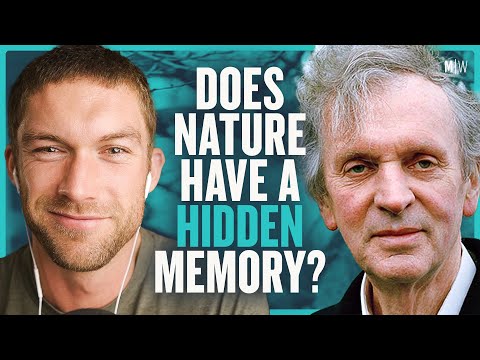
Does Nature Have A Hidden Memory? - Rupert Sheldrake | Modern Wisdom Podcast 379
Rupert Sheldrake (guest), Chris Williamson (host), Narrator
In this episode of Modern Wisdom, featuring Rupert Sheldrake and Chris Williamson, Does Nature Have A Hidden Memory? - Rupert Sheldrake | Modern Wisdom Podcast 379 explores rupert Sheldrake Challenges Scientific Dogma With Nature’s Hidden Memory Theory Rupert Sheldrake explains his hypothesis of morphic resonance—the idea that nature has a kind of memory and that so‑called laws of nature behave more like evolving habits than fixed rules.
Rupert Sheldrake Challenges Scientific Dogma With Nature’s Hidden Memory Theory
Rupert Sheldrake explains his hypothesis of morphic resonance—the idea that nature has a kind of memory and that so‑called laws of nature behave more like evolving habits than fixed rules.
He discusses experimental and anecdotal evidence from animals, humans, crystals, and learning behaviors (e.g., rats, blue tits, dogs, crossword puzzles, and telepathy studies) that he believes support this view.
Sheldrake contrasts his approach with mainstream materialist science, arguing that many scientific assumptions (eternal laws, brain‑stored memory, purely genetic inheritance) are dogmas rather than proven facts.
The conversation extends into telepathy, family trauma and constellation work, psychedelics, near‑death experiences, and spiritual practices as domains where morphic fields and morphic resonance might operate.
Key Takeaways
Morphic resonance proposes that nature learns and stabilizes patterns over time.
Instead of fixed, eternal laws, Sheldrake suggests that repeated forms and behaviors (crystal shapes, animal instincts, learned tasks) become easier to manifest because current systems resonate with similar past systems.
Get the full analysis with uListen AI
Certain animal behaviors may indicate nonlocal information transfer.
Cases like dogs anticipating owners’ returns, wolves coordinating at a distance, and flock or swarm behavior are framed as evidence for group fields or telepathic bonds that extend beyond the limits of sensory cues.
Get the full analysis with uListen AI
Human telepathy can be experimentally probed rather than dismissed.
Sheldrake describes controlled studies on “telephone telepathy” and breastfeeding mothers’ anticipatory milk let‑down, reporting hit rates far above chance and arguing that skeptics rely on armchair arguments instead of data.
Get the full analysis with uListen AI
Much of what’s called ‘genetic’ inheritance may not be explained by genes.
He highlights the ‘missing heritability’ problem: traits like height or schizophrenia show high parent‑child heritability, yet genome‑wide studies explain only a small fraction, suggesting other mechanisms like epigenetics and morphic resonance.
Get the full analysis with uListen AI
Family systems may transmit behavioral trauma through non-genetic fields.
Systemic family constellation therapy appears to reveal repeating patterns (exclusion, suicide, shame) across generations; Sheldrake suggests these may be mediated by family morphic fields rather than only by DNA or individual psychology.
Get the full analysis with uListen AI
Memories may be accessed rather than stored in the brain.
Arguing that decades of research have failed to locate discrete memory traces, Sheldrake proposes that the brain is more like a receiver tuning into its own past (via morphic resonance) instead of a device that literally stores all experiences.
Get the full analysis with uListen AI
Psychedelic and near‑death experiences might open access to collective fields.
He suggests that psychedelics disrupt normal brain filtering, allowing connection to collective experiential fields (e. ...
Get the full analysis with uListen AI
Notable Quotes
“I suggest that the so‑called laws of nature evolve along with nature.”
— Rupert Sheldrake
“Most scientists believe in eternal laws not because they’ve thought about them, but because they haven’t.”
— Rupert Sheldrake
“The brain is more like a TV receiver than a video recorder.”
— Rupert Sheldrake
“Is science a belief system, or is it an open‑minded method of inquiry?”
— Rupert Sheldrake
“Modern physics explains the visible in terms of the invisible, yet people say my ideas are unscientific because they’re not simple and mechanical.”
— Rupert Sheldrake
Questions Answered in This Episode
What specific experimental designs or replications would most convincingly test or falsify morphic resonance for mainstream scientists?
Rupert Sheldrake explains his hypothesis of morphic resonance—the idea that nature has a kind of memory and that so‑called laws of nature behave more like evolving habits than fixed rules.
Get the full analysis with uListen AI
How can we distinguish morphic resonance or telepathy from more conventional explanations like subtle sensory cues, bias, or statistical artifacts?
He discusses experimental and anecdotal evidence from animals, humans, crystals, and learning behaviors (e. ...
Get the full analysis with uListen AI
If memories are accessed nonlocally rather than stored in the brain, what predictions does this make for conditions like dementia, brain injury, or enhanced memory training?
Sheldrake contrasts his approach with mainstream materialist science, arguing that many scientific assumptions (eternal laws, brain‑stored memory, purely genetic inheritance) are dogmas rather than proven facts.
Get the full analysis with uListen AI
How might morphic fields and family constellation work integrate with, or challenge, existing psychological and psychiatric models of trauma and treatment?
The conversation extends into telepathy, family trauma and constellation work, psychedelics, near‑death experiences, and spiritual practices as domains where morphic fields and morphic resonance might operate.
Get the full analysis with uListen AI
What ethical and philosophical implications arise if human consciousness and learning are deeply interconnected through collective fields rather than being strictly individual and brain‑bound?
Get the full analysis with uListen AI
Transcript Preview
So I started my own investigations with the animals we know best, dogs and cats. And I started asking people if they've ever noticed their animals pick up their intentions. And lots and lots of people said yes. And the most testable of these was people saying that their dog knew when they were coming home. The dog would go and wait at a door or a window, and the people at home would know when that person was coming back. I did a survey and found about 50% of dogs do this. So we're not talking something very, very unusual. I'm quite sure a lot of people listening to us now will have dogs that do this. (wind blows)
Rupert Sheldrake, welcome to the show.
Good to be with you.
How do you describe what you do for work?
I'm a biologist, and I do scientific research. I write about it in books and in papers in peer-reviewed journals. I do experiments. I make observations. Um, I go to scientific meetings. So that's probably my main day job.
It's diverged a little bit from some of the more typical areas of study in those fields though.
Yes. I've, um, you know, I, I investigate things which most scientists don't, either because they want to stay within the fairly narrow confines of institutional orthodoxy, or, um, because they, these are new areas of research for which it's hard to get funding. And I like exploring areas where there's been very little exploration before. So that, that, that's my particular, um, thing. I mean, for many scientists, they prefer working in crowded areas of science where there's lots of other people doing similar things, where it's easy to get publications and grants and so on. Um, but I, I explore lesser-known areas of the natural and the psychological worlds.
Morphic resonance, which is one area of research in particular that you've come up with, how many other people are working within that field?
Well, in terms of actual experimental research, I think approximately zero. Um, um, the, uh, there are a lot of people who are interested in the idea. The idea is that there's a kind of memory in nature and that the so-called laws of nature are more like habits. Um, but when it comes to actually testing it, there have been quite a number of experiments over the years which are summarized in the new edition of my book, A New Science of Life. Um, but right now, um, there are two or three people who are planning some experiments in biology labs and, um, with animal behavior, but no one's actually doing them as we speak. However, there will be some happening quite soon, I hope.
What do you mean by memory and habits?
Well, the usual view of nature is that it's governed by eternal laws, uh, that at the moment of the Big Bang, all the laws of nature were supposed to be fixed, like a kind of Napoleonic, uh, code, a cosmic Napoleonic code. Um, that's the, the normal assumption in science. And they've assumed to be the same everywhere ever since. Uh, I suggest that the so-called laws of nature, um, evolve along with nature. They weren't all there at the beginning. I mean, after all, it's only an assumption. No one was around at the begin- Big Bang, uh, takering, taking scientific measurements. And if they had, by a time machine, managed to get to the Big Bang, they would have a- evaporated instantly. You know, billions of degrees centigrade. Um, so it's just an assumption. Um, and, uh, in fact, when you think about it, the idea of laws of nature is very metaphorical. It's based on human laws, and only humans have laws. And in fact, only civilized humans have laws. Tribes have customs. So what I'm suggesting is a better metaphor, is habits. And if nature has habits, then nature has to have a memory. Um, and so what I'm suggesting is that, uh, nature's full of habits. Crystals crystallize the way they do because they've crystallized that way before. Um, and when a new crystal appears, when chemists make a new compound and it crystallizes for the first time, there won't be a habit because it hasn't happened before. You may have to wait years for a crystal to form. But once it's formed in one place, it gets easier everywhere else. Likewise, if you train rats to learn a new trick in Newcastle, then rats all over the world should be able to learn the trick quicker just because they've learned it here in England first. Uh, and the more that learn it, the easier it should get. And the influence of morphic resonance is an influence of similar things upon subsequent similar things across time and space from the past to the present. So that's roughly what I'm trying to say in this hypothesis. And it leads to the idea that every species has a collective memory, uh, on which individuals draw and to which they contribute. And also that humans, of course, have a collective memory, which is very similar to the psychologist Jung, Jung's idea of the collective unconscious.
Install uListen to search the full transcript and get AI-powered insights
Get Full TranscriptGet more from every podcast
AI summaries, searchable transcripts, and fact-checking. Free forever.
Add to Chrome