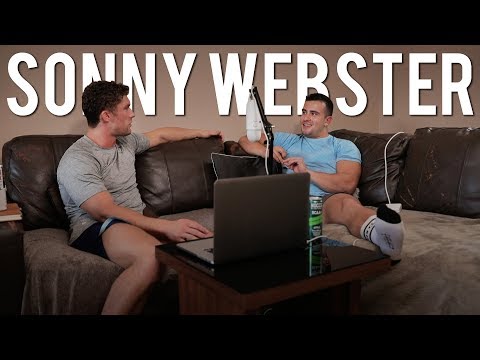
SONNY WEBSTER | From Zero To Rio: A Life's Journey To The Olympic Games
Chris Williamson (host), Sonny Webster (guest), Narrator, Narrator, Narrator
In this episode of Modern Wisdom, featuring Chris Williamson and Sonny Webster, SONNY WEBSTER | From Zero To Rio: A Life's Journey To The Olympic Games explores olympian Sonny Webster Reveals Grit, Sacrifice, and Reinvention Beyond Rio Sonny Webster, a British Olympic weightlifter, recounts his journey from a sporty kid to competing at the Rio 2016 Olympic Games, highlighting key moments of luck, resilience, and ruthless single‑mindedness.
Olympian Sonny Webster Reveals Grit, Sacrifice, and Reinvention Beyond Rio
Sonny Webster, a British Olympic weightlifter, recounts his journey from a sporty kid to competing at the Rio 2016 Olympic Games, highlighting key moments of luck, resilience, and ruthless single‑mindedness.
He describes discovering weightlifting by accident at school, early success followed by a humbling international result, and a serious spinal injury that forced him to rebuild from a 5–15 kg bar and perfect his technique.
Webster explains the financial and emotional realities of chasing Olympic qualification, including moving away from home at 16, hustling sponsors, narrowly missing London 2012, and ultimately hitting a lifetime performance peak to qualify for Rio.
Post‑Olympics, he discusses the psychological comedown, shifting into seminars and coaching, dabbling in CrossFit, and rethinking what long‑term success, happiness, and contribution in sport really look like.
Key Takeaways
Natural talent helps, but deliberate practice and technical depth determine long‑term success.
Webster could copy complex movements just by watching, yet he emphasizes that early technical work, especially after his back injury, and years of refinement were critical to making his lifting both heavy and consistent.
Get the full analysis with uListen AI
Getting humbled early broadens your ambition beyond being “best in your pond.”
After dominating domestically, Sonny finished 22nd of 23 at his first European meet; that shock forced him to recalibrate his standards from national dominance to true world‑class performance.
Get the full analysis with uListen AI
Injury can be a forced opportunity to rebuild fundamentals better than before.
His severe spinal issues at 14 initially threatened his career, but a year of snatching only 15 kg and fixing technical flaws turned into the foundation for his later technical consistency under big weights.
Get the full analysis with uListen AI
If you don’t ask, you don’t get—persistence unlocks unlikely support.
Sonny approached a stranger in a rough gym car park with a Porsche, bluntly asked for sponsorship, and—after many prior rejections—secured the backing that allowed him to keep training for the Olympics.
Get the full analysis with uListen AI
Psychological routines and focusing on controllables translate training performance to competition.
He developed a precise pre‑lift process (visualization, consistent setup, countdown) and learned to fixate on execution rather than outcome, which reduced negative thoughts like “this is heavy” and improved meet performance.
Get the full analysis with uListen AI
Peak moments come with a post‑high crash; you must plan for “after.”
Despite Rio being the best day of his life, Sonny describes a stark emotional low afterward—no big cheques or fanfare waiting at home—illustrating why athletes need a plan and identity beyond one event.
Get the full analysis with uListen AI
Long‑term sacrifice must align with evolving values, not just childhood goals.
Having lived monastically for years to reach Rio, he’s now prioritizing travel, coaching, and new challenges like CrossFit, and is undecided about sacrificing everything again for a Commonwealth gold or Games appearance.
Get the full analysis with uListen AI
Notable Quotes
“I very quickly realized that it wasn’t about being the best kid in your country or the best at your age. You had to look so much further past being the best in your pond.”
— Sonny Webster
“You have two choices really. If you carry on lifting, you’re going to be in a wheelchair, or you give it a go rehabbing it and see what happens.”
— Doctor at Bath University (as recounted by Sonny Webster)
“If you don’t ask, you don’t get. That wasn’t the first time I’d asked someone for sponsorship—that was probably about the 150th time.”
— Sonny Webster
“When you prepare for something that well, it didn’t matter how good the outcome was that day. You could have stuck me in a pink tutu and I would have still lifted the same.”
— Sonny Webster
“I haven’t trained my whole life to come here and sandbag myself. I’d rather have tried my hardest and got one lift than look back and think I could’ve lifted more.”
— Sonny Webster
Questions Answered in This Episode
How should young athletes balance ruthless ambition with maintaining a healthy, sustainable life outside of sport?
Sonny Webster, a British Olympic weightlifter, recounts his journey from a sporty kid to competing at the Rio 2016 Olympic Games, highlighting key moments of luck, resilience, and ruthless single‑mindedness.
Get the full analysis with uListen AI
To what extent should governing bodies and sponsors better support athletes through the post‑Olympic comedown and career transitions?
He describes discovering weightlifting by accident at school, early success followed by a humbling international result, and a serious spinal injury that forced him to rebuild from a 5–15 kg bar and perfect his technique.
Get the full analysis with uListen AI
How can non‑elite lifters apply Sonny’s injury‑driven approach—using very light loads to rebuild technique—to their own training without needing a crisis first?
Webster explains the financial and emotional realities of chasing Olympic qualification, including moving away from home at 16, hustling sponsors, narrowly missing London 2012, and ultimately hitting a lifetime performance peak to qualify for Rio.
Get the full analysis with uListen AI
What is the right moment for an athlete to pivot from chasing peak performance to focusing on coaching, business, or new disciplines like CrossFit?
Post‑Olympics, he discusses the psychological comedown, shifting into seminars and coaching, dabbling in CrossFit, and rethinking what long‑term success, happiness, and contribution in sport really look like.
Get the full analysis with uListen AI
Does modern sports media place unfair expectations on athletes to be charismatic public figures as well as high performers, and how does that affect their mental health?
Get the full analysis with uListen AI
Transcript Preview
(wind blowing) Look, he's learning already. He's learning to not put the can down too hard on the table. This is a man who's watched some podcasts.
(laughs)
Anyway, bang! Everyone who's listening, welcome back. Sonny Webster's joined me today. How are you?
Very well, thank you.
What's happening? Long drive today.
Long drive, five hours in the car, decent training session, considering.
Very decent training session, and worth it, obviously, to see me.
Of course. I'm looking forward to-
(laughs)
... the later part of tonight's antics.
Yes. Of course. Um, those of you who know what I, uh, how I perceive drinking, I'm gonna suspend my drinking habits, or my lack of drinking habits for one evening. I can talk about-
Bear in mind, when I met you-
I was still in-
... you were almost six months sober.
... a six-month sobriety stint. Yeah, exactly.
And we still went out, and you were there, like, itching. (laughs)
Itching. It was difficult. But that was at the end of it. That was, like, uh, like, two weeks to go.
Mm-hmm, like, two weeks ago. Yeah, fair.
It was not easy. But yeah, that was, um, that was still a really fun night at Bodhi, at BodyPower in Birmingham.
So good, 'cause we literally met, like, a few hours before that as well, and we just, like, click.
Yeah. It's cool, man. It's awesome.
Lovely. Mm-hmm.
So, anyone who's watching on the brand new Modern Wisdom YouTube channel, subscribe, subscribe, subscribe. If you don't know what Sonny does, Video Man Dean will make it appear here, and here, and also here.
(laughs)
So, Sonny is, uh, an Olympic weightlifter, represented Great Britain at Rio.
Yep, 2016.
Um, and now you are traveling the world doing weightlifting seminars and coaching people, doing a lot of PT work.
Having a lot of fun.
Having an awful lot of fun, and being a big-dick Instagram swinger, and-
(laughs)
... all the rest of the stuff, man. So, for the people who don't know who you are, and for the people who do, can you give us a background? How did you start in weightlifting, and what, where does it come, where do you begin?
Yeah, well, I guess I have to take you right back to me even as a kid, and go back and talk about, I guess, um, what got me into sport. Like, I mean, I've always been a sporty kid. You know, you got those kids that are the sporty kids, and then you got the kids that are more, like, artistic, et cetera. I was always a sporty kid. Um, my dad was always into golf. So, like, naturally, before I could pretty much walk, my dad had golf, uh, covered my hands. And I even remember, like, he's still got videos, like, on, you know, the old video recorders, like, the tapes-
Install uListen to search the full transcript and get AI-powered insights
Get Full TranscriptGet more from every podcast
AI summaries, searchable transcripts, and fact-checking. Free forever.
Add to Chrome