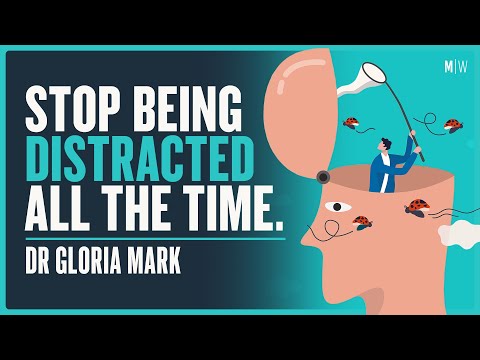
How To Regain Control Of Your Attention - Dr Gloria Mark
Dr Gloria Mark (guest), Chris Williamson (host)
In this episode of Modern Wisdom, featuring Dr Gloria Mark and Chris Williamson, How To Regain Control Of Your Attention - Dr Gloria Mark explores why Your Attention Is Collapsing And How To Take It Back Dr. Gloria Mark explains how our average on‑screen attention has dropped from about 2.5 minutes in 2004 to under 50 seconds today, with half of all screen visits lasting under 40 seconds. Distraction is not just about notifications and algorithms; roughly half of interruptions are self-generated, reflecting a deep interaction between human nature and digital environments. She outlines a nuanced model of attention, the high cognitive and emotional costs of multitasking, and how sleep, breaks, personality, and social drives shape our focus. The conversation closes with practical strategies for designing focused days, taking effective breaks, building meta-awareness, and pushing for collective changes like right-to-disconnect norms.
Why Your Attention Is Collapsing And How To Take It Back
Dr. Gloria Mark explains how our average on‑screen attention has dropped from about 2.5 minutes in 2004 to under 50 seconds today, with half of all screen visits lasting under 40 seconds. Distraction is not just about notifications and algorithms; roughly half of interruptions are self-generated, reflecting a deep interaction between human nature and digital environments. She outlines a nuanced model of attention, the high cognitive and emotional costs of multitasking, and how sleep, breaks, personality, and social drives shape our focus. The conversation closes with practical strategies for designing focused days, taking effective breaks, building meta-awareness, and pushing for collective changes like right-to-disconnect norms.
Key Takeaways
Your attention on screens is now measured in seconds, not minutes.
Dr. ...
Get the full analysis with uListen AI
Distraction is as much internal as external.
About half of interruptions are self-generated, not just driven by notifications or algorithms, so blaming technology alone misses the underlying human tendencies and habits that need to be addressed.
Get the full analysis with uListen AI
Multitasking is a myth; rapid task-switching is costly and stressful.
We cannot parallel-process two effortful tasks; instead we switch, which increases errors, lengthens completion time via switch costs, and reliably raises stress markers like blood pressure and heart rate.
Get the full analysis with uListen AI
Not all attention states are equal; ‘rote engagement’ often feels best.
Mark identifies four states—focus, rote engagement, boredom, and frustration—and finds people report feeling happiest during easy but engaging activities (rote attention), which is why simple games and social media feel so soothing.
Get the full analysis with uListen AI
Sleep is one of the most powerful levers for better attention.
Accumulated sleep debt shortens attention spans and pushes people toward lightweight, low-challenge activities (e. ...
Get the full analysis with uListen AI
Effective breaks are active, bounded, and often offline.
Short, intentional breaks—especially 20 minutes in nature or light ‘rote’ activities—restore mental resources and creativity, whereas social media breaks easily become unbounded rabbit holes that erode the workday.
Get the full analysis with uListen AI
Meta-awareness and forethought give you back agency over your attention.
Regularly probing yourself (“Why am I going here now? ...
Get the full analysis with uListen AI
Notable Quotes
“Half of all of our measurements show people's attention to be less than 40 seconds.”
— Dr. Gloria Mark
“It's not humanly possible to do two or more things at the same time that require mental effort.”
— Dr. Gloria Mark
“Every time we switch our attention, think of it as you have a tank of resources, and that tank leaks.”
— Dr. Gloria Mark
“I do believe that people can develop agency over their attention.”
— Dr. Gloria Mark
“We are individuals, hairless apes, trying to battle back against the most powerful algorithms in history.”
— Chris Williamson
Questions Answered in This Episode
How can an individual practically build the kind of meta-awareness you describe so that probing their own behavior becomes second nature rather than an extra cognitive burden?
Dr. ...
Get the full analysis with uListen AI
Given that people feel happiest during ‘rote’ activities, how can we design work and leisure so that we don’t sacrifice long-term meaning and achievement for short-term ease?
Get the full analysis with uListen AI
What realistic organizational policies (beyond email-free days) have you seen that genuinely reduce multitasking and digital overload without harming productivity?
Get the full analysis with uListen AI
How should someone high in neuroticism or conscientiousness adapt your strategies differently, given their particular vulnerabilities around stress and constant checking?
Get the full analysis with uListen AI
If algorithms both predict and shape our preferences, what regulatory or design changes would most effectively limit their ability to push users toward more extreme, more ‘predictable’ behavior?
Get the full analysis with uListen AI
Transcript Preview
We find that half of all of our measurements show people's attention to be less than 40 seconds. Yes, of course, sometimes we spend longer, but half the time that we're on our devices, our attention spans are 40 seconds or less in duration.
I would guess that managing my attention and the associated trials and tribulations that I go through trying to achieve that is probably the most common challenge that I face on a daily basis, and I also think that it's one that a lot of other people will resonate with as well. They don't need to be a podcaster, but just attention is something that feels to me to be slipping through my fingers on a second by second basis.
Yeah. And, and that's what our research shows, and I've been studying this for a very long time, for about two decades, and, uh, yeah, you, you are not alone. There are many, many people who share your concern.
Given that you've been studying it for quite a while, have you looked at any longitudinal stuff to do with this, if we had degradation over time? Is it worse now than it was 20 years ago?
Yes. As a matter of fact, I, I have. So I, I first started studying this back in 2004, and what led me to study this was I noticed my own attention was becoming problematic, and I found myself switching from project to project and, you know, app to app and web page to web page, and I wondered if it was just me, and I started talking to other people. Other people started mentioning similar kinds of things. So, you know, being a researcher and a psychologist, I thought, "I can study this empirically and find out if it's just me." Uh, so at the time, back in 2004, we used pretty primitive technology to measure this. We, we used stopwatches. So we would click the stopwatch every time a person shifted screens. Um, and it ... You know, it's very accurate, but it was very laborious, and, uh, you know, it took a long time, but we were able to get objective results, and back then, we found attention was about two and a half minutes on any screen before people switched to another screen. At the time, it astounded me, but I kept measuring this, and then computer logging techniques were invented, which made the process so much easier. They, again, could get very objective measures of how long people are on any computer or phone screen. Around 2011, we found attention spans to decline to about 75 seconds-
What was that, the first one was two and a half minutes?
Two and a half minutes, down to about a minute and 15 seconds. Uh, and this is on, on average in, in the last five, six years, we find, uh, it's about ... It's reached a steady state of about 47 seconds on any screen before switching. Um, i- i- this has also been replicated by others, who found results within a few seconds. So it, it seems to be that our attention spans have diminished, and, and let me present another way to look at this, which I think is, um, you know, makes, makes you see this perhaps more clearly. If you look at the median of our measurements, that means the midpoint, the midpoint, we find that half of all of our measurements show people's attention to be less than 40 seconds. So, you know, yes, of course, sometimes we spend longer, but half the time that we're on our devices, our attention spans are 40 seconds or l- less in duration.
Install uListen to search the full transcript and get AI-powered insights
Get Full TranscriptGet more from every podcast
AI summaries, searchable transcripts, and fact-checking. Free forever.
Add to Chrome