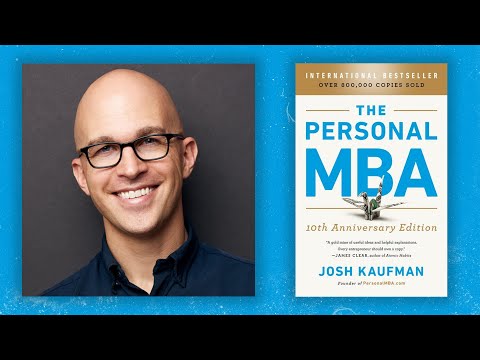
The Key Principles Of Running Any Business | Josh Kaufman | Modern Wisdom Podcast 215
Josh Kaufman (guest), Chris Williamson (host)
In this episode of Modern Wisdom, featuring Josh Kaufman and Chris Williamson, The Key Principles Of Running Any Business | Josh Kaufman | Modern Wisdom Podcast 215 explores mastering Business Basics: Five Parts, Simple Principles, Real-World Execution Josh Kaufman joins Chris Williamson to break down business into five universal components: value creation, marketing, sales, value delivery, and finance, arguing that nearly all business success stems from understanding and executing these fundamentals. He contrasts this practical, integrated view with traditional MBA programs, which he sees as siloed, theory-heavy, and often misaligned with entrepreneurs’ real needs. The conversation explores why people overcomplicate business, the power of simplicity and experimentation, and how pricing, status, and competition actually work in the real world. They finish by connecting business performance to personal development, courage in decision-making, and defining what a ‘successful life’ in business really means.
Mastering Business Basics: Five Parts, Simple Principles, Real-World Execution
Josh Kaufman joins Chris Williamson to break down business into five universal components: value creation, marketing, sales, value delivery, and finance, arguing that nearly all business success stems from understanding and executing these fundamentals. He contrasts this practical, integrated view with traditional MBA programs, which he sees as siloed, theory-heavy, and often misaligned with entrepreneurs’ real needs. The conversation explores why people overcomplicate business, the power of simplicity and experimentation, and how pricing, status, and competition actually work in the real world. They finish by connecting business performance to personal development, courage in decision-making, and defining what a ‘successful life’ in business really means.
Key Takeaways
Every viable business rests on five core functions.
If you aren’t creating value, attracting attention (marketing), converting interest into purchases (sales), delivering what you promised, and maintaining sound finances, you don’t have a business—you have a hobby, a charity, or a failing project.
Get the full analysis with uListen AI
You don’t need an MBA to understand business fundamentals.
Kaufman argues that most people can learn the essential principles of business more cheaply and effectively through focused self-study and practical experience than by taking on the time and debt of a formal MBA, which often lacks a unifying theory of what business is.
Get the full analysis with uListen AI
Simplicity in thinking and language is a competitive advantage.
Experts who truly understand business can explain concepts like branding as ‘reputation’ and avoid jargon; overcomplicating things usually signals insecurity or a desire to appear sophisticated, not actual insight.
Get the full analysis with uListen AI
Systematic experimentation beats static strategy.
Using the exploration–exploitation model, Kaufman notes that businesses should continually test new ideas (explore) while doubling down on proven winners (exploit), instead of betting everything on untested assumptions or getting stuck in local optima.
Get the full analysis with uListen AI
Most entrepreneurs underprice their offerings out of fear.
Both host and guest describe an irrational terror of raising prices; Kaufman’s rule of thumb is to triple your ‘obvious’ starting price and test it, since customers often interpret higher prices as higher quality or status—sometimes increasing demand.
Get the full analysis with uListen AI
Competition is evidence of a real market, not a threat to avoid.
Seeing others successfully sell similar products proves that customers are willing to pay; you can also learn from competitors’ successes and failures instead of paying the full ‘tuition’ yourself.
Get the full analysis with uListen AI
Personal values and self-knowledge should guide business design.
Kaufman emphasizes that ‘success’ isn’t just revenue or headcount; it’s building a business that supports the life you want, with work, people, and stress levels that fit you—something many never question due to upbringing, fear, or status games.
Get the full analysis with uListen AI
Notable Quotes
“Every business has five parts, and only five parts.”
— Josh Kaufman
“If one of them is missing, it's not a business. It's a hobby or a nonprofit or a flop or a scam or a bust.”
— Josh Kaufman
“It is the mark of a charlatan to explain a simple thing in a complex way. It is the mark of a genius to explain a complex thing in a simple way.”
— Chris Williamson
“Make other people tell you no. Don't assume the rejection before the rejection actually happens.”
— Josh Kaufman
“The more I reflect on the biological predispositions that arise, the less I am controlled by them.”
— Daniel Schmactenberger, quoted by Chris Williamson
Questions Answered in This Episode
How could I map my current business (or idea) explicitly onto the five parts—value creation, marketing, sales, value delivery, and finance—and where is my biggest bottleneck?
Josh Kaufman joins Chris Williamson to break down business into five universal components: value creation, marketing, sales, value delivery, and finance, arguing that nearly all business success stems from understanding and executing these fundamentals. ...
Get the full analysis with uListen AI
If I ignored my formal education for a moment, what have I actually learned about business only through direct experience?
Get the full analysis with uListen AI
Where am I overcomplicating things—using jargon, chasing branding details, or holding too many meetings—instead of focusing on what truly drives results?
Get the full analysis with uListen AI
What small, low-risk experiments could I run this month to ‘explore’ new marketing channels, offers, or pricing, while still exploiting what already works?
Get the full analysis with uListen AI
If I designed my business purely around the life I want to live in 5–10 years, what would I stop doing, start doing, or do very differently starting now?
Get the full analysis with uListen AI
Transcript Preview
Every business has five parts, and only five parts. Every business creates something of value, they attract the attention of people who might be interested in that thing, which is marketing, they sell that offer to people who want to buy it, which is sales, they deliver what they've promised to their paying customers, which is value delivery, and then there's finance. You look at all the money flowing out, you look at all the money flowing in, and you answer two very important questions: A, is more money flowing in than flowing out? If not, you have a problem. And B, is it enough? Is it enough to make all of this time and effort and stress and frustration worth it?
(wind blowing) I, um, this, I need to put a disclaimer out before we get started. Usually, the camera is not right up to my face. If you are watching on YouTube, you will be able to see this. This is the first horizontal cast that I've done since, uh, my Achilles repair recovery, um, so my foot is currently all the way over there in the air, uh, and, and I'm back here. But we're making it work. We're anti-fragile, and, uh, today we are celebrating the 10-year anniversary of The Personal MBA. Man, how does that feel?
It feels great. It feels surreal. Like, uh, I remember writing the first draft of the book, and it doesn't feel like 10 years ago. Uh, but it's, it's been really gratifying to see, uh, how much people all over the world have enjoyed it and found it useful. And, uh, it's always an interesting experience going back and editing things that you wrote 10 years ago. Um, so, so the past, uh, year and a half, two years that I've been working on this project has, has been very interesting from, from a personal time capsule, uh, standpoint. Uh, my, my, my writing has changed. My, my thoughts, uh, ab- about s- uh, a lot of things have changed. So it was, it was great to be able to, to revisit this particular work and, and really update it for 2020 and beyond.
Have you, when you go back through things, have you found that much about your thinking has, has changed? Have you got, are you sort of curling your toes at a couple of little bits here and there, and you think, "Oh my God, why did Josh 10 years ago think that?"
(laughs) The, the thinking overall, I'm, I'm happy to say, is still really solid. Uh, I used a lot of adverbs 10 years ago.
(laughs)
And I, I don't know why. I will have to go back into my Word document and figure out how many adverbs I deleted, and it is, it is in the, the probably mid-thousands.
Wow.
Um, so, so just like, you know, I- I think as a beginning writer... This is something that I think beginning writers do a lot. You want to emphasize the things that you're emphasizing in your head as you write, and the way to add that emphasis is, you know, adverbs or italics or, you know, exclamation points, getting really excited. And, and so for me, it was like being able to take a step back and say, "Okay, you can get, uh, get this point across far more effectively by being clear and simple and concise in your language, and let the construction of the sentences do the work instead of trying to underline and bullet point everything in the manuscript." So...
Install uListen to search the full transcript and get AI-powered insights
Get Full TranscriptGet more from every podcast
AI summaries, searchable transcripts, and fact-checking. Free forever.
Add to Chrome