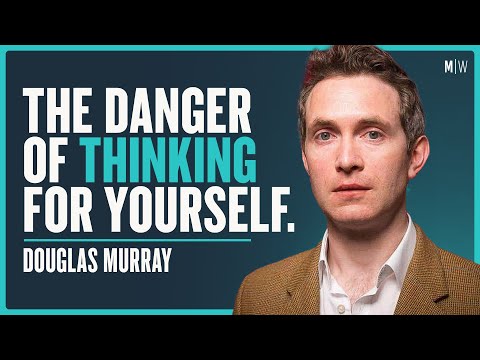
DOUGLAS MURRAY | The Price Of Thinking Out Loud | Modern Wisdom Podcast 109
Douglas Murray (guest), Chris Williamson (host), Narrator, Narrator
In this episode of Modern Wisdom, featuring Douglas Murray and Chris Williamson, DOUGLAS MURRAY | The Price Of Thinking Out Loud | Modern Wisdom Podcast 109 explores douglas Murray Dissects Identity Politics, Free Speech, And Modern Dogmas Douglas Murray discusses his book *The Madness of Crowds* with Chris Williamson, focusing on how contemporary debates around women, gay rights, race, and trans issues have become volatile and dogmatic. He argues that the social cost of thinking out loud has risen so high that many people self-censor, leaving only a few with the freedom and responsibility to challenge prevailing orthodoxies. Murray links today’s identity obsessions to the collapse of grand narratives like religion and traditional political ideologies, suggesting that social justice and intersectionality now act as substitute belief systems. He calls for a return to individual character, open disagreement, and more ambitious life goals than merely being “harmless” within rigid identity hierarchies.
Douglas Murray Dissects Identity Politics, Free Speech, And Modern Dogmas
Douglas Murray discusses his book *The Madness of Crowds* with Chris Williamson, focusing on how contemporary debates around women, gay rights, race, and trans issues have become volatile and dogmatic. He argues that the social cost of thinking out loud has risen so high that many people self-censor, leaving only a few with the freedom and responsibility to challenge prevailing orthodoxies. Murray links today’s identity obsessions to the collapse of grand narratives like religion and traditional political ideologies, suggesting that social justice and intersectionality now act as substitute belief systems. He calls for a return to individual character, open disagreement, and more ambitious life goals than merely being “harmless” within rigid identity hierarchies.
Key Takeaways
The social penalty for public thinking has become career-ending, discouraging honest debate.
Murray argues that many people no longer feel safe to explore ideas in public because a single misstep can trigger reputational destruction, leaving only those without vulnerable institutional ties to challenge consensus.
Get the full analysis with uListen AI
Identity politics has shifted from seeking equality to enforcing hierarchies of victimhood.
He contends that being part of a particular group now often confers presumed moral authority, leading to the belief that some voices deserve amplified status purely because of identity rather than argument or competence.
Get the full analysis with uListen AI
Society is over-correcting past injustices and struggling to know when and how to stop.
From disproportionate media coverage of trivial 'representation' stories to punitive attitudes toward white men, Murray says many institutions are overcompensating for historical wrongs without any clear criteria for returning to genuine equality.
Get the full analysis with uListen AI
The LGBT acronym conceals deep internal contradictions, especially around trans issues.
He notes that gay, lesbian, bisexual, and trans interests often clash—for example in child gender dysphoria and in how trans identities can undermine hard-won feminist and gay rights—making the narrative of a unified 'community' misleading.
Get the full analysis with uListen AI
Modern sexual norms impose impossible expectations on male–female interaction.
Using examples like Nicki Minaj’s ‘Anaconda,’ Murray says men are told women can be maximally sexual but must never be 'sexualized,' creating confused standards that push some young men to avoid relationships altogether.
Get the full analysis with uListen AI
The collapse of religion and grand ideologies has left a meaning vacuum filled by social justice.
Murray suggests that intersectional activism now functions like a replacement religion—offering purpose, moral certainty, and community—but rests on unstable ideas and can turn into a rigid, punitive dogma.
Get the full analysis with uListen AI
A healthier path forward emphasizes individual character, intellectual humility, and ambition.
He urges people to tolerate dissenting views, resist zero-sum identity thinking, and aspire to do extraordinary, constructive things with their lives rather than merely aiming to be 'harmless' and perfectly compliant.
Get the full analysis with uListen AI
Notable Quotes
“Just because somebody is of a particular group does not mean they're right.”
— Douglas Murray
“We might be among the first people in human history to have absolutely no explanation for what we're doing here.”
— Douglas Murray
“The moment when you're really integrated is when you realize you just have to put up with the same shit the rest of us have to put up with.”
— Douglas Murray (quoting an Irish friend)
“Women can be as sexual as they like, but they cannot be sexualized, and heaven help any man who responds.”
— Douglas Murray (paraphrased by Chris Williamson from the book)
“The aim of this generation is not just to be harmless; it's to be extraordinary, to be great.”
— Douglas Murray
Questions Answered in This Episode
How can societies practically determine when an 'over-correction' for past injustice has gone too far and how to recalibrate toward genuine equality?
Douglas Murray discusses his book *The Madness of Crowds* with Chris Williamson, focusing on how contemporary debates around women, gay rights, race, and trans issues have become volatile and dogmatic. ...
Get the full analysis with uListen AI
What concrete norms or institutions could protect free inquiry while still addressing legitimate harms such as harassment or discrimination?
Get the full analysis with uListen AI
Given the internal tensions within LGBT politics, what would a more honest, sustainable framework for discussing sexuality and gender look like?
Get the full analysis with uListen AI
How should young men and women navigate dating, flirting, and consent in a culture that sends conflicting messages about sex and power?
Get the full analysis with uListen AI
If social justice activism is filling the void left by religion, what alternative sources of shared meaning and purpose could we build instead?
Get the full analysis with uListen AI
Transcript Preview
First of all, just because somebody is of a particular group does not mean they're right.
Piers Morgan gets brought up a few times throughout the book. Is it coincidental or does he just happen to embroil himself in these situations a lot?
The references to him are not that obliging, and he's definitely one of those characters who throws himself into things, in his case, with just, you know, glee. The moment when you're integrated really into a society is not when you get anything special, or anything extra, or anything more. The moment when you're really integrated is when you realize you just have to put up with the same shit the rest of us have to put up with. We- we- we're living at a stage where we might be among the first people in human history to have absolutely no explanation for what we're doing here. I'm now going to be accused of biphobia, among all my other many, many crimes. But anyhow, the ridiculous person who complains on the BBC that they are often ridiculed in public, and that's not nice, but I point out, if you're ridiculous, you will be ridiculed.
I am joined by Douglas Murray, author of The Madness of Crowds, and bestselling author of The Strange Death of Europe. Douglas, welcome to the show.
It's been a great pleasure to join you so far.
(laughs) We've had a couple of, uh, a couple of technical issues, but got through them fine. Um, and now we get onto the real issues. First things first, Madness of Crowds, your new book, four chapters: women, gay, race, and trans. Each one of those is a nuclear warhead ready to go off underneath my foot.
(laughs)
Um, how, how are we going to be able to navigate this conversation, and how also did you navigate this, uh, without getting blown up?
Well, um, I- I don't know. I've survived so far. The book's been (laughs) been out a fortnight, I'm still here.
Yeah.
Um, look, uh, my- my- my view is, is that we- we- we've become, in our societies, really bad at having conversations. Um, we've become very bad at thinking because we can't think out loud, or at least the price of thinking out loud has become potential total career and life destruction. So when people wonder why people don't do it, it's- it's not hard to find the reason. (laughs) Um, I think that for some rea- uh, some reason, in recent years, I noticed that these four issues in particular, there are others, but these four issues in particular were the ones which people just kept on, uh... You know, the moment they nicked the tripwire, they were just detonated. And, uh, I just found that really interesting, also because I think all four issues are unbelievably interesting and, and actually significant. I mean, have significant, uh, um, effects on people's lives and on our societies. So my view is that, uh, um, we've got this strange position in our societies at the moment where the only people who can sort of speak or think out loud are people who don't have any hierarchy above them, that's vulnerable to crowd stampedes and mobs and so on. So those of us who can think aloud, whether we're right or wrong, I don't know, but, uh, sort of have a disproportionate duty to talk and think and write. And so I decided just to take each of the absolute nuclear bomb issues head on and just go jumping on in.
Install uListen to search the full transcript and get AI-powered insights
Get Full TranscriptGet more from every podcast
AI summaries, searchable transcripts, and fact-checking. Free forever.
Add to Chrome