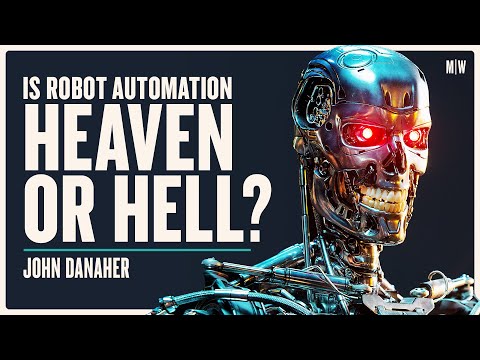
What Happens If Robots Automate The World? - John Danaher | Modern Wisdom Podcast 291
John Danaher (guest), Chris Williamson (host), Narrator
In this episode of Modern Wisdom, featuring John Danaher and Chris Williamson, What Happens If Robots Automate The World? - John Danaher | Modern Wisdom Podcast 291 explores will Post-Work Automation Free Humanity Or Turn Us Into Slugs? Chris Williamson and philosopher John Danaher discuss a future where automation and AI eliminate most human work, asking whether this leads to human flourishing or obsolescence.
Will Post-Work Automation Free Humanity Or Turn Us Into Slugs?
Chris Williamson and philosopher John Danaher discuss a future where automation and AI eliminate most human work, asking whether this leads to human flourishing or obsolescence.
Danaher argues much modern work is unfulfilling and often made worse by technology, so large-scale technological unemployment could be desirable if we redesign meaning, status, and income outside of jobs.
He contrasts two broad futures: a cyborg utopia where humans merge with machines to stay competitive in the ‘cognitive niche,’ and a virtual utopia where we retreat into rich, game-like, possibly simulated worlds of meaning.
Along the way they explore the psychology of work, definitions of a good life, status, Stoicism, virtual reality, transhumanism, and near‑ vs long‑term AI risks and ethics.
Key Takeaways
Most people don’t find work deeply meaningful, so a post-work world is an opportunity as well as a threat.
Gallup data suggest only a minority are actively engaged at work; Danaher argues much labor is monotonous, constrained, and often worsened by tech, implying that if income can be decoupled from jobs, many could be better off.
Get the full analysis with uListen AI
We need to separate the goods of work (community, mastery, status) from the job itself.
Many derive friends, pride, and identity from work largely because they have no alternative; consciously building community, skill, and recognition outside employment prepares us for a world with less traditional work.
Get the full analysis with uListen AI
A meaningful life likely requires both subjective fulfillment and objectively worthwhile activities.
Drawing on Susan Wolf, Danaher suggests meaning comes from being fulfilled by projects that also have real value (the “good, the true, and the beautiful”), not just feeling good about empty pursuits.
Get the full analysis with uListen AI
Automation risks creating a passive, overly comfortable humanity unless we engineer challenge and effort back in.
Using WALL‑E and modern comforts as examples, they argue that when technology removes friction and necessity, people easily default to couch‑bound passivity unless we intentionally design demanding, engaging activities.
Get the full analysis with uListen AI
Two main post-automation paths are cyborg enhancement or virtual retreat, and both are already emerging.
Cyborgization ranges from cochlear implants to brain–computer interfaces, aiming to keep humans competitive; virtual utopia treats life as layered “games” or simulations where we find meaning independent of economic necessity.
Get the full analysis with uListen AI
Our species-wide status as ‘the smartest’ is under threat, challenging human self-understanding.
If superintelligent AI arrives, humans may no longer be cognitively supreme; even without physical extinction, this could cause a deep identity and purpose crisis for civilization.
Get the full analysis with uListen AI
AI ethics debates must link the near term (bias, jobs, politics) with long-term existential risks.
Danaher notes current discourse often splits practical issues (automation, inequality, algorithmic bias) from Bostrom-style superintelligence concerns, but both shape the ‘human project’ and need to be thought about together.
Get the full analysis with uListen AI
Notable Quotes
“Is human obsolescence imminent? That’s the sentence I used to open the book, and it’s a little bit of rhetorical hyperbole.”
— John Danaher
“Most people seem to find work kind of mundane, a little bit monotonous, and not their main source of pride or mastery.”
— John Danaher
“Maybe that’s one of the tragedies of human life: we don’t get to run the experiment again.”
— John Danaher
“We face a dilemma: do we fight back against the machines and reclaim our dominance of the cognitive niche, or do we retreat from it and let the machines look after our needs and do something else?”
— John Danaher
“We are no longer going to be top of the tree. In a best-case scenario, we’re friends with a god we’ve managed to convince to align its goals with ours.”
— Chris Williamson
Questions Answered in This Episode
If income were guaranteed independent of work, how would you redesign your life for meaning, mastery, and community?
Chris Williamson and philosopher John Danaher discuss a future where automation and AI eliminate most human work, asking whether this leads to human flourishing or obsolescence.
Get the full analysis with uListen AI
Which future feels more appealing or plausible to you: enhancing yourself as a cyborg, or living much of life in rich virtual worlds—and why?
Danaher argues much modern work is unfulfilling and often made worse by technology, so large-scale technological unemployment could be desirable if we redesign meaning, status, and income outside of jobs.
Get the full analysis with uListen AI
How much of your current identity and status is tied to your job, and what would be left if that job disappeared?
He contrasts two broad futures: a cyborg utopia where humans merge with machines to stay competitive in the ‘cognitive niche,’ and a virtual utopia where we retreat into rich, game-like, possibly simulated worlds of meaning.
Get the full analysis with uListen AI
Should we actively design technologies and institutions that preserve struggle and challenge, rather than maximizing comfort and convenience?
Along the way they explore the psychology of work, definitions of a good life, status, Stoicism, virtual reality, transhumanism, and near‑ vs long‑term AI risks and ethics.
Get the full analysis with uListen AI
At what point does integration with technology change who we are—is there a clear line between ‘using tools’ and ‘becoming a cyborg’?
Get the full analysis with uListen AI
Transcript Preview
Do we try to fight back against the machines and reclaim our dominance of the cognitive niche, or do we try and retreat from the cognitive niche and, you know, let the, kind of, machines watch over us and look after our economic well-being, our m- needs, our, kind of, needs for abundance and affluence and so forth, and do something else?
(wind blows) Before we get started, there is a very famous Brazilian jiu-jitsu teacher who shares your name. Did you know this?
I, I am all too aware of this fact, yes.
Yeah. So (laughs) I, I posted a big list of upcoming guests (laughs) on my Instagram, and they were like, "Mate, I didn't know that you were interested in Brazilian jiu-jitsu." And I'm thinking, "Does a guy who talks about, like, automation and robots also do Brazilian jiu-jitsu training?" But it turns out that it's just, it's just two different interesting people.
Yeah. Your, um, g- your fans probably got very excited when they thought it was the other John Denner. He's, he's got a much higher profile than me .
Li- little do they know that they actually wanted to learn about robots. So what, what are we going to be talking about today? What's the, what's the topic of our discussion?
Yeah, so we're gonna talk about this, uh, book that I wrote a couple of years ago on automation and utopia, which is kind of a very, you know, abstract, (laughs) philosophical look at the meaning of life in a post-work world. If, if robots take all our jobs away, what are we going to do with our time, and will we be able to find meaning and flourish?
These sorts of questions are very common at the moment, I think. You know, it, it seems like every other week someone is referring to, like, when the robots take our jobs in a news article.
Yeah, I mean, it's been a fairly persistent theme in popular media and, kind of, academic discussions as well for the past decade or so. I'd say it really kind of took off after the 2008 financial crisis and the subsequent recession. Uh, y- ironically, it was probably starting to ebb away a little bit more recently due to the uptick in the economy in the past couple of years, but I think COVID-19 has really kickstarted the discussion once more, yeah.
An interesting thing I heard today on Ben Shapiro's show was concerns about Joe Biden raising the US minimum wage to $15, uh, encouraging many employers to replace workers with automation precisely for that reason, that if it costs X thousand, ten thousand, hundreds of thousands of pounds to install the robot system, the more that you raise the minimum wage, the more and more that becomes competitive.
Yeah, I mean, so I think, like, Economics 101 would tell you if you raise the price of anything, if you raise the price of labor, you're going to make it less attractive for employers. Uh, there, I mean, I, I don't know exactly whether the rise in the minimal wage in the US to $15 would, uh, would kickstart a w- a wave of automation or whether we're in fact in the midst of a wave anyway, that, you know, this is just a, kind of a minor nudge along the path. Uh, there was an interesting World Economic Forum report a couple of months ago about the impact of COVID-19 on automation, which had a survey of business leaders around the world and the percentage of them that were looking to, um, automate their workforces. I think it was about 41% of employers are looking to increase the amount of automation at the moment, and then I believe it's, again, somewhere in the 40 percentage range w- of people who want to increase the amount of outsourcing of labor that they do, and there was, was only a handful of, of employers that were actually looking to expand the workforce in, in the wake of COVID-19.
Install uListen to search the full transcript and get AI-powered insights
Get Full TranscriptGet more from every podcast
AI summaries, searchable transcripts, and fact-checking. Free forever.
Add to Chrome