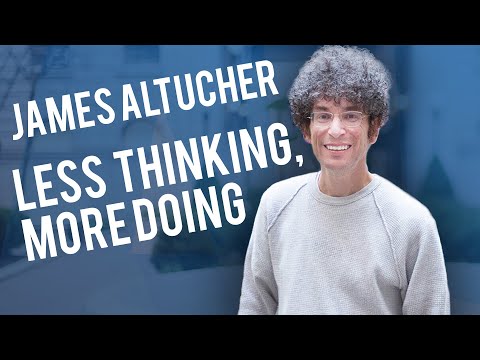
Treat Your Life As An Experiment | James Altucher | Modern Wisdom Podcast 138
James Altucher (guest), Chris Williamson (host), Narrator
In this episode of Modern Wisdom, featuring James Altucher and Chris Williamson, Treat Your Life As An Experiment | James Altucher | Modern Wisdom Podcast 138 explores experiment Relentlessly: James Altucher’s Playbook For Skipping Life’s Line James Altucher and Chris Williamson explore how treating life as a series of low‑risk experiments beats over‑planning and abstract goal setting. Altucher argues you can’t think your way to passion or mastery; you must act, gather feedback, and let reality refine your direction. They discuss “skipping the line” in careers by combining unique skills, taking strategic steps backward, and using experiments instead of the 10,000‑hour rule. The conversation also covers building differentiated offerings, the power of networks, and offering concrete value to others to create exponential opportunities.
Experiment Relentlessly: James Altucher’s Playbook For Skipping Life’s Line
James Altucher and Chris Williamson explore how treating life as a series of low‑risk experiments beats over‑planning and abstract goal setting. Altucher argues you can’t think your way to passion or mastery; you must act, gather feedback, and let reality refine your direction. They discuss “skipping the line” in careers by combining unique skills, taking strategic steps backward, and using experiments instead of the 10,000‑hour rule. The conversation also covers building differentiated offerings, the power of networks, and offering concrete value to others to create exponential opportunities.
Key Takeaways
Act first; you can’t think your way into a passion.
Both speakers emphasize that passions emerge through doing, not planning. ...
Get the full analysis with uListen AI
Use low-friction experiments to test ideas quickly and cheaply.
Altucher advocates simple, time-bounded experiments (e. ...
Get the full analysis with uListen AI
Replace the 10,000-hour rule with the 10,000-experiment mindset.
For complex, non-repetitive skills, structured experiments accelerate learning and differentiation more than sheer hours. ...
Get the full analysis with uListen AI
Combine your disparate skills to create a unique value proposition.
Real leverage often appears at the intersection of interests—like Altucher merging writing and investing into a lucrative newsletter, or Chris Turner fusing freestyle rap with comedy to stand out in a crowded field.
Get the full analysis with uListen AI
Strategically step backward to skip ahead later.
Taking seemingly ‘lower’ roles—like a law graduate interning at the Secret Service or HBO programmers pitching shows—can place you in unique positions (e. ...
Get the full analysis with uListen AI
Offer ultra-specific, no-friction value to people you admire.
Instead of vague offers like “Can I intern for you? ...
Get the full analysis with uListen AI
Treat your network as something to copy and share, not hoard.
Introducing valuable people to each other turns a linear network into an exponential one, keeps you embedded in more opportunities, and reinforces a mindset of abundance rather than scarcity around relationships and ideas.
Get the full analysis with uListen AI
Notable Quotes
“You can’t figure out your passion with just your brain. You have to do things.”
— James Altucher
“You can’t succeed by just being better. You have to be different also.”
— James Altucher
“The 10,000-hour rule only works for very repetitive tasks. I believe in the 10,000-experiment rule.”
— James Altucher
“You don’t really give a connection to someone else. You copy the connection and give the copy to someone.”
— James Altucher
“A lot of passions are emergent, not dictated.”
— Chris Williamson
Questions Answered in This Episode
How could I design one low-friction, low-risk experiment this week to test a curiosity I’ve been over-thinking?
James Altucher and Chris Williamson explore how treating life as a series of low‑risk experiments beats over‑planning and abstract goal setting. ...
Get the full analysis with uListen AI
What unique combination of my skills and experiences could form a differentiated offering that others can’t easily copy?
Get the full analysis with uListen AI
Where might taking a short-term ‘step back’—like an internship or junior role—actually position me to skip the line later?
Get the full analysis with uListen AI
In what ways am I using the idea of needing a perfect plan or skill set as an excuse not to start?
Get the full analysis with uListen AI
How can I systematically offer specific, no-friction value to people in my network to create exponential, not linear, opportunities?
Get the full analysis with uListen AI
Transcript Preview
... when you exercise that creativity muscle, you're able to come up with experiments. How can I experiment to improve this aspect of my knowledge or life or whatever? So for instance, with comedy again, I was having a hard time coming up with one-liners. Like, I'm, I'm a public speaker for a long time, so that means I'm good at storytelling and humorous storytelling. But coming up with one-liners, it's one sentence that gets people to laugh, that wasn't an expertise of mine. So here's an experiment I did. Took a half hour. I went onto a subway and every stop I moved from car to car in the subway, and I would do standup comedy in the subway. And now no other person sitting in the subway wanted to hear me doing standup comedy. (laughs) So it was really difficult. It was really out of my comfort zone. Yeah. It's got to be a little uncomfortable- Yeah. ... because no one's ever done it before, so it's got to be uncomfortable. And I had to really tighten up my jokes super hard to get anybody to laugh, and that was an experiment that helped me improve my one-liners and, by the way, it also became a story I could tell, or a story I could write about.
One of the things that I was talking about recently was with an ex-Marines officer from the UK, and he was talking about his time over in Afghanistan. And he was a Somalia, uh, pirate hunter, Somali pirate hunter. Was, like, his second sort of, uh, career after he left, left work in Afghanistan. And, um, he was talking about just how different life is out there, and he said he was talking about singing the praises of travel and new experiences. And what you've suggested to there about the idea generation and how important it is, is you kind of don't really know what you like until you-
Yeah.
... until you, you try to do something. And our sample size, the sample size of experiences that we're working with is so... it's such a fraction of the total potential number of experiences that you could have as a human, right? Like, uh, unless you try something, how do you know whether you do or don't like it?
Right. Like, people often think to themselves that they could think... uh, they, they can think their way to their passion. Y- there's no way to figure out what your passion is with just your brain. You have to do things. The- there's no thinking. You have to actually do in order to know, and that's critical. That's why, that's why travel is interesting. If you're, if you're the sort of person who benefits a lot from travel or, or, you know, if you enjoy traveling, travel to as many places as possible to see where you like, what you like to do, wh- what you like to do in each place. For me, I like to ex- experiment with these different ideas because again, I'm not gonna know until I do something. I'm not gonna know what it's like to write... Like, I could think b- uh, of a great plot in my head for a novel, but I'm not gonna know what it's like to write a novel unless I sit down and write it.
Install uListen to search the full transcript and get AI-powered insights
Get Full TranscriptGet more from every podcast
AI summaries, searchable transcripts, and fact-checking. Free forever.
Add to Chrome