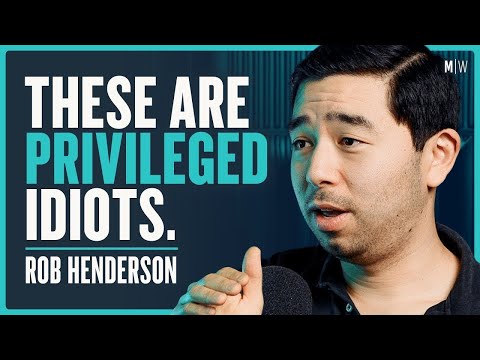
The Real Agenda Of Those In Power - Rob Henderson
Chris Williamson (host), Rob Henderson (guest)
In this episode of Modern Wisdom, featuring Chris Williamson and Rob Henderson, The Real Agenda Of Those In Power - Rob Henderson explores rob Henderson Exposes Luxury Beliefs And Hollow Morality Of Elites Rob Henderson discusses the cultural and ideological decay he witnessed at elite universities like Yale and Harvard, tracing today’s campus politics back to the 2015 ‘woke’ wave and the Yale Halloween incident. He introduces and applies his concept of “luxury beliefs”: status-signaling ideas held by affluent elites that impose real costs on poorer people, using examples like Defund the Police, family norms, and academic credential snobbery. Henderson contrasts elite rhetoric about equality with the hidden hierarchies and class contempt he observed, such as reactions to Christopher Rufo’s Harvard Extension degree and the treatment of canceled academics.
Rob Henderson Exposes Luxury Beliefs And Hollow Morality Of Elites
Rob Henderson discusses the cultural and ideological decay he witnessed at elite universities like Yale and Harvard, tracing today’s campus politics back to the 2015 ‘woke’ wave and the Yale Halloween incident. He introduces and applies his concept of “luxury beliefs”: status-signaling ideas held by affluent elites that impose real costs on poorer people, using examples like Defund the Police, family norms, and academic credential snobbery. Henderson contrasts elite rhetoric about equality with the hidden hierarchies and class contempt he observed, such as reactions to Christopher Rufo’s Harvard Extension degree and the treatment of canceled academics.
He also reflects on his own trajectory from chaotic foster care and poverty, through the U.S. Air Force, to Yale, Cambridge, and becoming a writer, emphasizing the roles of discipline, stability, and realistic agency within genetic and social limits. The conversation ranges into how status is signaled across cultures, how media and pop culture romanticize crime and victimhood, and how modern “Instagram therapy” encourages people to build identities around trauma.
Throughout, Henderson and Williamson question elite moral posturing, the gap between professed egalitarian values and actual behavior, and the real-world fallout of fashionable ideas on those with the least margin for error.
Key Takeaways
Luxury beliefs let elites signal virtue while others bear the costs.
Henderson defines luxury beliefs as ideas that raise the status of affluent believers but harm lower classes—like denigrating marriage or policing, which wealthier people can insulate themselves from via stable families, safe neighborhoods, or private security.
Get the full analysis with uListen AI
Defund the Police shows how elite moral fashion can hurt the poor.
Survey data showed higher-income and white Democrats were most supportive of defunding police, while low-income and Black/Hispanic Americans were least supportive, even as violent crime and victimization rose most in poorer neighborhoods.
Get the full analysis with uListen AI
Instability, not material poverty alone, strongly predicts bad outcomes.
Research and Henderson’s experience suggest chaotic family environments (divorce, frequent moves, rotating adults, addiction) correlate far more with crime, addiction, and dysfunction than low income by itself—even when controlling for money.
Get the full analysis with uListen AI
Elite institutions preach equality while practicing intricate status games.
The mockery of Christopher Rufo’s Harvard Extension degree and the two-tier messaging around that program expose a duplicitous system: “We are Harvard” to outsiders, but “not real Harvard” to insiders guarding their status fragments.
Get the full analysis with uListen AI
Discipline can be learned and often matters more than motivation.
Henderson credits eight years in the Air Force with transforming his habits—teaching him to act regardless of feelings, structure his days, and build a life not dominated by chaos, which later enabled academic and writing success.
Get the full analysis with uListen AI
Victimhood can become an identity that traps rather than frees.
He distinguishes between acknowledging trauma and building your whole identity around it, criticizing “Instagram therapy” and noting he didn’t think of himself as a victim until elite environments taught him that frame.
Get the full analysis with uListen AI
Status signaling has shifted from luxury goods to luxury ideas.
Drawing on Veblen and Bourdieu, Henderson argues that as clothes and consumer goods became less reliable status markers, educated elites increasingly use niche cultural tastes and fashionable political beliefs to display superiority.
Get the full analysis with uListen AI
Notable Quotes
“Luxury beliefs are ideas and opinions that confer status on the affluent, while often inflicting costs on the lower classes.”
— Rob Henderson
“Everyone is equal, but some people are less equal than others.”
— Rob Henderson (paraphrasing Animal Farm to describe elite universities)
“The people who were supporting Defund the Police are the ones most likely to live in a gated community… it’s rules for thee but not for me.”
— Chris Williamson
“Childhood poverty is not really a strong predictor of harmful outcomes later in life… childhood instability is.”
— Rob Henderson
“You can become so preoccupied with your genetic limitations that you never actually try to reach them.”
— Rob Henderson (summarizing James Clear)
Questions Answered in This Episode
How can ordinary people identify luxury beliefs in their own circles before those ideas get implemented in ways that harm the vulnerable?
Rob Henderson discusses the cultural and ideological decay he witnessed at elite universities like Yale and Harvard, tracing today’s campus politics back to the 2015 ‘woke’ wave and the Yale Halloween incident. ...
Get the full analysis with uListen AI
What concrete policy or cultural changes would actually reduce childhood instability without resorting to heavy-handed state control of family life?
He also reflects on his own trajectory from chaotic foster care and poverty, through the U. ...
Get the full analysis with uListen AI
To what extent are elite universities reformable from within, versus needing to be bypassed by parallel institutions like Substack, podcasts, and new schools?
Throughout, Henderson and Williamson question elite moral posturing, the gap between professed egalitarian values and actual behavior, and the real-world fallout of fashionable ideas on those with the least margin for error.
Get the full analysis with uListen AI
How should we teach young people about behavioral genetics and class without encouraging fatalism or absolving individuals of responsibility?
Get the full analysis with uListen AI
What practical steps can someone from a chaotic background take to build the kind of disciplined, stable life that Henderson describes developing in the military?
Get the full analysis with uListen AI
Transcript Preview
What do you make of the last few months of fallout from Yale and Harvard and such?
I mean, yeah, we saw that big, uh, testimonial from the presidents. Yeah, it was- it was Harvard, MIT, Penn. Uh, I mean, I wasn't surprised by it. I mean, a lot of people, I think, are finally fully realizing, they're coming to their senses. People have been saying this for a while now, "Oh, you know, eventually the pendulum will swing back and people will finally figure out what's really going on in these institutions, and this sort of ideology that's been spilling out of the universities." And now I think they finally are actually truly realizing it. But yeah, I saw the- it's kind of the birth of what a lot of people call wokeness, uh, in 2015 when I arrived on campus at Yale. And that was my first semester, I saw what was happening there, and yeah, I mean, I think you can draw a straight line from some of those events in 2015 to what we're seeing now. And yeah, it's been really ugly, but you know, kinda- kind of amusing, you know, from my perspective because I- I- you know, I was one of the... I- I'd like to think that I was one of the sort of early, uh, observers and people who could recognize what was occurring. And then later on, you know, so Jordan Peterson was- was another, and- and there have been other critics of higher ed and especially these elite universities. Um, but yeah, it's been, uh, really, really amusing and- and- and also sort of disheartening to- to see it.
It's this- this sort of odd blend of fatalism, schadenfreude-
(laughs) Yes.
... nihilism-
Yeah, yeah.
... sort of pleasure, displeasure-
Yeah.
... like, ick, pity.
Yeah.
Uh, it's a real concatenation of- of things.
Yeah.
And obviously we've got a couple of mutual friends that have either been directly or tangentially involved.
Mm-hmm.
Vincent, uh-
Yeah.
... our mutual friend, I managed to get removed from a higher education institution-
(laughs) Yeah, that's-
... uh, because of him appearing on this podcast.
Yeah.
Carol Hooven-
Yeah.
... uh, who is, you know, a really good mutual friend-
Yes.
... um, ha- has kind of been thrust into the middle of this.
Right.
She told me that she basically felt like she'd been used like a- a football. Um, and, uh, for the people who know who Carol is, she went on Rogan, I think she cried like six times on Joe's show, she cried at least three times on mine. We went for breakfast, I'm pretty sure she cried like three times at breakfast. She's just a very sort of emotional person.
Yeah.
She is- she- she's really sort of feeling this, and uh-
Install uListen to search the full transcript and get AI-powered insights
Get Full TranscriptGet more from every podcast
AI summaries, searchable transcripts, and fact-checking. Free forever.
Add to Chrome