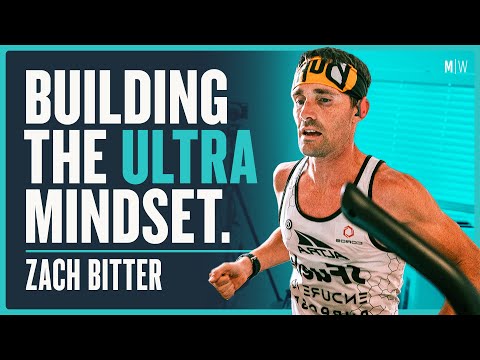
The Mindset To Break A 100-Mile Record - Zach Bitter
Zach Bitter (guest), Chris Williamson (host)
In this episode of Modern Wisdom, featuring Zach Bitter and Chris Williamson, The Mindset To Break A 100-Mile Record - Zach Bitter explores inside the Mind of a 100-Mile Record Hunter: Zach Bitter’s Blueprint Zach Bitter, former 100-mile world record holder, discusses the training, mindset, and strategy required to compete at the very top of ultramarathon running. He explains how he periodizes training for events from 100 miles to 24 hours, and why success depends as much on mental resilience and visualization as on physical conditioning.
Inside the Mind of a 100-Mile Record Hunter: Zach Bitter’s Blueprint
Zach Bitter, former 100-mile world record holder, discusses the training, mindset, and strategy required to compete at the very top of ultramarathon running. He explains how he periodizes training for events from 100 miles to 24 hours, and why success depends as much on mental resilience and visualization as on physical conditioning.
Bitter breaks down how he structures race pacing, fueling, and breaks in highly controlled environments, sometimes stopping for less than a minute over 100 miles. He contrasts sharp, short-distance pain with the long, dull discomfort of ultras and details how runners mentally manage that sustained suffering.
The conversation expands into longevity, life trade-offs, and why elite-level performance almost always costs some health and balance, making a strong distinction between professional and recreational approaches. They also explore how lessons from 100-mile racing transfer to business, creativity, and other high-performance domains.
Throughout, Bitter emphasizes process over outcomes, the importance of genuinely enjoying the training itself, and the danger of using new achievements to retroactively diminish past efforts.
Key Takeaways
Break massive goals into small, near-term targets to protect mental energy.
Bitter warns that thinking about the full 100 miles at the start creates a ‘monster’ that drains your mental battery; instead, he focuses only on the next benchmark (e. ...
Get the full analysis with uListen AI
Train your mind deliberately, not just your body.
He treats visualization and mental rehearsal as part of the training plan, especially in the final third of a build-up, replaying what miles 70–100 will feel like so race-day effort feels familiar rather than overwhelming.
Get the full analysis with uListen AI
Use controlled environments and on-the-move fueling to maximize performance.
On record attempts, Bitter races on standardized loops or tracks with support tables, taking fuel and fluids without stopping whenever possible; in his best 100-milers, total stoppage was under a few minutes across 11–12 hours.
Get the full analysis with uListen AI
Accept that ultra performance requires trade-offs with health and life balance.
He acknowledges that he has moved beyond purely health-driven running into performance territory, which likely costs some longevity and lifestyle flexibility—but sees that as an intentional choice aligned with his priorities.
Get the full analysis with uListen AI
If you don’t enjoy the process, the goal isn’t worth it.
Bitter argues that ultra training must be intrinsically rewarding; if months of preparation feel like ‘pulling teeth,’ even a successful race won’t make the experience worthwhile, and you’re better off choosing a different pursuit.
Get the full analysis with uListen AI
Don’t let new successes poison your perception of past efforts.
He notes a common trap: when you break through a new barrier, it’s tempting to judge earlier races as mentally weak; instead, he suggests recognizing that both physical readiness and mental capacity evolve over time.
Get the full analysis with uListen AI
Use hard physical challenges as a laboratory for other life domains.
The mindset that gets you through a brutal low point at mile 70—short-term focus, persistence through doubt, re-framing discomfort—can be directly applied to business, creative work, or any long, uncertain project.
Get the full analysis with uListen AI
Notable Quotes
“One of the biggest mistakes ultra runners can make is you find yourself at the starting line of a 100-mile race and you just create this monster in your head of what you're going to do.”
— Zach Bitter
“When I start a 100-mile race, I'm not going to be thinking about finishing. I'm going to be thinking about hitting that first benchmark.”
— Zach Bitter
“There's really no such thing as a perfect 100 miler, 'cause it's just too long. There's gonna be a mistake or something happens that you didn't anticipate.”
— Zach Bitter
“It's hard to compete with somebody who's having fun.”
— Chris Williamson
“I’ve probably crossed that point where I'm maximizing health through the activities I'm doing and leaning a little bit more into performance at the expense of some health.”
— Zach Bitter
Questions Answered in This Episode
How could an everyday runner adapt Zach Bitter’s visualization and segmenting strategies for shorter races like 5Ks or marathons?
Zach Bitter, former 100-mile world record holder, discusses the training, mindset, and strategy required to compete at the very top of ultramarathon running. ...
Get the full analysis with uListen AI
Where is the personal line between pursuing excellence and sacrificing too much health or life balance, and how do you know when you’ve crossed it?
Bitter breaks down how he structures race pacing, fueling, and breaks in highly controlled environments, sometimes stopping for less than a minute over 100 miles. ...
Get the full analysis with uListen AI
In what concrete ways can experiencing ‘rock bottom’ in a physical challenge change how you approach setbacks in business, relationships, or creative work?
The conversation expands into longevity, life trade-offs, and why elite-level performance almost always costs some health and balance, making a strong distinction between professional and recreational approaches. ...
Get the full analysis with uListen AI
How should recreational athletes interpret elite training and nutrition research, given that professionals strip out life variables that normal people can’t or don’t want to remove?
Throughout, Bitter emphasizes process over outcomes, the importance of genuinely enjoying the training itself, and the danger of using new achievements to retroactively diminish past efforts.
Get the full analysis with uListen AI
If there’s no such thing as a perfect 100-miler, what does a ‘perfect’ performance look like in any field that’s long, complex, and full of uncontrollable variables?
Get the full analysis with uListen AI
Transcript Preview
One of the biggest mistakes I think ultra runners can make is, you find yourself at the starting line of a 100-mile race and you just create this monster in your head of what you're going to do and then you try to wrap your head around that. And you burn so much mental energy thinking about that all day, that when you get to the end and it's time to really push, you've got nothing left to give mentally, you've kind of drained that mental battery, so to speak. (wind blows)
Zach Bitter, welcome to the show.
Hey, thanks for having me.
How are you finding training now that you're in Austin? Has it got the right, the requisite trails and running routes that you need?
Yeah. You know, the biggest transition for me so far has just been going from like a very oppressively hot dry climate in Phoenix to a slightly more, or I shouldn't say slightly, but much muggier climate here in Austin.
Equally oppressive, but a bit wetter.
(laughs)
Yeah.
Yeah. I grew up in the Midwest. I spent a couple of decades in, in Wisconsin actually. So I got sort of familiar with humid summers, so I have an idea of what's, what's coming and, you know, one of the reasons why my wife and I moved to Austin was 'cause I ended up coming down here, I think five times last year. And she was already kind of interested in, in moving to Austin at some point. So we, we decided, uh, it was time to make it happen, so. But yeah, adjusting, I'm training for mostly flat stuff right now, so terrain isn't as big of an issue. It's just, you know, normalizing the, the temperatures more or less.
We don't have a lot of elevation or mountains in Austin. Or at least I haven't been to see any yet. I haven't been shown any of them.
No. They, I mean, they call it hill country, I guess. So you can get some rollers, but not a lot of like two-mile-a-cent type of situations like you're gonna find in like the canyons out in California and stuff like that. So it's a little different. Uh, I kind of like it though. I like running controlled surfaces a little bit better. I, I like doing the trail stuff as well, but usually I'll use that as a way to kind of like break up kind of big buildups for more flatter races and that just kind of keeps, keeps me excited about it. Makes it not quite as monotonous and I think just kind of gives you a little bit of an edge when you're kind of going back and forth a little bit. But I'm sure once the summers really pick up, we'll head up to Colorado for some, some, uh, training sessions up in, uh, in the mountains if there's a race that's kind of targeting that type of terrain as well.
Install uListen to search the full transcript and get AI-powered insights
Get Full TranscriptGet more from every podcast
AI summaries, searchable transcripts, and fact-checking. Free forever.
Add to Chrome