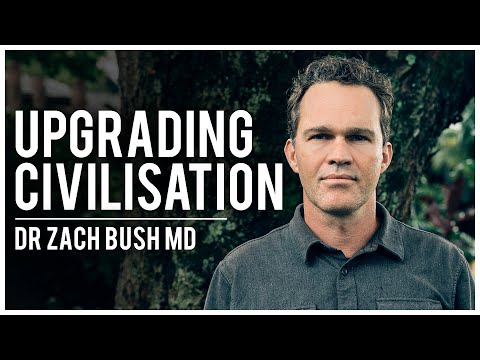
Dr Zach Bush MD - Why We Shouldn't Aim For A New Normal | Modern Wisdom Podcast 286
Dr. Zach Bush (guest), Chris Williamson (host), Narrator
In this episode of Modern Wisdom, featuring Dr. Zach Bush and Chris Williamson, Dr Zach Bush MD - Why We Shouldn't Aim For A New Normal | Modern Wisdom Podcast 286 explores dr. Zach Bush: Rejecting ‘New Normal’ For Radical Human Reimagining Dr. Zach Bush and Chris Williamson use 2020 as a lens to explore trauma, growth, and the dangers of returning to a comforting but destructive ‘normal.’
Dr. Zach Bush: Rejecting ‘New Normal’ For Radical Human Reimagining
Dr. Zach Bush and Chris Williamson use 2020 as a lens to explore trauma, growth, and the dangers of returning to a comforting but destructive ‘normal.’
Bush argues that intense loss and disruption can trigger heightened consciousness and opportunity, if we resist numbing ourselves and instead pause to feel and reorient.
They critique current civilization: political polarization, environmental collapse, COVID, genetic engineering, and AGI are framed as symptoms of deeper philosophical and biological disconnection from nature.
Bush calls for a shift from ethics to integrity, and from conformity to true unity, grounded in microbiome health, regenerative agriculture, decentralization, and daily practices of stillness and self-reinvention.
Key Takeaways
Use crisis and loss as forced course‑corrections, not just tragedies.
Bush reframes job loss, divorce, and 2020’s upheaval as painful but clarifying free‑fall moments that strip away false identities and open doors to more authentic paths if we stop clinging to the old ledge.
Get the full analysis with uListen AI
Create daily pauses of stillness to realign with a deeper ‘flow.’
He recommends cultivating a deliberate pause—mental and physical—to quiet the mind, feel fully, and sense subtle directions from a larger current of life, then adjusting relationships, work, and habits accordingly.
Get the full analysis with uListen AI
Prioritize integrity over ethics, and unity over conformity.
Ethics and conformity depend on narrow, programmable perspectives and easily justify control; integrity and true unity, by contrast, imply internal coherence, respect for difference, and creativity that scales across systems.
Get the full analysis with uListen AI
Recognize social and political chaos as symptoms of biological collapse.
Bush links rising polarization, aggression, and unrest to environmental degradation, microbiome loss, and chronic inflammation, arguing that our war on microbes produces both physical disease and inflamed collective behavior.
Get the full analysis with uListen AI
Be critically aware of the shift toward direct genetic modification.
He views mRNA COVID vaccines as a historic step in human self‑engineering—an attempt to separate from nature—which may trigger cascading ‘gene‑of‑the‑year’ interventions and a deepening arms race if not philosophically reevaluated.
Get the full analysis with uListen AI
Decentralize your life by reconnecting health, food, and community to nature.
Future health, he suggests, will depend less on gyms and hospitals and more on regenerative agriculture, local food systems, microbiome restoration, and small ‘pilot projects’—households and communities embodying a new model.
Get the full analysis with uListen AI
Cultivate a ‘mindfulness gap’ between stimulus and response.
Echoing meditation insights, they emphasize building a small pause before reacting—especially in emotionally charged times—as a crucial skill for mental robustness and for choosing aligned rather than automatic behavior.
Get the full analysis with uListen AI
Notable Quotes
“Every opportunity we have to dull the experience of being alive, we do.”
— Dr. Zach Bush
“The worst possible outcome of 2021 would be that we go back to some sort of previous normal.”
— Dr. Zach Bush
“Unity allows for the whole to be greater than the sum of its parts. Conformity dissolves the potential for creativity, co‑creation, and a future of hope.”
— Dr. Zach Bush
“What if you let your partner be somebody completely new in the next millisecond, and what if they let you be somebody new?”
— Dr. Zach Bush
“You can go through your entire life within the middle interquartile range of experience… and feeling alive—what else are we really here for?”
— Chris Williamson
Questions Answered in This Episode
How can an individual practically distinguish between healthy ‘free‑fall’ transformation and genuinely dangerous instability when life structures collapse?
Dr. ...
Get the full analysis with uListen AI
What concrete policies or institutions would a society built on integrity (rather than ethics) and unity (rather than conformity) actually look like?
Bush argues that intense loss and disruption can trigger heightened consciousness and opportunity, if we resist numbing ourselves and instead pause to feel and reorient.
Get the full analysis with uListen AI
To what extent is it fair—or useful—to frame political extremism and social unrest primarily as symptoms of microbiome and ecosystem collapse?
They critique current civilization: political polarization, environmental collapse, COVID, genetic engineering, and AGI are framed as symptoms of deeper philosophical and biological disconnection from nature.
Get the full analysis with uListen AI
How should we balance the potential benefits of mRNA and future genetic technologies with the philosophical concern of drifting further from nature?
Bush calls for a shift from ethics to integrity, and from conformity to true unity, grounded in microbiome health, regenerative agriculture, decentralization, and daily practices of stillness and self-reinvention.
Get the full analysis with uListen AI
What first steps can a typical urban or suburban listener take to participate in the ‘pilot projects’ of regenerative living and decentralized health Bush describes?
Get the full analysis with uListen AI
Transcript Preview
If we rephilosophize where we are, and what does human integrity rather than human ethic look like, what does human unity rather than human conformity look like, if we start stepping through that philosophy, the behaviors that we see filling up the headlines simply disappear. (airplane whooshing)
What is the biggest lesson that you took from 2020?
Wow. You know, I think y- it's hard to dissect them all out, but I think if I were to, you know, take a reductionist approach to that, um, I'm, I'm ultimately just glad to be alive at this moment. Uh, what a privilege to have witnessed 2020. Uh, it, it's, it's n- difficult to overstate the tipping point situations that are so multifaceted; tipping point of human health, tipping point of socioeconomics, tipping point of sociology and psychology o- of, of populations, and that just is extraordinary space to be in. So, uh, I- I am walking away with a new sense of gratitude to the moment that I showed up in. And so, that's, I think, a way of looking, uh, positively at a, at a year in which so many people lost so much and so many people gained so much. And, uh, in that, uh, dichotomy, uh, what a privilege to be alive, what a privilege to be witness to it all.
That's a really interesting take on it and one that I actually quite appreciate. (clears throat) I, I wonder whether there is a ... whether there is an advantage to living through history. Um, you know, like it is ... it was uncomfortable, you know. Like I, I preferred 2019 in terms of an experiential, uh, adventurous world than 2020. But, you know, if you look at between sort of in the '60s, there have been people that have born and died and had a good amount of life without actually living through a massive amount of history, you know. Um, I wonder whether that's part of something that can add meaning to life, going through something which is a global trauma, species-wide, civilizational threat. I wonder whether that's something that can add meaning and is actually worthwhile living through, whether it is, as you say, a, a blessing almost to, to have endured it.
I think it is a blessing. I think if we look at the generations that have not witnessed war or not had to be a part of war, there's a lethargy that sets in in that generation, and there's a laziness. Uh, there's, uh, there's a tendency to take things for granted, uh, in that, that, uh, group. And I think that my grandfather's generation really struggled with, uh, the younger generations who had not, uh, seen global co- conflict on that scale before with the flippancy that we would talk about politics or we would talk about civil liberties. Um, eh, you know, people who lived through the initial civil rights movement, uh, and watching how flippantly we've given away those civil liberties and civil rights in recent months and years, uh, I, I think there's a real discouragement, uh, there. And so when we find ourselves as a, a new generation that's in, in the mix of massive, you know, catastrophic events or, you know, conflict, uh, whether it be socioeconomic or military or otherwise, uh, we do have to be cognizant that we are brushing against the very thing that it means to be aware. And so, uh, to be aware is to be, uh, threatened in some ways. Unfortunately, the neural network of the human brain, uh, is easily distracted and is easily, uh, tempted into the, the, uh, the softness of comfort, uh, when we're not in a fight-or-flight state. And in that comfort state, we tend to dull our senses. Uh, we can see this in the way that we celebrate, right? We can, we ... or in the way which we s- you know, we deal with bad things. You know, you, you get fired from your job, you go to the bar and you drink with your friends to dull your- dull the pain. You get the big promotion, you go to the b- same bar, you drink-
Install uListen to search the full transcript and get AI-powered insights
Get Full TranscriptGet more from every podcast
AI summaries, searchable transcripts, and fact-checking. Free forever.
Add to Chrome