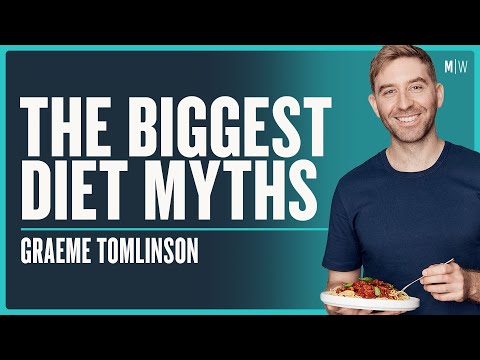
The Biggest Myths About Fat Loss - The Fitness Chef | Modern Wisdom Podcast 309
Graeme Tomlinson (guest), Chris Williamson (host), Narrator
In this episode of Modern Wisdom, featuring Graeme Tomlinson and Chris Williamson, The Biggest Myths About Fat Loss - The Fitness Chef | Modern Wisdom Podcast 309 explores destroying Fat-Loss Myths: Calories, Carbs, Keto, and Diet Dogma Debunked Chris Williamson and Graham Tomlinson (The Fitness Chef) break down the fundamental principles of fat loss, emphasizing that a sustained calorie deficit—not specific foods or diets—is the only physiological route to losing body fat.
Destroying Fat-Loss Myths: Calories, Carbs, Keto, and Diet Dogma Debunked
Chris Williamson and Graham Tomlinson (The Fitness Chef) break down the fundamental principles of fat loss, emphasizing that a sustained calorie deficit—not specific foods or diets—is the only physiological route to losing body fat.
They dissect popular approaches like low-carb, keto, intermittent fasting, slimming clubs, juice cleanses, and detoxes, showing how each ultimately works (or fails) through calorie balance rather than magic mechanisms.
The conversation also covers sustainability, protein intake, food choices that make dieting easier, NEAT and step count, and evidence-based use of supplements.
A recurring theme is the tribal, almost religious attachment people develop to diets, and how better education, flexible eating, and focusing on adherence can make fat loss both more effective and less miserable.
Key Takeaways
Fat loss requires a calorie deficit, not a specific diet type.
Regardless of whether you eat low-carb, low-fat, or follow keto or fasting, body fat only decreases when you consistently consume fewer calories than you expend; macronutrient splits mostly affect preference, adherence, and health, not the basic mechanism of fat loss.
Get the full analysis with uListen AI
Overly aggressive calorie cuts are unsustainable and backfire.
Typical app-driven goals like 1,000–1,200 calories per day may produce fast short-term loss but are extremely hard to adhere to, increasing hunger, binges, and dropout; aiming for around 0. ...
Get the full analysis with uListen AI
No single food is “good” or “bad”; your overall diet matters.
An avocado and a chocolate bar can both be 200 calories—the body fat outcome is tied to energy intake, while health is tied to nutrients and fiber; one high-calorie meal in an otherwise balanced week will not ruin progress, so guilt around individual foods is misplaced.
Get the full analysis with uListen AI
Low-carb and keto do not inherently burn more fat than low-fat.
When calories and protein are matched, studies and meta-analyses show no meaningful difference in fat loss between low-carb and low-fat groups; perceived advantages of low-carb usually come from appetite control and food restriction reducing calories, not special hormonal magic.
Get the full analysis with uListen AI
Intermittent fasting is a tool to reduce calories, not a shortcut.
Skipping breakfast or compressing your eating window can make it harder to overeat and may subjectively improve energy, but you can still gain fat in a surplus; fasting only works for fat loss if it helps you maintain a calorie deficit you can stick to.
Get the full analysis with uListen AI
Prioritize protein, fiber, and food volume to stay full in a deficit.
Higher-protein foods increase the thermic effect of food and satiety, while fiber-rich whole foods and smart low-calorie swaps (e. ...
Get the full analysis with uListen AI
Increase daily movement and NEAT to boost energy expenditure.
Non-exercise activity—like walking, fidgeting, chores, and post-meal walks—can meaningfully raise calorie burn and is often what separates more and less lean people with similar workouts; aiming for regular walks and higher step counts is a practical, low-stress strategy.
Get the full analysis with uListen AI
Notable Quotes
“The most important thing about fat loss isn’t the calorie deficit, it’s adhering to the calorie deficit over a period of time.”
— Graham Tomlinson
“There can’t be such a thing as a good food or a bad food. There can only be a good or bad overall diet.”
— Graham Tomlinson
“Despite the fact that insulin is there and it’s part of the process, the end result is defined by total energy in versus total energy out.”
— Graham Tomlinson
“Nobody in history has ever accidentally consumed 200 grams of protein a day.”
— Chris Williamson
“Their success as a business depends on their members’ failure, because that means they’re going to keep coming back.”
— Graham Tomlinson (on slimming clubs)
Questions Answered in This Episode
If calorie deficit is the core mechanism, how should an individual choose between low-carb, low-fat, or intermittent fasting based on their own preferences and lifestyle?
Chris Williamson and Graham Tomlinson (The Fitness Chef) break down the fundamental principles of fat loss, emphasizing that a sustained calorie deficit—not specific foods or diets—is the only physiological route to losing body fat.
Get the full analysis with uListen AI
What practical markers (beyond scale weight) can people use to assess whether their diet is sustainable and truly improving their health?
They dissect popular approaches like low-carb, keto, intermittent fasting, slimming clubs, juice cleanses, and detoxes, showing how each ultimately works (or fails) through calorie balance rather than magic mechanisms.
Get the full analysis with uListen AI
How can someone deprogram guilt and moral judgment around specific foods after years of “good vs. bad” diet messaging?
The conversation also covers sustainability, protein intake, food choices that make dieting easier, NEAT and step count, and evidence-based use of supplements.
Get the full analysis with uListen AI
In what ways could mainstream slimming clubs and diet programs be redesigned to be both honest about calories and still commercially viable?
A recurring theme is the tribal, almost religious attachment people develop to diets, and how better education, flexible eating, and focusing on adherence can make fat loss both more effective and less miserable.
Get the full analysis with uListen AI
Given the tribalism around diets, what communication strategies actually help change someone’s mind who’s deeply invested in a particular eating ideology?
Get the full analysis with uListen AI
Transcript Preview
They tested a low carb group and a low fat group. They equated calories and protein in each group, so they're eating the same amount of calories, same amount of protein, and then they just wanted to see which group resulted in more fat loss, and they couldn't find any difference.
(wind blowing) Graham Tomlinson, welcome to the show.
Thanks for having me. How are you doing?
I'm well, man. I went to Leeds and back today, and this is how downregulated the stimulus of my life has become. I've spent so much time in the same four walls that a journey to Leeds and back actually felt like an adventure. I spent three and a half hours in the car and, and literally felt like I'd gone on holiday.
Well, talking of holidays, it doesn't look like that's going to happen anytime, anytime soon. Um, yeah, it's been a funny, funny year, hasn't it, with lockdown? And to be honest, I don't know about you, but it hasn't actually affected me that much because, like yourself, I'm kind of working from home anyway. And the only thing that's changed for me is not being able to go abroad or get on a plane to go to London or something like that.
Yeah.
And obviously, obviously, not seeing family and friends is, um, not great. But yeah, in terms of work, everyday life, it's, it's not that much different.
No.
And at the start, it was actually quite nice. (laughs)
Dude-
But it's a bit much now.
... I said, I said that every introvert, it's now their dream. You know, you don't have to go and do all of the social events that you never enjoyed, but I, I'm, u- perfectly fine working on my own, doing my solitary stuff, but after 12 months of being in exactly the same location, even I... Like, and if I'm starting to push it, then for the people that are listening who are really social and, and used to going out and spending tons of time with their friends and... It, it really is challenging. So yeah, man, I'm looking forward... Even if we can't go abroad, I'm just looking forward to, to Leeds, West Yorkshire, not somehow feeling like I should be grateful for it. I shouldn't be grateful for the fucking A1.
(laughs)
Do you know what I mean? Like this isn't, this isn't-
Yeah.
... me taking a, taking a trip to somewhere exotic. But anyway, anyway, we-
(laughs)
... are going to talk about fat loss today. You are The Fitness Chef on Instagram. You are red pilling people on how to really understand calories from foods, what they think is happening, what's actually happening, and the truth behind weight loss. What are the most common errors that you see people making when they're trying to lose weight?
Um, I think one of them is, is not understanding what you, you were just saying there. Understanding that, A, you need a, a calorie deficit, so consume less calories than you use each day, um, to lose fat. That is the principle. That is not a method. That is literally the only physiological way you can lose fat. So unfortunately, unfortunately, it's not sexy enough to be marketed, so it kind of misses a lot of people. So a lot of people start trying to lose fat without even understanding that basic element that's required. Um, and so once you start from there and you start going on an, uh, an extreme intervention like low carb or keto or whatever it is, and you don't understand about calorie balance, you're almost setting yourself up for failure. Um, another one would be, even if you do understand that you need the calorie deficit, is making it unsustainable. In other words, having it ultra restrictive and aggressive. So for myself, I know my maintenance calories would be around about 2,200, 2,400, um, for my activity level. And, you know, for the average female, it could be, I don't know, 1,700 to 1,900. But when they go on these calorie counting apps like MyFitnessPal, it asks them, "How much weight do you want to lose?" Gives them an option and it'll be like, "One pound a week, two pounds, three pounds." Of course you're going to select the biggest amount of weight loss. Why wouldn't you? I would do that. Um, but unfortunately, what that does is, is that formulates a calorie target of something like 1,000 to 1,200 calories, which yes, it's a calorie deficit, but it's quite extreme and unsustainable. Um, you'll be very hungry and it'll be difficult to adhere to it. And the most important thing about fat loss isn't the calorie deficit, it's actually adhering to the calorie deficit over a period of time. So those are probably the two main things, um, that I would say that are very basic for people to understand.
Install uListen to search the full transcript and get AI-powered insights
Get Full TranscriptGet more from every podcast
AI summaries, searchable transcripts, and fact-checking. Free forever.
Add to Chrome