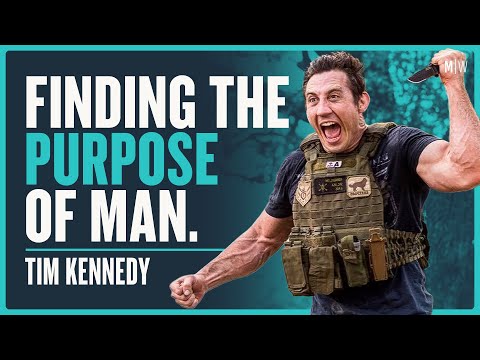
Tim Kennedy - Lessons Learned Through Pain
Tim Kennedy (guest), Chris Williamson (host)
In this episode of Modern Wisdom, featuring Tim Kennedy and Chris Williamson, Tim Kennedy - Lessons Learned Through Pain explores tim Kennedy: Embracing Pain, Responsibility, And Relentless Self-Discipline Tim Kennedy discusses how pain, shame, and failure have been crucial teachers in shaping his life as a soldier, special operator, and UFC fighter. He argues that most of his problems were self‑inflicted and that radical ownership—without numbing or avoiding pain—is essential for growth. Kennedy contrasts the protective power of elite teams with the loneliness and chaos of operating alone in combat, recounting harrowing battlefield experiences and how they reframe risk in the cage. He closes by reflecting on the physical and emotional cost of his path, the burden of surviving many fallen friends, and how preparation and disciplined daily choices underpin his current work, from running a school to humanitarian missions.
Tim Kennedy: Embracing Pain, Responsibility, And Relentless Self-Discipline
Tim Kennedy discusses how pain, shame, and failure have been crucial teachers in shaping his life as a soldier, special operator, and UFC fighter. He argues that most of his problems were self‑inflicted and that radical ownership—without numbing or avoiding pain—is essential for growth. Kennedy contrasts the protective power of elite teams with the loneliness and chaos of operating alone in combat, recounting harrowing battlefield experiences and how they reframe risk in the cage. He closes by reflecting on the physical and emotional cost of his path, the burden of surviving many fallen friends, and how preparation and disciplined daily choices underpin his current work, from running a school to humanitarian missions.
Key Takeaways
Pain is a signal, not an enemy—use it to change behavior.
Kennedy refuses anesthetic for fight stitches because he wants to fully feel the consequence of mistakes; he sees physical and emotional pain as feedback that should drive you off the metaphorical ‘hot grill’ and toward better choices.
Get the full analysis with uListen AI
Own your problems ruthlessly, but be honest about what’s actually yours.
He embraces Jocko-style extreme ownership, noting that most of his crises (reckless sex, crashes, career missteps) were directly his doing, while acknowledging there’s a risk of over-owning things truly outside your control.
Get the full analysis with uListen AI
Environment and standards shape you—surround yourself where ‘average’ isn’t acceptable.
Growing up amid war heroes and high achievers, with ‘ordinary’ not allowed, normalized risk, service, and excellence for him and created early clarity around fighting bullies and joining the military.
Get the full analysis with uListen AI
Teams forge you under pressure; solo hero fantasies ignore survivability.
His first Special Forces deployment with an elite 12-man team ‘pounded the impurities out’ of him, whereas later operating alone with foreign units left him without advocacy, support, or even someone to write his award after being blown up.
Get the full analysis with uListen AI
Training for sport and training for lethal violence share deep foundations.
He describes using BJJ techniques like the kimura in real combat for weapon control and disabling threats, arguing that high-intensity, contact sports create familiarity with hardship that transfers well into special operations.
Get the full analysis with uListen AI
Discipline at 5:30 a.m. is built the day before, not at the alarm.
He rejects the idea that willpower in a single moment determines success; instead, quality sleep, prior workouts, good food, and aligned choices create the momentum that makes getting up early almost automatic.
Get the full analysis with uListen AI
High achievement carries a heavy cost in scars, loss, and emotional weight.
Kennedy details bad knees, visible and internal scars, and the grief of outliving most of his closest teammates, highlighting that the ‘price of being Tim Kennedy’ includes chronic pain, moral injuries, and survivor’s guilt.
Get the full analysis with uListen AI
Notable Quotes
“There is a beautiful purpose to pain.”
— Tim Kennedy
“If I step on a grill that’s 400 degrees, why would I stay there?”
— Tim Kennedy
“Almost all of the things that were going wrong in my life were my doing.”
— Tim Kennedy
“I would never let the doctor use any painkiller… There should be a consequence for that pain, and I wanted to remember that pain in the future.”
— Tim Kennedy
“True hell is when the person that you are meets the person you could have been.”
— Chris Williamson (paraphrasing a saying, discussed with Tim Kennedy)
Questions Answered in This Episode
How do you distinguish between productive ownership of your mistakes and unhealthy self-blame for things you truly couldn’t control?
Tim Kennedy discusses how pain, shame, and failure have been crucial teachers in shaping his life as a soldier, special operator, and UFC fighter. ...
Get the full analysis with uListen AI
What practical steps can someone take to start using emotional pain as a teacher instead of something to numb or avoid?
Get the full analysis with uListen AI
Where is the line between necessary ‘hazing’ that forges a team and abuse that breaks people in unhelpful ways?
Get the full analysis with uListen AI
How do you personally process survivor’s guilt when you look at how many of your peers have died while you’re still here?
Get the full analysis with uListen AI
For someone who feels overwhelmed and keeps ‘hitting snooze’ on life, what is the very first small decision you’d tell them to change today?
Get the full analysis with uListen AI
Transcript Preview
When I was fighting in the UFC, I would never let the doctor ever use any painkiller anytime he had to stitch me closed because I wanted to feel that pain. Because I made a mistake in there, in the octagon, and I didn't want to dull the pain 'cause there should be a consequence for that pain. And, uh, and I wanted to remember that pain in the future. (wind blowing)
Tim Kennedy.
America.
(laughs)
You're fucking here. Sorry.
I made it, man.
All right, do your thing.
I made it.
I'm glad you're here.
I'm here. I did make it.
I'm pumped.
Thank you.
Oh.
What's happening?
Just, uh, busy bee as ever.
Yes.
Um, getting ready for this book and, uh, expanding freedom, preserving and protecting human life, uh, man, just like the purpose of man, I guess.
I knew that you'd done a lot and then reading the book, it feels like you've lived maybe between four and five lifetimes to fit everything in.
Yeah. My, my mom is absolutely positive that I'm ... If like reincarnation's a real thing, I'm a cat and that I have died nine times already and that I've broken the cat nine life rule because clearly I should have been dead more than nine times already and I've lived at least nine lives.
Yes. Talk to me about what's driven you through childhood to get to where you are now, the sort of person that's in front of me.
Yeah. The, I'm dumb. That's a big contribu- a big contributing factor is I'm dumb. Uh, I'm really stubborn and I can't stop. And when you put those things together, you, um, you have this kind of relentless pursuit of, in my case, it was a purpose and an idea and like it didn't matter as a young man without a fully developed frontal lobe, you know (laughs) , like making lots of bad decisions, I still kept moving, right? Uh, even almost drowning, uh, when I was, I don't know, trying to kill myself or not but swimming out in the Pacific Ocean a couple miles just to try to like get a- another chance at life, um, I just kept swimming, you know? Getting blown up in Afghanistan, just kept moving. Um, you know, like pissing off m- my teammates in Iraq, being a young ignorant narcissist, I just kept moving. So, uh, yeah, just kind of this adventure that is life that's full of failure and lots of struggles in my life, I just kept moving.
Do you know where that comes from? Is that something that's just in you? Is that... Do you feel like that's herited?
Uh, I think a little n- nature and a little nurture. You know, uh, my family, I'm surrounded by greatness, you know. My, my grandpa came from the greatest generation, you know, World War II hero, um, you know, literally dropped bombs on Nazis type guy and, um, survived the Great Depression, you know, the patriarch of our family and setting everything up and then my dad, uh, heroic b- undercover narcotics officer, my big brother, all my uncles, Vietnam War, like I'm j- I'm surrounded by greatness.
Install uListen to search the full transcript and get AI-powered insights
Get Full TranscriptGet more from every podcast
AI summaries, searchable transcripts, and fact-checking. Free forever.
Add to Chrome