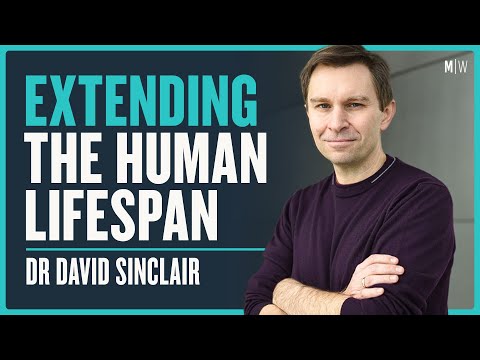
Dr David Sinclair - Defeating Ageing & Living Longer | Modern Wisdom Podcast 343
Dr David Sinclair (guest), Chris Williamson (host)
In this episode of Modern Wisdom, featuring Dr David Sinclair and Chris Williamson, Dr David Sinclair - Defeating Ageing & Living Longer | Modern Wisdom Podcast 343 explores david Sinclair on hacking evolution to slow, reverse human aging Dr. David Sinclair joins Chris Williamson to discuss the science and practice of extending healthy human lifespan, arguing that aging is malleable and increasingly reversible. He explains why evolution only optimizes us to live long enough to reproduce and how modern technology and lifestyle now allow us to “jump the queue” of evolution. The conversation covers practical longevity strategies—fasting, exercise, sleep, emotional health, social connection, and wearables—as well as emerging interventions like NAD+ boosters, senolytics, and cellular reprogramming. Sinclair also touches on ethical and societal implications, from data privacy and vaccines to mental health and the future of work and purpose in a longer-lived world.
David Sinclair on hacking evolution to slow, reverse human aging
Dr. David Sinclair joins Chris Williamson to discuss the science and practice of extending healthy human lifespan, arguing that aging is malleable and increasingly reversible. He explains why evolution only optimizes us to live long enough to reproduce and how modern technology and lifestyle now allow us to “jump the queue” of evolution. The conversation covers practical longevity strategies—fasting, exercise, sleep, emotional health, social connection, and wearables—as well as emerging interventions like NAD+ boosters, senolytics, and cellular reprogramming. Sinclair also touches on ethical and societal implications, from data privacy and vaccines to mental health and the future of work and purpose in a longer-lived world.
Key Takeaways
Aging isn’t fixed; it’s a programmable, partially reversible process.
Sinclair argues that aging is driven largely by epigenetic changes (how genes are controlled), not just irreversible damage, and his lab has shown in mice that tissues like the eye, brain, and optic nerve can be age-reprogrammed back to youthful function.
Get the full analysis with uListen AI
Simple lifestyle habits can add over a decade of healthy life.
Avoiding smoking, exercising regularly, eating less frequently, sleeping well, and maintaining social connections can collectively add around 14 extra years of life expectancy compared with people who don’t adopt these behaviors.
Get the full analysis with uListen AI
Intermittent fasting and low meal frequency activate longevity defenses.
Periods of low glucose and amino acids (rather than constant spikes from frequent eating) trigger cellular ‘defense programs’ like SIRT1 and related pathways; Sinclair typically eats one main meal a day and fasts ~18 hours, using tea/coffee to bridge hunger.
Get the full analysis with uListen AI
Minimal but consistent exercise delivers large longevity benefits.
Losing your breath for at least 10 minutes, a few times a week—or regular long walks plus some resistance training—is presented as a realistic minimum effective dose that enhances cardiovascular health, muscle maintenance, and lifespan.
Get the full analysis with uListen AI
Sleep quality and circadian rhythm are central to aging control.
Unlike hormetic stressors like fasting, chronic sleep loss disrupts circadian-regulated longevity genes and NAD+ cycles, accelerating aging; Sinclair advises aligning NAD+ supplementation with the morning rise to support, rather than confuse, the body clock.
Get the full analysis with uListen AI
Emotional health, purpose, and relationships materially affect lifespan.
Chronic psychological stress and anxiety elevate cortisol and inflammation, shortening life, while purpose, friends, and even pets (especially dogs) seem to extend lifespan by reducing stress, providing meaning, and nudging people into healthier routines.
Get the full analysis with uListen AI
Wearables and continuous monitoring will transform preventive medicine.
Sinclair envisages a near future where FDA-approved patches and devices continuously track vitals, glucose, inflammation, and more, sending data to doctors, predicting events like heart attacks, and informing individualized strategies to slow biological aging.
Get the full analysis with uListen AI
Notable Quotes
“We’re like phones built with planned obsolescence—evolution never needed us to last much longer than it took to replace ourselves.”
— David Sinclair
“We’re not going to evolve fast enough for it to matter to any of us. We have to engineer ourselves to live longer.”
— David Sinclair
“Gaining an extra 15 years isn’t that difficult if you just do the right things that we all know are good for us.”
— David Sinclair
“One great thing about staying young and living longer is that you outlive your enemies, and it makes life a lot easier.”
— David Sinclair
“If you wake up in the morning, your heart is beating, you’ve got friends, you’ve got your health—it’s a good day no matter what.”
— David Sinclair
Questions Answered in This Episode
If aging is largely epigenetic and reversible in animals, what are the biggest scientific and ethical barriers to safely applying these reprogramming techniques in humans?
Dr. ...
Get the full analysis with uListen AI
How should people in their 20s and 30s prioritize between lifestyle habits and early supplementation if their goal is maximum healthy lifespan without unnecessary risk?
Get the full analysis with uListen AI
What level of health-data sharing and privacy trade-offs are acceptable in exchange for continuous monitoring devices that might extend life by a decade or more?
Get the full analysis with uListen AI
Could widespread life extension worsen inequality, and what policies or frameworks would be needed to avoid a two-tiered longevity society?
Get the full analysis with uListen AI
How can individuals realistically balance the discipline required for longevity (fasting, exercise, restraint) with living a psychologically enjoyable and socially connected life?
Get the full analysis with uListen AI
Transcript Preview
One great thing about staying young and living, living longer is that you outlive your enemies, and it makes life a lot easier. For me, I, I've never felt this good. I've never been this sharp. I've never been this happy. I'm not going to say I've never looked this good, but I certainly feel young and, and great with what I'm doing.
What was it you said? F- the limbic system.
Don't do what it says. Otherwise, all we'd be doing would be eating, sleeping, and having sex.
Yeah.
I know that sounds great, but you're not going to live that long, unfortunately, especially if you're doing them all at the same time. That's a really, really, really, really good question. No one's ever asked me that. But the answer is that ... (wind blowing)
Ladies and gentlemen, boys and girls, welcome back to the show. I am joined by Dr. David Sinclair. InStyle Magazine referred to you as a Sydney-born researcher who is a rockstar in the longevity field. In 2014, he was voted alongside the likes of Jeff Bezos and Beyoncé one of TIME Magazine's 100 Most Influential People in the world. David, welcome back.
Oh, boy. Thanks, Chris. What an intro.
(laughs) Beyoncé. Did you ever think that your work would take you into the, the echelons of Beyoncé?
Uh, I guess I, I dreamt about it. (laughs)
(laughs) It seems like you're everywhere at the moment. Are you? It feels like you are.
No.
You are everywhere.
I, I, I mean, I came out of, out of the, uh, pandemic, you know, with a rush. Uh, a lot of people wanted to see me. So that's why it feels like I'm everywhere. But, uh, no, I've been very quiet. Uh, even social media, I wasn't, uh, as active. But I'm certainly dying to be out there, um, communicating, talking about my next book. The old one's selling really well. So people want to hear what I have to say, so I don't mind being a, a scientific communicator 'cause right now there's a lot of BS out there in terms of information. And, uh, I think people like me need to step up.
You've hinted at the new book. What can you tell us about what it is?
Okay. Uh, so it's... I have to be careful not to give it away 'cause someone probably will bang it out and beat me to it. But it's a, it's a, a look at how did we end up in this world that we live in, that we've created, and the effect it's had on our bodies over the last six million years. Technology is great, but it also makes us weaker as a species, and many of us are living lives that are extremely unhealthy because of it. And we have to use the four traits of humanity that separate us from animals, uh, to get us out of this mess, uh, because they got us into this mess. Uh, and I'm talking about the fact that I'm sitting in front of bright lights, staring down a computer, sitting down. Uh, we're all eating too much too often. Uh, these things we've created, and, and it's beyond that actually. Our bodies have evolved to be pathetic because our technology has replaced the need for big muscles. Uh, and instead we look like a lollipop.
Install uListen to search the full transcript and get AI-powered insights
Get Full TranscriptGet more from every podcast
AI summaries, searchable transcripts, and fact-checking. Free forever.
Add to Chrome