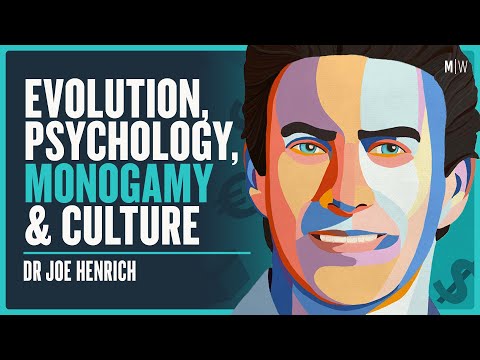
Evolution, Psychology, Monogamy & Culture - Dr Joe Henrich
Joe Henrich (guest), Chris Williamson (host)
In this episode of Modern Wisdom, featuring Joe Henrich and Chris Williamson, Evolution, Psychology, Monogamy & Culture - Dr Joe Henrich explores how Culture, Kinship And Monogamy Rewire Human Minds And Societies Joe Henrich explains how much of what we call “human nature” is actually culture-shaped psychology, using his WEIRD (Western, Educated, Industrialized, Rich, Democratic) framework to show that modern Western minds are global outliers.
How Culture, Kinship And Monogamy Rewire Human Minds And Societies
Joe Henrich explains how much of what we call “human nature” is actually culture-shaped psychology, using his WEIRD (Western, Educated, Industrialized, Rich, Democratic) framework to show that modern Western minds are global outliers.
He traces how kinship structures, ecology, religion and economic organization—like rice vs. wheat farming, clan systems, and Western Church marriage bans—produce different psychologies around conformity, trust, guilt/shame, risk-taking and individualism.
Henrich argues that marriage systems and mating markets (polygyny vs. monogamy, modern dating apps, female hypergamy) deeply affect male behavior, crime, and social stability by altering incentives and even hormones.
He also discusses how culture feeds back into biology (e.g., literacy reshaping brains; monogamy lowering testosterone), and how modern individualization and safety nets may boost growth yet undermine community, leaving people lonelier and more atomized.
Key Takeaways
Most psychological research reflects WEIRD minds, not universal human nature.
Roughly 95–96% of psychology subjects come from modern Western societies, yet humans evolved in small-scale, kin-based groups. ...
Get the full analysis with uListen AI
Kinship and ecology strongly shape how people think and relate to others.
Family structures (nuclear vs. ...
Get the full analysis with uListen AI
Marriage systems redistribute risk and aggression among men.
Polygyny may be “efficient” in allocating women toward wealthier men, but it reliably creates a surplus of low-status, unmarried men who are more willing to take dangerous, antisocial risks. ...
Get the full analysis with uListen AI
Female choice plus rising female status is reshaping modern mating markets.
As women gain education and income, they prefer partners at or above their own status and can opt out of marriage entirely, contributing to a pool of sexless men and highly selective women—a modern echo of the polygyny math problem without formal polygamy.
Get the full analysis with uListen AI
Culture literally rewires biology without changing genes.
Practices like monogamous marriage or polygynous mating change male testosterone profiles; literacy thickens the corpus callosum and creates letter-recognition circuitry. ...
Get the full analysis with uListen AI
Loose, individualistic, non-zero-sum cultures tend to innovate more.
Regions with weaker kinship ties and looser norms (e. ...
Get the full analysis with uListen AI
Western dominance emerged from long-run changes in family and institutions.
Henrich argues that the Western Church’s bans on cousin marriage and polygyny dissolved clans into nuclear families, forcing people into voluntary associations—towns, guilds, universities—that over centuries produced individual rights, markets, and democratic institutions.
Get the full analysis with uListen AI
Notable Quotes
“Culture changes our biology. The exact same genetic program can produce different biology depending on the institutions and technologies around it.”
— Joe Henrich
“Monogamous marriage domesticates males and probably even has a hormonal effect of reducing testosterone.”
— Joe Henrich
“If you look at the world around 1000 CE, Europe looks like a backwater. An alien would not have predicted Western dominance.”
— Joe Henrich
“In societies with intensive kinship, being in the village where you’re related to everybody feels like being wrapped in a warm hug.”
— Joe Henrich
“The higher you go up the status hierarchy, the less attractive most men get, because you only like men that are at least your equal.”
— Chris Williamson
Questions Answered in This Episode
If most of our data comes from WEIRD populations, how should we reinterpret classic psychology findings that have shaped policy, education, and therapy?
Joe Henrich explains how much of what we call “human nature” is actually culture-shaped psychology, using his WEIRD (Western, Educated, Industrialized, Rich, Democratic) framework to show that modern Western minds are global outliers.
Get the full analysis with uListen AI
Can we design dating platforms or social norms that preserve female autonomy and equality while reducing the pool of disenfranchised, sexless men?
He traces how kinship structures, ecology, religion and economic organization—like rice vs. ...
Get the full analysis with uListen AI
What kinds of new, non-kin communities could recreate the psychological benefits of clans and extended families without sacrificing economic dynamism?
Henrich argues that marriage systems and mating markets (polygyny vs. ...
Get the full analysis with uListen AI
How far should societies go in using religious or quasi-religious beliefs (e.g., strong moral surveillance, fear of punishment) to boost cooperation and productivity?
He also discusses how culture feeds back into biology (e. ...
Get the full analysis with uListen AI
If personality structure itself is culturally contingent, what does that imply about the validity of using Western-based personality tests across the globe?
Get the full analysis with uListen AI
Transcript Preview
That's what evolutionary biologists have argued, that if you give females the choice and there's high inequality among men, say, in wealth, it would be fitness maximizing for them to allocate according to the available resources. But what it does do is that it'll inevitably create a pool of low-status unmarried men if there's too much polygyny. And those are the guys who cause problems, because they're faced with possibly being zeros in the evolutionary race, and so they are willing to take big risks in order to catapult themselves up the status hierarchy and have a chance to get into the marriage and mating market.
(wind blowing) I had a conversation with a friend, Daniel, a couple of months ago on the podcast. And on it, he explained to me that a lot of the traits that we associate with human behavior, the sort of, um, unwritten rules that govern the way that we go about our, our lives, he summarized it as "cultural conditioning masquerading as human nature". Because the only time that we've been able to do, uh, psychological experiments which have been sufficiently robust and well-practiced using the scientific method has only been during this time, this time period. What's your thoughts on that cultural conditioning masquerading as human nature?
Yeah, well, I think there's a lot, a lot of reasons to be concerned about that, because, uh, so much research ... I mean, if you look at the percentage of subjects in psychology experiments that come from modern Western societies, it's about 95 or 96%. So my colleagues and I raised, uh, concerns about this in a paper we published in 2010 called The WEIRDest People in the World, where WEIRDest is an acronym that stands for Western, Educated, Industrialized, Rich, and Democratic. And if you think about, you know, the origins of human nature, humans e- evolve in relatively small scale, primate societies, uh, hunting and gathering. So that's m- very much the kind of environment that a lot of human nature has, has evolved for. And then you put them in a society with hospitals, lots of interaction with strangers, police forces, judicial stuff, and I mean, you can expect you're going to get a very different phenotype when you do that.
What is the boundary of Western?
Well, so the important thing about the acronym WEIRDest is that it's really a consciousness-raising device. And so what I really do in the book is, um, is try to g- get rid of the need to define something like Western, and we try to explain the cultural evolutionary processes that lead down this particular path and cause people in this society to have, uh, unusual psychology. But one of the exercises I do in the book is to explain variation among European regions, so I can tell you why Southern Italy is different from Northern Italy, and try to explain variation among different Italian provinces. You know, I try to explain why Eastern Europe is different than Western Europe, and tag that to events in European history that led to the diffusion of some institutions versus other kinds of institutions.
Install uListen to search the full transcript and get AI-powered insights
Get Full TranscriptGet more from every podcast
AI summaries, searchable transcripts, and fact-checking. Free forever.
Add to Chrome