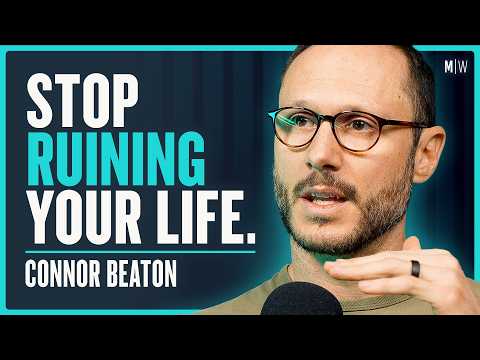
How to Stop Wasting Your Life - Connor Beaton
Chris Williamson (host), Connor Beaton (guest), Narrator, Narrator, Narrator
In this episode of Modern Wisdom, featuring Chris Williamson and Connor Beaton, How to Stop Wasting Your Life - Connor Beaton explores high-Functioning Men, Hidden Shame, And The Cost Of Suppression Chris Williamson and Connor Beaton explore why many high-functioning men quietly self-destruct despite external success. They trace this pattern to perfectionism, emotional suppression, shame-based motivation, and unresolved childhood and maternal dynamics. The conversation covers how performance-driven traits rewarded in public become toxic in private, leading to addictions, numbness, burnout, and dead relationships. They outline a path toward emotional literacy, nervous-system regulation, healthier masculinity, and more honest, sexually alive relationships.
High-Functioning Men, Hidden Shame, And The Cost Of Suppression
Chris Williamson and Connor Beaton explore why many high-functioning men quietly self-destruct despite external success. They trace this pattern to perfectionism, emotional suppression, shame-based motivation, and unresolved childhood and maternal dynamics. The conversation covers how performance-driven traits rewarded in public become toxic in private, leading to addictions, numbness, burnout, and dead relationships. They outline a path toward emotional literacy, nervous-system regulation, healthier masculinity, and more honest, sexually alive relationships.
Key Takeaways
Publicly rewarded traits often become privately destructive.
Hyper-competitiveness, suppression of feelings, extreme work ethic, and capacity to suffer are praised in careers, but the same traits cause men to tolerate toxic relationships, health crises, and profound emotional suffering far past healthy limits.
Get the full analysis with uListen AI
Strength through suppression has a psychological debt that eventually comes due.
Men are taught to be strong by suppressing exhaustion, fear, shame, and vulnerability; over years this builds massive ‘emotional debt’ that erupts as breakdowns, addictions, affairs, or sudden life collapses just when success peaks.
Get the full analysis with uListen AI
Shame and pain can fuel success, but that fuel has a shelf life.
Many men are driven by “dark motivation” (“I’ll prove I’m not a failure”), and it works—until they realize they never built self-recognition or self-compassion, so achievements feel empty and a crash follows if they don’t develop healthier inner tools.
Get the full analysis with uListen AI
Refusing inner work keeps you fragmented and confused about your own life.
Ignoring emotions creates numbness, not because there’s nothing there, but because there’s too much; cutting off emotional data leads to chronic confusion about career, relationships, and purpose, like haunting your own life rather than living it.
Get the full analysis with uListen AI
Emotional safety starts with regulating your own nervous system.
An emotionally safe man can name what he feels, slow down his reactions with breath, and respond rather than attack or collapse; this ‘vagal authority’ lets him absorb intensity—his own and others’—without being hijacked, which is deeply attractive and stabilizing.
Get the full analysis with uListen AI
Modern men are over-indexed on performance and underdeveloped in emotional range.
Culture trains men to build identity through hierarchy, competition, and output while neglecting emotional attunement, boundaries, and relational skills; future-effective leadership and relationships will require high emotional literacy and regulation, not just competence.
Get the full analysis with uListen AI
Unresolved mother dynamics distort desire through the Madonna–whore split.
Men who idealize or react against their mothers often project a pure, untouchable ‘good woman’ onto partners while banishing their primal sexual energy to porn, affairs, or fantasy; healing requires integrating need, boundaries, and eroticism with the same woman.
Get the full analysis with uListen AI
Notable Quotes
“In male culture, it's very common that we teach strength through suppression.”
— Connor Beaton
“Numbness is not emotional vacancy; it is emotional fullness.”
— Connor Beaton
“Your capacity that you are praised for in public is toxic in private.”
— Chris Williamson
“There’s a very interesting correlation between your ability to confront the unsavory truths of your life and maturation.”
— Connor Beaton
“If you pedestal a woman, don’t be surprised when you find her looking down on you.”
— Connor Beaton
Questions Answered in This Episode
How can a high-performing man tell the difference between healthy discipline and self-destructive suppression?
Chris Williamson and Connor Beaton explore why many high-functioning men quietly self-destruct despite external success. ...
Get the full analysis with uListen AI
What practical first steps can a man take if he realizes his main fuel has been shame and self-hatred?
Get the full analysis with uListen AI
How do you build emotional literacy and nervous-system regulation without feeling like you’re sacrificing your edge or ambition?
Get the full analysis with uListen AI
In what ways might unresolved mother wounds be subtly shaping the way men choose, desire, or resent their partners?
Get the full analysis with uListen AI
How can couples deliberately reintroduce polarity and desire when comfort, cohabitation, or working from home have flattened their sexual connection?
Get the full analysis with uListen AI
Transcript Preview
Why do so many high functioning men self-destruct in private?
(laughs) It's like, you're like describing my, my clients. Oh, boy. Um, I think there's a number of different reasons. There's, there's trying to maintain this image externally and part of that image is the perfectionist. So there's never any room for downfall. There's never any room for weakness, there's never any room for problems, um, or issues, and so for a lot of men, that becomes... (sighs) it becomes something that they start to medicate and usually that has rooting in childhood, right? That they had to be a certain way in order to garner love, to garner attention. So for a lot of super high performing men, they're, you know, they grew up in an environment where they kind of had to be perfect, and if they were perfect enough, then they would get affection, then they would get love, they would get praise, they'd get validation. And so for a lot of young guys, it's like, a lot of men in general, it's, "If I can be perfect enough and I can perform well enough-"
Mm.
"... then everything will be okay, but if that starts to falter just a little bit, then it says something about me personally, it means that something's wrong with me." And then sh- shame starts to creep in and they don't want anybody to know that that's happening.
Mm.
And so slowly over time, because they can't admit that there's something wrong, they can't admit that there's an issue, they can't sort of vocalize it, they start to medicate that shame or they start to medicate the perceived weakness, the insecurity, the anxiety-
Mm.
... uh, with booze or weed or women or, you know, hookers, whatever it is, right? Whatever their sort of drug choice is. Could be gambling or whatever.
Mm.
And slowly over time, that becomes the method that they need in order to just maintain homeostasis and it's almost like there's a debt building in the background that's building over time. Every little mess up, every little screw up is just sort of accruing this, this massive debt inside of them, and eventually it just craters. Um, and so, you know, and in a lot of ways, they need to be able to bring forward some of those weaknesses or insecurities or-
Mm.
... anxieties or, you know, the, the trauma that they've just been holding on for fucking decades.
Mm-hmm.
You know? Um, so I think that's a huge part of it and, and I think for a lot of men it's, it's correlated to how... it's correlated to their sense of masculinity and their sense of manhood.
Mm-hmm.
So it's like, "Well, if I admit this weakness, if I admit that I'm struggling, then it means that there's something wrong with me as a man, that I'm less masculine." Um, and I don't think that that's necessarily something that we think about top of mind. It's more perf- performance at all costs, and so I don't want to admit that there's something going on behind the scenes.
Install uListen to search the full transcript and get AI-powered insights
Get Full TranscriptGet more from every podcast
AI summaries, searchable transcripts, and fact-checking. Free forever.
Add to Chrome