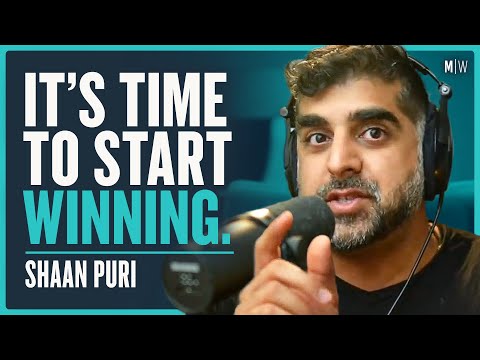
7 Semi-Controversial Rules For Success - Shaan Puri
Chris Williamson (host), Shaan Puri (guest), Narrator
In this episode of Modern Wisdom, featuring Chris Williamson and Shaan Puri, 7 Semi-Controversial Rules For Success - Shaan Puri explores shaan Puri’s Uncomfortable Rules For Smarter Success, Happiness, And Wealth Chris Williamson and Shaan Puri revisit Shaan’s semi‑controversial principles about success, focusing on why hard work, billion‑dollar goals, and knowledge hoarding are overrated compared to choosing the right game, enthusiasm, and clear orientations in life.
Shaan Puri’s Uncomfortable Rules For Smarter Success, Happiness, And Wealth
Chris Williamson and Shaan Puri revisit Shaan’s semi‑controversial principles about success, focusing on why hard work, billion‑dollar goals, and knowledge hoarding are overrated compared to choosing the right game, enthusiasm, and clear orientations in life.
They argue that project selection and the people around you matter far more than raw effort, and that enthusiasm, storytelling, and biasing toward action are massively underused advantages in business and life.
The conversation challenges common mantras like “we learn most from failure” and “self‑made success,” suggesting that many people mislearn from both wins and losses and should design simple feedback systems to improve decision‑making.
They also explore mental minimalism, time‑boxing worries and life phases, why being a billionaire is a poor life target, and how buying back time with services (assistants, chefs, “experience architects”) can be far more rational than luxury consumerism.
Key Takeaways
Treat hard work as a threshold, not the main lever.
Puri argues that once you work ‘enough,’ the big determinant of success is *what* you work on and *who* you work with; janitors and line cooks often work harder than founders but aren’t rich, showing that game selection and environment trump extra hours.
Get the full analysis with uListen AI
Actively cultivate enthusiasm, especially when things are neutral or bad.
He frames enthusiasm as “borrowing energy from the future,” a contagious fuel that raises belief, action, and results; simple practices like consciously entering rooms with “honey, I’m home” energy can reset your own state and everyone else’s.
Get the full analysis with uListen AI
Use story and vibe, not just information, to make ideas stick.
Storytelling built around a clear intention, obstacle, and stakes is a far more durable way to transfer knowledge than raw facts; in long-form formats like podcasts, being a ‘vibe architect’ who allows meandering, human conversations often beats hyper-efficient info-delivery.
Get the full analysis with uListen AI
Change how you feel by changing what you do, not just what you think.
They emphasize flipping the usual ‘think → feel → do’ model to ‘do → feel → think’: physical actions (exercise, cold water, movement) can rapidly shift emotional state and cognition, whereas trying to think your way out of overthinking usually compounds it.
Get the full analysis with uListen AI
Adopt mental minimalism: fewer principles, more execution.
Puri criticizes ‘knowledge porn’ and midwit over-complication, suggesting that most effective people run on a small set of operating principles (e. ...
Get the full analysis with uListen AI
Build a simple system to actually learn from your decisions.
Contrary to the cliché that “failure teaches,” they note most people misremember or misinterpret what happened; writing down your reasons before big decisions and revisiting them periodically creates a feedback loop that sharpens judgment over time.
Get the full analysis with uListen AI
Optimize for the right kind of abundance, not billionaire status.
Given that ultra-wealthy people often give away most of their money, Puri argues that chasing billions is a poor objective compared to maximizing time, youth, generosity, and fun—then using money to buy services (assistants, chefs, experiences) that expand those instead of status goods.
Get the full analysis with uListen AI
Notable Quotes
“Hard work will let you win the game you’re playing, but it doesn’t help you if you chose the wrong game.”
— Shaan Puri
“In Silicon Valley, the cynics get to be right and the optimists get to be rich.”
— Shaan Puri
“At the end of the day, you’ve got to feel some type of way, so why not feel unbeatable?”
— Conor McGregor, quoted by Shaan Puri
“Trying to think your way out of overthinking is like trying to sniff your way out of a cocaine addiction.”
— George Mack, quoted by Chris Williamson and Shaan Puri
“Most people should strive to be either the Neanderthal or the Jedi; the midwit is the one tying themselves in knots.”
— Shaan Puri
Questions Answered in This Episode
If hard work is only the fourth or fifth most important factor, how should someone practically go about improving their ‘project selection’ and ‘who they’re around’ in the next year?
Chris Williamson and Shaan Puri revisit Shaan’s semi‑controversial principles about success, focusing on why hard work, billion‑dollar goals, and knowledge hoarding are overrated compared to choosing the right game, enthusiasm, and clear orientations in life.
Get the full analysis with uListen AI
What concrete habits could a naturally cynical or anxious person implement this week to start training genuine enthusiasm without feeling fake?
They argue that project selection and the people around you matter far more than raw effort, and that enthusiasm, storytelling, and biasing toward action are massively underused advantages in business and life.
Get the full analysis with uListen AI
How might you build a lightweight decision journal or feedback loop for your own life to avoid mislearning from both successes and failures?
The conversation challenges common mantras like “we learn most from failure” and “self‑made success,” suggesting that many people mislearn from both wins and losses and should design simple feedback systems to improve decision‑making.
Get the full analysis with uListen AI
If you stopped optimizing for money beyond ‘enough,’ what single orienting principle or game would you design your next 5–7 years around?
They also explore mental minimalism, time‑boxing worries and life phases, why being a billionaire is a poor life target, and how buying back time with services (assistants, chefs, “experience architects”) can be far more rational than luxury consumerism.
Get the full analysis with uListen AI
Which services or forms of ‘buying back time’ (e.g., assistant, meal prep, childcare) would most radically improve your quality of life if you redirected spending from status goods toward them?
Get the full analysis with uListen AI
Transcript Preview
We already did this once. It went well, it went amazingly well, and I was very sad that we couldn't put it out because we had technical difficulties. This time, we're both in our home setup, no technical difficulties, and we're going to run it back from what we got through last time, plus more.
Well, last time I was also very sick that night, uh, after we rec- I had recorded a podcast, I did the podcast with you, so two podcasts in a row. And I went home and basically just was in bed with a fever for the rest of the night. So, uh, ha- if you thought that was good, great, uh, because (laughs) I thought it was terrible, and I was feeling terrible at the time. I gotta, I gotta do better than that.
Okay. Maybe that's just what all guests feel like once they've finished up recording with me.
(laughs) That's what I thought.
That might be like the, the post-coital-
(laughs)
... like, depression that occurs after you've podcasted with me. I'm not, I'm not too sure. I'll have to ask some previous guests. All right, so I wanna go through some of your most controversial, semi-controversial opinions, which you've kind of become famous for, I think. First one, one of my favorites, hard work is massively overrated. Why?
Well, I'll take a step back. The reason I like these controversial opinions is, uh, A, you always look cool if you have some controversial opinions, uh, but B, I l- I'm- I've learned how much of what we believe is just simply stories that were told. Um, this goes from everything, religion to, uh, school, to being taught what you should be doing for your career, and all this stuff. And so I've actively tried to just deprogram myself and ask, and question the assumptions. So I actually started with looking at, what are the things that almost nobody disagrees with, and are those really true? And one of those that I found that I, in practice, disagree with was, growing up I was told hard work is what's most important, hard work is the key to success. Hard work is... And you just hear hard work preached, and it's almost like you'd have to be insane to be, um, anti-hard work, right? (laughs) Like, uh, some people do it just for the, just for the effect, but I don't, I don't really mean it like that. I just mean it's overrated. It's not that it's a bad thing, but that it is overrated. Um, because what I've found in my life is that what you do is far more important than how f- how hard you work on that thing. So, for example, you know, I thought about the hard work thing, and I used to work in restaurants. And nobody works harder than people (laughs) in restaurants. Restaurants are open, you know, from breakfast till, till late night, every single day, seven days a week. It is, uh, you know, a thankless job. You are working in a hot kitchen, um, and you are, you know... Cooks work hard. Cooks in the back line of a kitchen work hard. Janitors work hard. You know, the cleaning lady works hard. Um, but, you know, you sort of think about it, you're like, "Why isn't the janitor driving a Bentley?" Right? Like, if hard work was the key to success, then why aren't the people who I think works, work the hardest in, in most these situations doing better? Um, and it's because, you know, hard work will let you win the game that you're playing, but it doesn't help you if you chose the wrong game. And so the most critical decision is actually project selection, what you decide to work on. Uh, what you decide to do with your talent and your time and your, your work ethic is far more important. And I don't really hear that. In fact, I actually, growing up, heard the opposite. Um, you know, you get to college and they're like, "What's your major?" "Uh, I don't know, I'm 17, 18." Like, w- how am I supposed to... Uh, you know, I just came from high school, right? Like, I don't, I don't know what the thing is yet. Um, is there a list I can look at of, like, the jobs and what they're like? Can I, do, do I get to go see one? Um, y- you know, and instead it's just like, "Just pick." Oh, if you don't pick, if you don't declare, if you don't declare your major... This is in the US at least, I don't know how it is for you. I- i- if you don't declare your major, you're behind. (laughs) Like, already it's like, you... If you've chosen to wait and see or think or go test, you've fallen behind, right? So it, it just became this thing where picking what you do was like this quick one-second thing you were supposed to just get right right away with no preparation, and then spend the rest of your t- life working hard. And I just found that, uh, the opposite actually turned out to be true for me, which was picking the right projects made the, made a huge difference, and working hard enough was good enough. I consider myself to be, frankly, somewhat lazy, but very happy and successful. So, you know, I, you know, I don't know if I'm the outlier or what, but like, at least disproved it is not, um, it is not the main thing, uh, in terms of success. I believe it's overrated.
Install uListen to search the full transcript and get AI-powered insights
Get Full TranscriptGet more from every podcast
AI summaries, searchable transcripts, and fact-checking. Free forever.
Add to Chrome