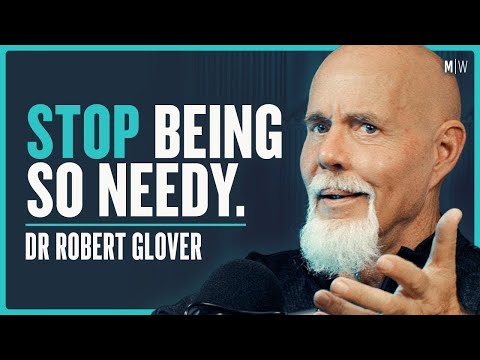
Women Are Turned Off By Passive Men - Dr Robert Glover
Chris Williamson (host), Dr Robert Glover (guest), Narrator
In this episode of Modern Wisdom, featuring Chris Williamson and Dr Robert Glover, Women Are Turned Off By Passive Men - Dr Robert Glover explores stop People-Pleasing: Prioritize Yourself And Quit Seeking Female Approval Dr. Robert Glover explains how many men learn in childhood to suppress their own needs, become "nice guys," and then unconsciously seek approval and validation—especially from women—as a way to feel worthy and get their needs met. He argues this strategy backfires, creating isolation, neediness, resentment, and an inability to receive love or support. Instead, he urges men to fill their own bucket first, build cooperative reciprocal relationships, and become outcome-agnostic so they can act boldly without being driven by shame or fear of rejection. The conversation also covers ruminating brains, modern male isolation, post-MeToo dating dynamics, and practical ways to change deeply ingrained patterns over time.
Stop People-Pleasing: Prioritize Yourself And Quit Seeking Female Approval
Dr. Robert Glover explains how many men learn in childhood to suppress their own needs, become "nice guys," and then unconsciously seek approval and validation—especially from women—as a way to feel worthy and get their needs met. He argues this strategy backfires, creating isolation, neediness, resentment, and an inability to receive love or support. Instead, he urges men to fill their own bucket first, build cooperative reciprocal relationships, and become outcome-agnostic so they can act boldly without being driven by shame or fear of rejection. The conversation also covers ruminating brains, modern male isolation, post-MeToo dating dynamics, and practical ways to change deeply ingrained patterns over time.
Key Takeaways
Stop outsourcing your worth to other people’s approval, especially women’s.
Glover argues that a man doesn’t fully mature until he quits seeking a woman’s approval; chasing approval makes you needy, anxious, and unattractive, and keeps you from living by your own values.
Get the full analysis with uListen AI
Make your needs a conscious priority and learn to give to yourself first.
He suggests systematically reversing the "give-to-get" pattern—buy yourself things, look after your health, rest, and social life—so you’re no longer trying to give from an empty bucket or manipulating others to fill you.
Get the full analysis with uListen AI
Get out of isolation and build cooperative reciprocal relationships.
Men often hide in an "emotional tree fort" of porn, gaming, and internet consumption; Glover insists that real growth requires in-person connection, accountability, and relationships where both people choose to be there and both benefit.
Get the full analysis with uListen AI
Don’t try to fix broken people to get your needs met.
Many nice guys pick partners whose lives are chaotic, hoping that saving them will earn care in return; he calls this a terrible strategy and recommends seeking people who already manage their own lives and can also give to you.
Get the full analysis with uListen AI
Practice being outcome-agnostic to reduce anxiety and act boldly.
Attachment to specific outcomes (a particular woman, a perfect result) creates anxiety and paralysis; learning to be "equally okay" with all possible outcomes frees you to take action, risk rejection, and enjoy the process.
Get the full analysis with uListen AI
Challenge ruminating thoughts by becoming the observer, not the believer.
Ruminating brains loop on past regrets, future catastrophes, and comparisons; Glover recommends mindfulness plus CBT-style noticing so you can step "out of the washing machine," see thoughts as just thoughts, and stop letting them define you.
Get the full analysis with uListen AI
Date by walking through open doors instead of pounding on closed ones.
Rather than cold-approaching purely on looks and begging for approval, he tells men to become socially engaged, test for interest, respond to women who show openness, and require small investments from others to gauge real interest.
Get the full analysis with uListen AI
Notable Quotes
“A man doesn’t mature until he quits seeking the approval of a woman.”
— Dr. Robert Glover
“I was trying to give from an empty bucket—my bucket was bone dry.”
— Dr. Robert Glover
“Your mind would rather manage old and familiar anxieties than confront new and unknown ones.”
— Chris Williamson (quoting Glover)
“Making your needs a priority does not make you needy. Walking around with an empty bucket and a big vacuum hose trying to hook up to other people—that’s neediness.”
— Dr. Robert Glover
“How long are you going to wait until you start to demand the best for yourself?”
— Chris Williamson (quoting Seneca)
Questions Answered in This Episode
If I realized I’ve been living as a “nice guy,” what is the very first concrete behavior I should change this week?
Dr. ...
Get the full analysis with uListen AI
How can men distinguish between healthy self-prioritization and genuine selfishness in relationships?
Get the full analysis with uListen AI
What practical steps can someone with a ruminating, self-critical mind take in the moment when they get stuck replaying past mistakes?
Get the full analysis with uListen AI
In a post-MeToo and highly online dating environment, what does a confident but non-creepy approach to women actually look like in practice?
Get the full analysis with uListen AI
How can someone who’s chronically isolated start building cooperative reciprocal relationships if they currently have almost no in-person social circle?
Get the full analysis with uListen AI
Transcript Preview
So, you say if you don't believe you and your needs are important, you won't be receptive to the good things the world wants to give you?
That's a good starting point.
Why do you think so many guys subjugate their needs?
Um, we've been taught to, and we inaccurately internalized, ironically, that that was the best way to get our needs met. I mean, think about it, if- if you're a- a small child, infant, and you don't have a lot of thinking, processing power, just survival power, and, uh, let's say you- you quickly come to the awareness that the caretakers in your life are not real competent. They don't respond timely, they don't respond cont- consistently. They don't respond with what you really need. And, um, so what you learn is, "Well, maybe if I get rid of my needs, or maybe if I become needless and wantless..." I mean, this isn't thought, it's just emotional survival reaction. "If I take care of their needs, if I make sure they're okay, then they'll be okay to make sure I'm okay." And all of this begins before we can even think about it. So, it gets wired into our nervous system, and we grow up to be children, adolescents, adults, and we just keep following the same thing that got wired in when... very inaccurately, when we were just a few months old.
Isn't it strange to think that we can rail against the world not giving us the things that we want, meanwhile, we don't make the things that we want a priority?
Well, th- that's- that's a big piece I've worked on, and I work, uh, you know, I work- I work with men, and, uh, that's a really big piece. I... You know, I used to do things like not tell anybody what my needs and wants were, or even hide them, or I'd still, at times, make it difficult for people to give to me. I've been told by many people in my life that I'm difficult to give to, uh, so I consciously work at that. Another piece with the men I work with that I call nice guys is, again, they believe they're bad for having needs, everybody else's needs are more important. And here- here again, the- kind of the distorted logic that a lot of us use, I've done this, a lot of guys do this, women do it too, is they'll go find a person whose life is a mess. You know, they- they can't pay their own bills, they can't hold a job, th- they- they fight with everybody they know, they're depressed, th- you know, whatever. And we think, "I can fix them up. I- I'll- I'll d- I'll dedicate all my resources to getting them good, and once they're good, they'll get- th- they'll be there for me."
Mm-hmm.
"They'll help me get my needs met." But that's just ter- terrible (laughs) terrible strategy. If you wanna get your needs met, go find people who are already competent at getting their own z- needs met, and who are available to help give to you. But again, most of this stuff is so unconscious w- we're not thinking about it, we just keep doing the same thing hoping that at some point, it will work. And then again, often when people then do try to give to us, "No, no, that's okay. It's all right."
Install uListen to search the full transcript and get AI-powered insights
Get Full TranscriptGet more from every podcast
AI summaries, searchable transcripts, and fact-checking. Free forever.
Add to Chrome