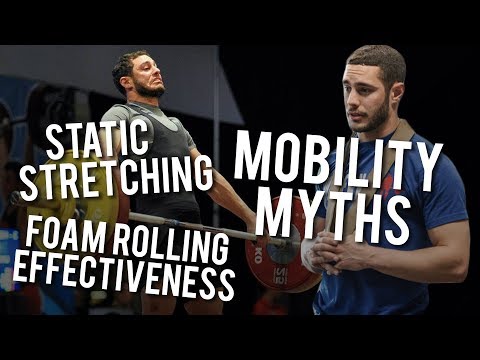
Mobility Myths | Dr Quinn Henoch
Chris Williamson (host), Quinn Henoch (guest), Narrator
In this episode of Modern Wisdom, featuring Chris Williamson and Quinn Henoch, Mobility Myths | Dr Quinn Henoch explores mobility Myths Debunked: Why Practice Beats Stretching For Performance Gains Dr. Quinn Henoch argues that most people misunderstand 'mobility', and that the fitness industry has built an overcomplicated, often misleading ecosystem of stretching and soft-tissue rituals around a poorly defined concept.
Mobility Myths Debunked: Why Practice Beats Stretching For Performance Gains
Dr. Quinn Henoch argues that most people misunderstand 'mobility', and that the fitness industry has built an overcomplicated, often misleading ecosystem of stretching and soft-tissue rituals around a poorly defined concept.
He reframes mobility as simple joint range of motion and explains that problems in movement are usually due to motor control, strength, and skill under load and fatigue, not fixed structural limitations.
Henoch reviews the science on soft-tissue work, static stretching, and dynamic stretching, showing they create only short-term changes in sensation and range of motion, not lasting tissue remodeling or magical 'adhesion breaking'.
His main recommendation is to spend far less time on passive prep and far more on practicing the actual movements with smart variations, light loads, tempo, and patience over months, using tools like foam rolling only minimally and strategically if at all.
Key Takeaways
Treat 'mobility' as joint range of motion plus control, not a mystical separate quality.
Henoch suggests using clear terms: passive range of motion, motor control, and stability. ...
Get the full analysis with uListen AI
Stop assuming your structure is the problem when your skill isn’t developed.
Most people who say they “don’t have the mobility” for a snatch or squat actually move fine passively but lack motor control and strength under load, speed, or fatigue. ...
Get the full analysis with uListen AI
Soft-tissue tools don’t ‘break up adhesions’—they change how things feel, briefly.
Foam rollers, balls, and massage guns are not strong or specific enough to remodel tissue the way marketing claims. ...
Get the full analysis with uListen AI
Static stretching offers short-lived range gains and may transiently reduce power.
Static stretching increases tolerance to stretch via the nervous system rather than permanently lengthening muscles or tendons. ...
Get the full analysis with uListen AI
Dynamic movement and loaded end-range practice are more useful than long passive stretching.
Henoch favors active drills like light RDLs or controlled squats with pauses over passive holds. ...
Get the full analysis with uListen AI
Use minimal, targeted prep and invest the saved time into the actual lifts.
Rather than 20–30 minutes of rolling and stretching, he recommends short bouts (10–30 seconds) of any chosen soft-tissue work inserted between light warm-up sets, then dropping it entirely once working sets begin and focusing on the movement itself.
Get the full analysis with uListen AI
Respect individual anatomy: technique must be personalized, not forced into templates.
Hip socket depth, orientation, and limb proportions vary widely, so stance width and toe angle for squats or overhead positions must be discovered and refined, not dictated by a coach’s fixed cue card.
Get the full analysis with uListen AI
Notable Quotes
“When you say, 'I gotta work on my mobility,' nobody knows what the hell that means.”
— Dr. Quinn Henoch
“If you were able to rearrange your tissues with a foam roller, what would a barbell sitting on your back do to you?”
— Dr. Quinn Henoch
“The splits are not gonna get you the overhead squat that you want. The overhead squat is gonna give you the overhead squat that you want.”
— Dr. Quinn Henoch
“People spend way too much time doing non-specific mobility work and not enough time doing the actual movement.”
— Dr. Quinn Henoch
“You don’t have to be a gymnast to do an overhead squat, I promise you.”
— Dr. Quinn Henoch
Questions Answered in This Episode
If most of my passive range of motion is already adequate, how should I redesign my warm-up to focus on motor control and skill instead of long foam-rolling and stretching sessions?
Dr. ...
Get the full analysis with uListen AI
What specific movement variations (tempo, pauses, partial ranges, goblet squats, etc.) would best help me progress toward a full, comfortable overhead squat?
He reframes mobility as simple joint range of motion and explains that problems in movement are usually due to motor control, strength, and skill under load and fatigue, not fixed structural limitations.
Get the full analysis with uListen AI
How can I tell the difference between a true structural limitation that requires modification and a perceived mobility issue that will improve with practice and load?
Henoch reviews the science on soft-tissue work, static stretching, and dynamic stretching, showing they create only short-term changes in sensation and range of motion, not lasting tissue remodeling or magical 'adhesion breaking'.
Get the full analysis with uListen AI
For athletes who genuinely enjoy yoga or mobility work, how can they integrate it without letting it replace the focused practice their sport actually requires?
His main recommendation is to spend far less time on passive prep and far more on practicing the actual movements with smart variations, light loads, tempo, and patience over months, using tools like foam rolling only minimally and strategically if at all.
Get the full analysis with uListen AI
What metrics or checkpoints over a 3–6 month period can I use to objectively see if a ‘practice-the-movement’ approach is improving my positions more than my old stretching routine did?
Get the full analysis with uListen AI
Transcript Preview
(wind blowing) Hello, there. This week I have the pleasure of hosting Quinn Heneck. Quinn is a doctor of physical therapy, he's the head of sports rehabilitation for Juggernaut Training Systems, and the man behind clinicalathlete.com. He is about as no-bullshit as you can get, and I've wanted to have him on the podcast for so long. As far as I can see, mobility is this, like, charlatan rich, awash world where no one really knows what's going on, and there's so much disinformation that it feels like the Trump presidential campaign all over again, which isn't good, right? People need mobility. They want to be mobile within particular ranges of motion. They want to be able to do an overhead squat, and a normal squat, and complete a variety of tasks that require their bodies to be mobile, but there doesn't appear to be any consensus or appropriate information. Quinn does a series on YouTube called Mobility Myths, and as soon as I saw that, I knew that I had to have a conversation with him, and it went better than I could have hoped. I've just about managed to pick my jaw up off the floor after finishing with him. And we go through what the science says about typical approaches to achieving mobility. We look at the word mobility, flexibility, stability. What do all of these words mean in a performance con- uh, context? What are the typical approaches and their efficacy, their usefulness within training, from static stretching, to dynamic stretching, to soft tissue work? What do they actually do, if anything? And I think there's some, uh, there's some very surprising takeaways. Even if you're not a highly functioning or even moderately functioning athlete, even if you're a couch potato, this information is so important to understand how our bodies work in relation to moving. I- I couldn't believe some of the, some of the, uh, summaries that he gave me, and some of the conclusions that he's drawn. Hopefully, we're going to save people an awful lot of time in the gym, and we're going to improve their ability to understand their body and to adapt their training to the needs that they've got. So, I'm gonna stop bloviating here, because this podcast just, it speaks for itself. Hope you enjoy it. Here it is, Quinn Heneck. (instrumental music plays) So, Quinn Heneck, Doctor of Physical Therapy, Head of Sports Rehabilitation for Juggernaut Training Systems, and the man behind clinicalathlete.com, how are you today?
Chris, I'm doing well, man. Thanks for having me on.
Thank you for coming on, man. I really appreciate it. So, (laughs) I want to cut sort of straight to the chase here. Um, researching mobility online, for me, can feel a little bit like a, a minefield of disinformation. Um, for every article that says yes to one approach, there does seem to be 20 arguing against it. Do you think there's a, a lack of clarity with what's published online?
Install uListen to search the full transcript and get AI-powered insights
Get Full TranscriptGet more from every podcast
AI summaries, searchable transcripts, and fact-checking. Free forever.
Add to Chrome