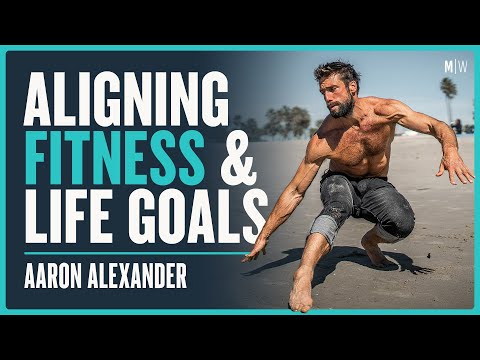
Engineer Your Body To Improve Your Mind - Aaron Alexander
Aaron Alexander (guest), Chris Williamson (host), Narrator
In this episode of Modern Wisdom, featuring Aaron Alexander and Chris Williamson, Engineer Your Body To Improve Your Mind - Aaron Alexander explores engineer Your Environment, Posture, And Play To Transform Your Bodymind Aaron Alexander explains his holistic view of fitness as something expressed all day, not just in the gym, emphasizing posture, environment, and daily movement as constant builders of the body and nervous system.
Engineer Your Environment, Posture, And Play To Transform Your Bodymind
Aaron Alexander explains his holistic view of fitness as something expressed all day, not just in the gym, emphasizing posture, environment, and daily movement as constant builders of the body and nervous system.
He argues that every position and stimulus—sitting, walking, temperature, light, social interaction—acts as a signal that literally reconstructs tissues and shapes how we feel, move, and show up in work, relationships, and sex.
Key practices include spending more time on the floor with hips below knees, using environmental design and play to ‘automate’ better movement, and incorporating hot/cold exposure and sunlight as essential hormetic stressors.
The conversation also explores how emotion and shame live in the body, the impact of visual focus and smartphones on nervous system state, and how relationship patterns often reflect early family dynamics and unexamined internal tensions.
Key Takeaways
Treat your body as ‘under construction’ 24/7, not just in workouts.
Every position you hold and surface you interact with sends mechanical and electrical signals to cells (mechanotransduction, piezoelectricity) that tell your tissues what to strengthen, weaken, or atrophy—practice makes permanent, not perfect.
Get the full analysis with uListen AI
Design your environment so movement and mobility happen automatically.
Simple changes—floor cushions, a pull-up bar in a doorway, a foam roller in front of the TV—invite squatting, hanging, and varied positions without willpower, shifting the ‘culture of your cells’ the way changing a Petri dish medium changes a cell.
Get the full analysis with uListen AI
Get your hips below your knees regularly to preserve lifelong athleticism.
Spending time squatting, kneeling, or sitting on the floor (as kids and hunter‑gatherers do) maintains ankle and hip range of motion, improves circulation, reduces swelling, and significantly lowers fall risk and loss of independence in old age.
Get the full analysis with uListen AI
Train whole-body integration and athleticism, not just isolated muscles.
Programs obsessed with single muscles can ‘paint you into a corner’ of stiffness and dysfunction; prioritizing gait, lunges, spinal mobility, and integrated patterns builds adaptability, better performance, and nervous-system safety to express strength.
Get the full analysis with uListen AI
Use hormetic stressors like hot/cold and light to build resilience.
Cold, heat, altitude, and especially natural sunlight trigger systemic adaptive responses similar to strength training, improving cardiovascular, metabolic, and visual health while powerfully elevating mood and energy when dosed appropriately.
Get the full analysis with uListen AI
Let how you feel after a session guide your training choices.
If you consistently leave workouts feeling depleted, in pain, or worse mentally, you’re likely training against your biology and psychology; modalities that leave you feeling lighter, stronger, and more alive are better long-term investments.
Get the full analysis with uListen AI
Recognize that emotions, shame, and attachment styles are embodied.
States like shame, pride, safety, or avoidance are expressed physically (collapsing, bracing, tightness in the pelvis, breathing changes); becoming aware of these patterns in sex, relationships, and daily life is a doorway to ‘health as wholeness’ rather than just symptom management.
Get the full analysis with uListen AI
Notable Quotes
“One hundred percent of the time you are under a state of construction, and all your body knows is environmental stimuli.”
— Aaron Alexander
“Fitness isn’t a thing that I do; fitness is a thing that I am.”
— Aaron Alexander
“Practice doesn’t make perfect; practice makes permanent.”
— Aaron Alexander
“We’ve done such a tremendous job at outsourcing our body’s necessity to show up that you can lie on a couch, press buttons on your phone, and have food and sex delivered to your face.”
— Aaron Alexander
“There’s nothing to get rid of—only parts of yourself to bring into a healthier relationship. Health just means whole.”
— Aaron Alexander
Questions Answered in This Episode
If my body is constantly being remodeled by my environment, what three changes to my home or workspace would most powerfully improve my posture, energy, and long-term health?
Aaron Alexander explains his holistic view of fitness as something expressed all day, not just in the gym, emphasizing posture, environment, and daily movement as constant builders of the body and nervous system.
Get the full analysis with uListen AI
How can I systematically reintroduce ground-sitting and hip-below-knee positions into a modern lifestyle without aggravating existing pain or injuries?
He argues that every position and stimulus—sitting, walking, temperature, light, social interaction—acts as a signal that literally reconstructs tissues and shapes how we feel, move, and show up in work, relationships, and sex.
Get the full analysis with uListen AI
In what ways might my current training style be ‘painting me into a corner’—building aesthetics or strength at the cost of adaptability and joint safety?
Key practices include spending more time on the floor with hips below knees, using environmental design and play to ‘automate’ better movement, and incorporating hot/cold exposure and sunlight as essential hormetic stressors.
Get the full analysis with uListen AI
Where do I notice shame, tension, or emotional avoidance in my body during sex or intimate conversations, and how could I gently explore those areas rather than armoring against them?
The conversation also explores how emotion and shame live in the body, the impact of visual focus and smartphones on nervous system state, and how relationship patterns often reflect early family dynamics and unexamined internal tensions.
Get the full analysis with uListen AI
How is my visual and tech environment—constant screen focus, indoor lighting, lack of distance gaze—shaping my nervous system state, mood, and even my eyesight over time?
Get the full analysis with uListen AI
Transcript Preview
... 100% of the time, you are under a state of construction, and all your body knows is environmental stimuli. And so you have this amazing opportunity to, through exposure therapy, you can start to make yourself be stronger or weaker. So if you don't expose your body to enough exposure in the form of heat, in the form of cold, in the form of some type of hermetic stressor, then the body will start to atrophy, because it's inherently incredibly lazy.
(wind blowing) Th- th- there won't be a single shot where I can put my hand in all of these, will there? (hands clapping)
No, not really. I mean, I guess there's this kind of (overlapping) . Oh, d- d- do you need to see it? I thought it was just an audio thing.
Well, no, because what you're trying to do is you're syncing-
So you're seeing a blip.
You're syncing the audio with the video.
You can see it.
You can watch it.
Oh. I thought it was just an audio blip, but yeah, you're right. God dang it.
What can I say, man?
I'm not a videographer.
No, no, but that's-
I just like clapping.
Y- just here to clap.
Maybe we both clap. (hands clapping)
Yes.
Boom!
Fucking-
All angles!
Podcast time.
We're in!
Podcast time.
Yeah, we're locked in.
Aaron Alexander, welcome to the show.
Christopher, thank you for making this happen. It's been a got-dang pleasure getting to know you over the last few weeks.
So good, man.
Yeah?
Yeah. The bromance has happened quickly.
Bromance is real.
It's got serious-
Yep.
... very fast.
Yep. We're moving quick.
How would you describe your approach to fitness? I've been very interested since I've been out here, we've trained a fair bit. We've done some sessions barefooted in, on it, doing sprint training, and contralateral movements, and all manner of different things that, as someone that's spent a lot of time training, I've seen online, but I'm n- not really been exposed to very much. And I'm quite interested to work out how you arrive at whatever view of health and fitness it is that you have.
Yeah. Um, so my... First, thanks for doing this. I appreciate it. Uh, my background mostly was in manual therapy. Like, my main field of, of specialty is working with people from hands-on body work. Uh, and s- before that, it was, it was training. Uh, but my main interest really has been helping people come into alignment with their bodies, uh, so that we can get them to a point that when they move through their lives, uh, as they are breathing, as they're just living their lives, they can be almost self-organizing into a greater place of alignment, of balance, of homeostasis, just through their existence. And that sounds a little bit maybe like meta and out there, um, so specifically what that means is looking at what are the, the variables, the environmental conditions that are forming the body to fit into the positions that might create discomfort or dis-ease. And so my approach to fitness, um, isn't so much about what we're doing in a gym, it's more what we're doing for all the times that we're not in the gym, and I consider the, the gym to be... For me, the gym's like, uh, my buddy Kelly Starrett, who he did the, the forward for my, my book coming up, um, he calls it, like, classical ballet. You know, so when you're in the gym, you're working on these classical forms to bring your body into balance enough that you can go out and do modern dance, you know, modern dances the rest of your life. And so what I'm really interested with, with fitness predominantly is, uh, how do you start to integrate the concepts that you'd learn in a gym, in a yoga studio, um, in a martial arts studio, into the way that you show up in business, in, you know, when you're out on a date with somebody, when you're s- at your house watching Netflix? All of that is fitness, and your body doesn't know the difference between, "I'm in a yoga studio," or, "I'm just, you know, at my, my house in my underpants."
Install uListen to search the full transcript and get AI-powered insights
Get Full TranscriptGet more from every podcast
AI summaries, searchable transcripts, and fact-checking. Free forever.
Add to Chrome