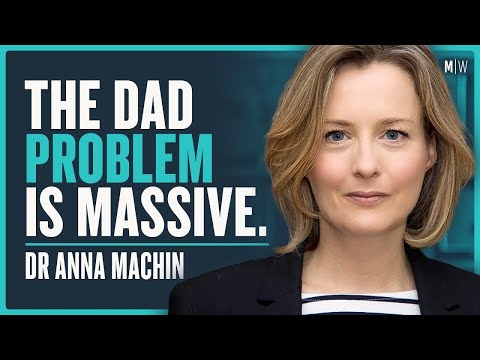
Why Fathers Matter - Dr Anna Machin
Chris Williamson (host), Dr Anna Machin (guest), Narrator
In this episode of Modern Wisdom, featuring Chris Williamson and Dr Anna Machin, Why Fathers Matter - Dr Anna Machin explores evolutionary anthropologist reveals crucial, misunderstood role of modern fathers Dr. Anna Machin argues that dominant cultural narratives about fathers are fictional, unscientific, and damaging to men, children, and families. Drawing on evolutionary anthropology and contemporary research, she explains that human males are biologically primed to parent and that male parental investment was pivotal to our species’ survival. Fathers and mothers are equal in importance but distinct in function: mothers specialize in core nurturing while fathers uniquely scaffold children’s social skills, resilience, and entry into the wider world. She calls for cultural, medical, and policy changes—especially better paternity leave and father-focused support—to recognize fathers as true co-parents rather than optional extras.
Evolutionary anthropologist reveals crucial, misunderstood role of modern fathers
Dr. Anna Machin argues that dominant cultural narratives about fathers are fictional, unscientific, and damaging to men, children, and families. Drawing on evolutionary anthropology and contemporary research, she explains that human males are biologically primed to parent and that male parental investment was pivotal to our species’ survival. Fathers and mothers are equal in importance but distinct in function: mothers specialize in core nurturing while fathers uniquely scaffold children’s social skills, resilience, and entry into the wider world. She calls for cultural, medical, and policy changes—especially better paternity leave and father-focused support—to recognize fathers as true co-parents rather than optional extras.
Key Takeaways
Men are biologically primed to parent, not secondary or non‑instinctive carers.
Contrary to the myth that only mothers are ‘natural’ parents, scans show men’s brains and hormones reshape for caregiving, with increases in empathy, risk detection, and executive function comparable to mothers—just triggered differently and often later.
Get the full analysis with uListen AI
Human fathers evolved because they were essential to our survival.
As big-brained, bipedal babies were born increasingly helpless, maternal and female-kin care became insufficient; male parental investment emerged to keep infants alive, making humans a rare mammal—and the only ape—where fathers routinely invest in offspring.
Get the full analysis with uListen AI
Fathers and mothers have distinct, complementary developmental roles.
While both parents nurture and attach, mothers’ peak brain activation is in ancient limbic regions linked to core caregiving, whereas fathers’ peaks in neocortical social cognition support ‘scaffolding’ children into the wider world—social skills, networks, risk-taking, and resilience.
Get the full analysis with uListen AI
Father–child play, especially rough-and-tumble, is a developmental engine.
Physical, high-energy play rapidly releases bonding hormones and teaches reciprocity, empathy, risk assessment, and persistence; it’s a time-efficient way for often time-poor fathers to build strong bonds and foster resilience from infancy through adolescence.
Get the full analysis with uListen AI
Fathers profoundly influence adolescent mental health and self‑esteem.
Research shows the quality of the father–child relationship predicts teens’ resilience, depression and anxiety risk, and ability to handle daily stress—often with particularly strong protective effects for girls in patriarchal cultures.
Get the full analysis with uListen AI
Postnatal depression and emotional upheaval affect fathers too, but are ignored.
Around 10% of fathers experience genuine postnatal depression, driven by hormonal shifts, sleep deprivation, role conflict, and partner difficulties, yet cultural scripts and healthcare systems rarely acknowledge or screen for it, leaving men unsupported and ashamed.
Get the full analysis with uListen AI
Policy and culture undervalue fathers despite clear societal benefits.
Equal, well-designed paternity leave and father-inclusive antenatal support improve child outcomes, reduce maternal career penalties, and narrow the gender pay gap, yet governments and some strands of feminism resist, treating gains for fathers as losses for mothers.
Get the full analysis with uListen AI
Notable Quotes
“The narrative we have about fathers is a complete fiction… it's based on absolutely zero academic or observational research.”
— Dr. Anna Machin
“Evolution hates redundancy. It would not have evolved fathers unless they were absolutely critical for our species’ survival.”
— Dr. Anna Machin
“Fathers aren’t really there for mothers. Fathers are there for their children.”
— Dr. Anna Machin
“Rough-and-tumble play is the most critical thing fathers can do with their children.”
— Dr. Anna Machin
“If a woman has a problem we ask, ‘What can we do to fix society?’ If a man has a problem, we ask, ‘What can men do to fix themselves?’”
— Chris Williamson
Questions Answered in This Episode
How would parenting norms, healthcare practices, and media change if we fully accepted that men are instinctive, biologically primed parents?
Dr. ...
Get the full analysis with uListen AI
What practical steps can expectant fathers take during pregnancy and early infancy to build a strong bond despite not experiencing birth or breastfeeding?
Get the full analysis with uListen AI
How can single-mother households systematically incorporate ‘social fathers’ (e.g., relatives, coaches, mentors) to provide the unique developmental inputs usually associated with dads?
Get the full analysis with uListen AI
What policy designs for paternity leave have proven most effective in countries that successfully involve fathers, and how could those be adapted elsewhere?
Get the full analysis with uListen AI
In an age of smartphones and rising teen mental health problems, how can fathers best use their unique ‘social scaffolding’ role to buffer daughters and sons against social media–driven harms?
Get the full analysis with uListen AI
Transcript Preview
Why do we need to change the narrative around fathers?
We need to change the narrative about fathers partly because the one we have at the moment is a complete fiction, which is kind of made up from many myths and stories we've been told in our culture over the years about the role of fathers, about their importance to their children, about how they become fathers, how they learn the knowledge to become fathers. And actually, all of this is based upon absolutely zero academic research, absolutely no observational research at all. It's just stories that we've told each other, anecdotes. And because of that, the myths we've built up around fathers are just that, they're myths. They're not actually true, and they are very damaging to fathers, they're damaging to men, and they're also damaging to their families. Um, so the work that I do and those of my colleagues around the world, we do it because we actually want the facts to be out there. We want the stories we tell about fathers to actually be accurate.
Which myths do you wish that you could put into the ground and fully bury about dads?
Uh, the first one I would bury is that fathers, men, are not instinctive parents. So we have this story, and I hear it a lot still from the dads that I study, right before they have children, which is that like mom is an instinctive parent. She's somehow like magically able to do this, whereas dads have to learn. And because of that, they tend to see what mom does as a gold standard of parenting, and whatever they do as a secondary bit of a failure, and actually, it's not true. And we'll probably go into that a little bit later. But we've, we've discovered that men are as biologically primed to parent as women are, which as an evolutionary anthropologist makes perfect sense to me. But that's probably one of the biggest ones because it really undermines a man's confidence that he feels that actually, if he just goes with what his gut is telling him, he will be okay. He really, a lot of them lack a lot of confidence, and they do very much belittle themselves in relation, for example, to what mom is doing.
Yeah, it's, uh, there is a demonization of fatherhood, and I wanna get into this later as well, but I wonder how much of it is a cope in response to single-parent households and us trying to not make children who grow up in single-parent households feel like they're falling behind. Because if we minimize the impact that fathers have on children's rearing, then the people who do grow up with just mom don't feel like they're missing out as, o- on as much. And this is a trend that we see, you know, uh, it's the tyranny of the minority is somehow sometimes how it's categorized. But yeah, it's so, so fascinating. One of the other things, uh, William Costello, who's one of David Buss's students out here, told me a story that you taught him about how fathers saved the human race for extinction because babies' heads got too big.
Install uListen to search the full transcript and get AI-powered insights
Get Full TranscriptGet more from every podcast
AI summaries, searchable transcripts, and fact-checking. Free forever.
Add to Chrome