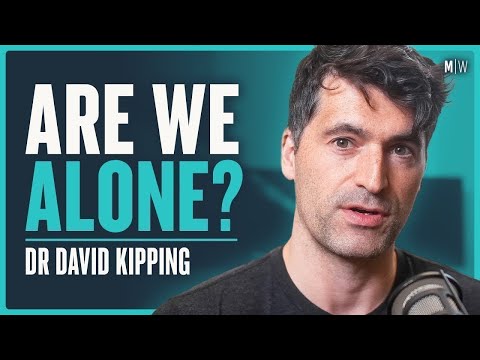
The 3 Body Problem, Aliens & How The World Ends - Dr David Kipping
Chris Williamson (host), Dr David Kipping (guest)
In this episode of Modern Wisdom, featuring Chris Williamson and Dr David Kipping, The 3 Body Problem, Aliens & How The World Ends - Dr David Kipping explores cosmic Rarity, Alien Life, And Humanity’s Precarious Galactic Future Astrophysicist Dr. David Kipping and Chris Williamson explore how physics, astronomy, and cosmology shape our understanding of life’s rarity and humanity’s future in the universe. They discuss scientific method and peer review, quantum entanglement myths, gravity and gravitational waves, and why our solar system and galactic neighborhood may be unusually stable and hospitable. Kipping explains the three‑body problem, exomoons, red dwarf paradoxes, and the conditions needed for life and technological civilizations. The conversation repeatedly returns to the Fermi paradox, deep time, existential risk, and the moral responsibility implied by our seemingly special position in cosmic history.
Cosmic Rarity, Alien Life, And Humanity’s Precarious Galactic Future
Astrophysicist Dr. David Kipping and Chris Williamson explore how physics, astronomy, and cosmology shape our understanding of life’s rarity and humanity’s future in the universe. They discuss scientific method and peer review, quantum entanglement myths, gravity and gravitational waves, and why our solar system and galactic neighborhood may be unusually stable and hospitable. Kipping explains the three‑body problem, exomoons, red dwarf paradoxes, and the conditions needed for life and technological civilizations. The conversation repeatedly returns to the Fermi paradox, deep time, existential risk, and the moral responsibility implied by our seemingly special position in cosmic history.
Key themes include the limits of faster‑than‑light communication, the importance of the Moon and plate tectonics, prospects for star‑lifting and stellar engineering, and why intelligent, sustainable civilizations might be nearly undetectable. Kipping closes by describing his exomoon search with the James Webb Space Telescope and how public support lets his lab pursue high‑risk, high‑reward questions about whether we are alone.
Key Takeaways
Peer review and broad scrutiny are essential, but imperfect, filters for radical ideas.
Kipping notes that academics are inundated with “theories of everything,” and while many are misguided, it’s vital not to crush curiosity or passion; instead, ideas should be exposed to community critique (journals, arXiv, social media) where evidence and explanatory power—not sexiness or contrarianism—determine what survives.
Get the full analysis with uListen AI
Quantum entanglement cannot be used for faster‑than‑light communication.
Entangled particles collapse to correlated states when measured, but each local outcome is irreducibly random and you cannot control or bias those outcomes; once measured, the entanglement is destroyed, so there’s no way to encode and transmit information superluminally.
Get the full analysis with uListen AI
Many‑body gravitational systems are deterministic yet effectively unpredictable over long timescales.
The three‑body problem and solar system simulations show small initial uncertainties get exponentially amplified; while we can statistically characterize outcomes, we can’t precisely forecast planetary configurations billions of years ahead, and even our seemingly stable solar system has a non‑zero chance of large rearrangements (e. ...
Get the full analysis with uListen AI
Our planetary, stellar, and galactic circumstances appear unusually favorable and perhaps rare.
The Sun is quiet and uncommonly sun‑like, Jupiter may shield Earth and enabled our architecture, plate tectonics and a large Moon underpin climate stability and the carbon cycle, and our “suburban” position in the Milky Way avoids the supernova‑rich, dynamically violent galactic center—suggesting multiple layers of “rare Earth/rare solar system/rare suburb” effects.
Get the full analysis with uListen AI
Life may start relatively easily, but complex intelligence and technology could be extremely improbable.
On Earth, life appeared quickly once conditions allowed, but major evolutionary transitions (eukaryotes, sex, multicellularity, intelligence) are spaced almost uniformly across the planet’s habitable window, consistent with Brandon Carter’s ‘hard steps’ model where each step is individually very unlikely; Kipping’s Bayesian work suggests abiogenesis might recur often, while intelligence may not.
Get the full analysis with uListen AI
Red dwarf stars expose a paradox about where most life “should” be and why we might not see it.
Red dwarfs are the most common, live trillions of years, and host many Earth‑size planets, yet early violent activity may strip those worlds of water and atmospheres; Kipping’s “red sky paradox” suggests either we don’t understand their habitability, or there’s some deep reason most conscious observers don’t live around them.
Get the full analysis with uListen AI
Humanity likely sits very early in cosmic time, which clashes with the usual mediocrity assumption.
Given the immense future duration of star formation and long‑lived red dwarfs, we appear in the first tiny “letter” of the universe’s story rather than the middle; resolving this temporal oddity may require rethinking mediocrity, positing catastrophic filters (e. ...
Get the full analysis with uListen AI
Technological civilizations face a coordination problem: their own tools and behaviors are their main existential threat.
Nuclear weapons, climate change, and information overload illustrate how progress can undermine long‑term survival; even if interplanetary settlement raises resilience, true safety would demand interstellar or intergalactic dispersion—and civilizations that actually reach full sustainability might leave almost no detectable technosignatures.
Get the full analysis with uListen AI
Future mega‑engineering (e.g., star‑lifting, orbital migration) is allowed by physics and may be observable.
Kipping describes proposals to gradually move Earth outward using asteroid slingshots or cool the Sun by removing mass with ‘star‑lifting’; similar interventions could prune dangerous stars or extend habitable epochs, and such activities might leave detectable signatures astronomers can search for in other systems.
Get the full analysis with uListen AI
Exomoons are a critical, underexplored frontier for both planetary science and biosignature interpretation.
Moons affect climate, tides, and tectonics, might host subsurface oceans, and will blur the light from future directly imaged Earth‑like exoplanets; Kipping’s team has secured James Webb time to observe a Jupiter analog (Kepler‑167e) where any moons could finally be detected, potentially opening a “post‑exoplanet” era analogous to the exoplanet boom after 1995.
Get the full analysis with uListen AI
Notable Quotes
“Physics and science is like being in love; when you're in love, you just want to sing it to the world.”
— David Kipping
“The most boring outcome is that we understand everything.”
— David Kipping
“Rare Earth, rare solar system, rare suburb.”
— Chris Williamson
“We are at the very first letter of the universe’s story, not even the first page.”
— David Kipping
“We can do whatever the hell we want to do… If we want to destroy our planet, we are totally capable. If we want a civilization that spans the galaxy, that’s within the rules of the game too.”
— David Kipping
Questions Answered in This Episode
If the ‘hard steps’ model of evolution is right, what does that imply about our moral responsibility as potentially one of very few technological civilizations in the galaxy—or even the universe?
Astrophysicist Dr. ...
Get the full analysis with uListen AI
How could we empirically distinguish between ‘we are early and rare’ versus ‘civilizations routinely self‑destruct’ as explanations of the Fermi paradox?
Key themes include the limits of faster‑than‑light communication, the importance of the Moon and plate tectonics, prospects for star‑lifting and stellar engineering, and why intelligent, sustainable civilizations might be nearly undetectable. ...
Get the full analysis with uListen AI
What concrete observational signatures would star‑lifting or large‑scale stellar engineering produce, and how is Kipping’s group or others actively searching for them?
Get the full analysis with uListen AI
If red dwarfs are ultimately the dominant long‑term hosts of habitability, how might our notion of a “typical” conscious observer in the universe need to change?
Get the full analysis with uListen AI
In practice, how will the detection (or strong non‑detection) of exomoons with JWST reshape our models of planet formation, Earth’s uniqueness, and the strategy for future life‑finding missions?
Get the full analysis with uListen AI
Transcript Preview
Dude, I love your YouTube channel. The number of airplane flights that I've been on, delays, sat somewhere where I wish that I wasn't listening to your YouTube channel has been insane. So thank you very much for what you do.
Likewise, I've been listening to your podcast for a while, and you have so many great guests, so much wisdom on the channel, as the name suggests. So I really appreciate being on here as well.
You got tenure. Congratulations.
Yeah. That's a big- big deal for me personally, to hit this landmark. Yeah. I don't know if too many people know what it means, though. I think tenure is a- is a term which may be, outside of academia, it's unclear what that really means.
Yeah. But it's like a- you're allowed to research whatever you want now and no one can tell you no.
(laughs) Right. Uh, ultimate freedom.
Yeah.
That's kind of one way to think about it. It's- yeah, it's supposed to be, I think, ideally that it gives you the ability to pursue much more high-risk endeavors. So maybe as a tenured track faculty, which is what I was before, you're kind of living like day to day. Like, you're- each project has to deliver something within the next quarter, the next year, and everything's kind of very short term, which is how a lot of corporations work, of course. But when you get tenure, you get to think about going truly long term for something which is 10, 20 years, for the rest of your career, and that's exciting. I'm- I'm still trying to figure out exactly what I want to do with my tenure, but it's an amazing gift to have.
Speaking of high-risk, explorative conversations, did you listen to Terrence Howard on Joe Rogan?
I did. I was actually listening this morning, I was in the gym and I was listening to Neil deGrasse Tyson's video, which was a response-
Me too. Me too.
... to it. And the- and I think Neil did a great job in being very respectful and thoughtful and polite, but at the same time, forcefully pushing back, uh, about many of the things which, uh, were questionable in- in this treatise that- that Terrence had come up with.
What did you make of the conversation with Joe? 'Cause there's been a lot of, uh, I think- it caused a lot of ripples. Uh, a lot of people were very excited, and, you know, it seems like it's upended or some people believe that it was able to upend mathematics, and, you know, there's sort of a narrative, it's personified there, keeping the real information from us, type thing. What did it feel like as someone who kind of lives in the world of maths and- and physics listening to that conversation?
Yeah. I- I only saw snippets of the conversation, but I will say that it's not unusual to see a reaction like this. I know it's kind of blown up on social media, and- and in social media world, perhaps it's unusual. But in my world, I receive letters every day coming through my- through my post box with theories and ideas. I get, of course, many, many blind emails, cold emails saying, "Here's my theory of everything. Please check it out. You know, I've proved that Einstein is wrong." This kind of stuff. It's very, very common to, not just myself, but many academics, we are used to this. And I think Neil is in the same boat. I'm sure he gets tons of those kinds of pet theories sent to him as well. And so, you know, they range from, uh, from some of them are just a complete crapshoot, to some of them, there's some serious thought in it. And I think Terrence actually did try to put some thought into it, despite the fact there was many missteps and, uh, misrepresentations of- of other information that- that predates his ideas. However, I think it is true what Neil said, that it is really important that we don't kill that- that idea, that- that love and that passion, because I was that person once. I remember when I was probably 11 years old, I wrote a theory, uh, and I sent it to my- I gave it to my physics teacher at school, and I said to him, "I think I've proven, there's like a new relativity theory that I've proven." And it was something about clocks ticking at different rates to different observers, and it was kind of like a proto-relativity. So I hadn't actually (laughs) I'm not claiming like I, you know, independently invented relativity or anything. But I wasn't aware of relativity, and it just struck me that somebody approaching a clock close to the speed of light would see the rate at which it ticks be very different to someone flying away from the clock. And so does that have some in- interesting implications about time? And so I wrote one of those crazy, not crazy, but, you know, not- not well-informed, let's just say-
Install uListen to search the full transcript and get AI-powered insights
Get Full TranscriptGet more from every podcast
AI summaries, searchable transcripts, and fact-checking. Free forever.
Add to Chrome