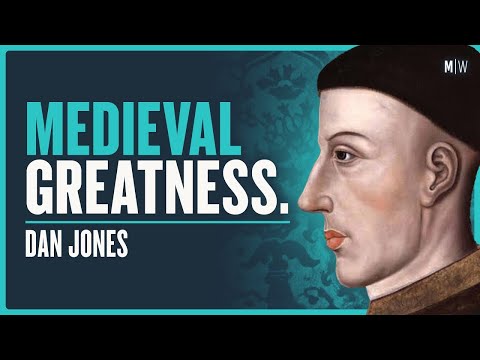
The Rise Of England’s Greatest King: An Untold Story - Dan Jones
Chris Williamson (host), Dan Jones (guest)
In this episode of Modern Wisdom, featuring Chris Williamson and Dan Jones, The Rise Of England’s Greatest King: An Untold Story - Dan Jones explores henry V: Medieval GOAT, Wartime CEO, And Cautionary Legend Explained Dan Jones discusses why Henry V merits a major biography, framing him both as the archetypal medieval king and as a case study in crisis leadership. He traces Henry’s unlikely path to the throne, his brutal formative years in Wales and at Shrewsbury, and the near‑fatal arrow wound that likely convinced Henry he was divinely spared for a purpose. The conversation unpacks Henry’s hands‑on military style, political ruthlessness, and intense personal austerity, culminating in Agincourt, the conquest of Normandy, and his abrupt death from disease at 35. Jones and Williamson then zoom out to compare “great man” history versus structural forces, the uses and abuses of moralizing the past, and how studying history offers perspective amid today’s hyper‑online politics.
Henry V: Medieval GOAT, Wartime CEO, And Cautionary Legend Explained
Dan Jones discusses why Henry V merits a major biography, framing him both as the archetypal medieval king and as a case study in crisis leadership. He traces Henry’s unlikely path to the throne, his brutal formative years in Wales and at Shrewsbury, and the near‑fatal arrow wound that likely convinced Henry he was divinely spared for a purpose. The conversation unpacks Henry’s hands‑on military style, political ruthlessness, and intense personal austerity, culminating in Agincourt, the conquest of Normandy, and his abrupt death from disease at 35. Jones and Williamson then zoom out to compare “great man” history versus structural forces, the uses and abuses of moralizing the past, and how studying history offers perspective amid today’s hyper‑online politics.
Key Takeaways
Extraordinary impact often rests on a long, gritty apprenticeship, not sudden genius.
Henry V’s nine-year reign was so effective largely because he’d spent over a decade learning war, finance, and governance in Wales and at court; by 26 he could “hit the ground running” rather than learn kingship on the job.
Get the full analysis with uListen AI
Near‑death experiences can forge a powerful sense of destiny—and leadership authority.
Surviving a longbow arrow embedded six inches in his skull and a 30‑day experimental surgery seems to have convinced Henry he was preserved by God for a mission, a belief he later used to galvanize followers as “God’s instrument.”
Get the full analysis with uListen AI
Effective leadership in crisis combines vision, relentless execution, and visible presence.
Henry listened to grievances, defined clear objectives, and then obsessively followed through—touring siege lines daily, micromanaging logistics, and constantly pressing subordinates with ‘see that you fail not thereof.’
Get the full analysis with uListen AI
Competence without succession planning creates a ‘curse of competence’ for successors.
Henry built an overextended Anglo‑French empire but died at 35, leaving an infant heir and no one with his authority to renegotiate his hardline terms; that rigidity helped destabilize England and fed into the Wars of the Roses.
Get the full analysis with uListen AI
Context matters: actions that look barbaric now could be rational within their time.
Henry’s order to kill French prisoners at Agincourt is often denounced today, but Jones argues that, amid a chaotic battlefield and looming second attack, it was a militarily logical move under medieval laws of war.
Get the full analysis with uListen AI
History is shaped by both big forces and singular personalities—and you need both lenses.
Jones contrasts climate shifts, pandemics, and technology (like the Little Ice Age or printing press) with outsized figures like Henry V, arguing that modern politics (Trump, Putin, etc. ...
Get the full analysis with uListen AI
Using history mainly as a morality play for today weakens understanding and honesty.
They criticize the trend of treating historians as ‘time‑traveling policemen’ who exist to condemn the past by current values, rather than to reconstruct what happened and why with nuance, evidence, and restraint.
Get the full analysis with uListen AI
Notable Quotes
“Henry V was considered, in his day and thereafter, to be the GOAT of medieval kingship.”
— Dan Jones
“He hits the ground running; he doesn’t have to learn on the job, he’s just ready to go.”
— Dan Jones
“From the moment he survives that arrow in the face, he seems to believe God has kept him on Earth because God wants him to do something.”
— Dan Jones
“It’s very foolish to think you’re either one thing or the other politically; how often does an entire party package map onto one individual’s thoughts?”
— Dan Jones
“Reading history feels like looking up through a tree—your vision widens and you suddenly breathe a bit more slowly.”
— Chris Williamson
Questions Answered in This Episode
To what extent did Henry V’s sense of divine mission enhance his effectiveness versus blinding him to long‑term risks?
Dan Jones discusses why Henry V merits a major biography, framing him both as the archetypal medieval king and as a case study in crisis leadership. ...
Get the full analysis with uListen AI
If Henry had lived another decade, how might he realistically have reshaped the settlement with France and avoided later civil wars?
Get the full analysis with uListen AI
Where should modern historians draw the line between explaining historical actors and morally judging them for contemporary audiences?
Get the full analysis with uListen AI
How do we balance the ‘great man’ focus on figures like Henry V with structural explanations such as climate change and pandemics?
Get the full analysis with uListen AI
What lessons from Henry V’s leadership—both his strengths and his blind spots—are actually transferable to modern political or business leaders?
Get the full analysis with uListen AI
Transcript Preview
Why write a book about Henry V? Why is he sufficiently important for you to spend, uh, several thousand words talking about him?
Well, um, in a sense it's what I do. I mean, I, I write mostly medieval history books, um, and so there's a personal element to it which is like, um, unfinished business. So early in my career, I wrote a book called The Plantagenets, and that was like a dynastic history of the great English medieval dynasty that started in the 1150s with Henry II, founder of the dynasty, and worked up to Richard II, who was deposed in 1399. Then I wrote another book about The Wars of the Roses, which took the- the last half of the dynasty, and that started in 1420, marriage of Henry V and Catherine de Valois, and it went up to the early Tudor period. So that left a little slice of 21 years, mostly, uh, covering Henry V's life. So, uh, filling that gap, that Henry V-shaped hole, um, was sort of important in- in completing a sort of run of books, a- not quite a trilogy, but a triptych in my oeuvre, or canon, if you will. Um, but there's- I think there's a more important point th- than that. With regards to the subject himself, Henry V is considered, in his day and thereafter, for hundreds of years, to be the acme, the paradigm, the, um, the- the- the GOAT of medieval history.
Was he like a British Aurelius?
Kind of, yes. You know, uh, or a little bit like Alexander the Great. Um, just considered the best who ever did it, you know, who really understood every side of kingship and performed it, and was then, you know, it- bec- his name became a byword for great kingship. So I- I think that biographical studies tend to be very interesting if they're about somebody who's the best at doing something or the worst at doing something, and Henry's the best. So i- if you're a medievalist, this is- this is a, you know, a landscape you've got to approach at some point. But the basi- the biggest reason, probably, to write it now is that Henry's life can be read, even if you're not interested in medieval history, which I accept there are a few people in the world still left who aren't, um, it can be read as a- a great case study of leadership in a time of crisis, because he comes to power when you've got a- a realm that's, like, politically partisan, fractious, divided, two kind of camps at each other's throats. Um, you've got sort of the lingering aftereffects of a pandemic. You've got a kind of period of- of at least regional, possibly global climate change. You've got, um, you know, a- a real sense of hopelessness around politics in particular, and failed foreign policy as well, but a hopeless sense around politics in particular, that- that feels like it's intractable, that it- it's un- unsolvable. And yet along comes one guy, seemingly almost out of nowhere, who through the force of personality, charisma, competence, diligence, probity, moral example, drags his realm from the doldrums to the peak of triumph. And I think that's something- that's an attractive idea today. In some ways, that's like everybody's kind of fantasy today, like who, whether you're in the United States, whether in Europe, whatever, outside probably the- the tyrannous autocracies of the world, that is the- the kind of thing everyone's looking for at the moment. So it- although Henry V is not an analogy for American politics directly, he's not a parable, his story does speak to themes that I think are really in the air in the world at the moment.
Install uListen to search the full transcript and get AI-powered insights
Get Full TranscriptGet more from every podcast
AI summaries, searchable transcripts, and fact-checking. Free forever.
Add to Chrome