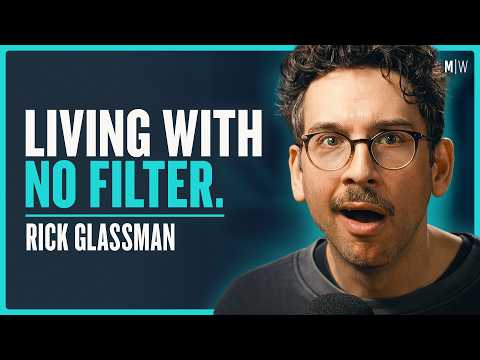
The Case Against Condoms & Fake Friendship - Rick Glassman (4K)
Chris Williamson (host), Rick Glassman (guest), Chris Williamson (host)
In this episode of Modern Wisdom, featuring Chris Williamson and Rick Glassman, The Case Against Condoms & Fake Friendship - Rick Glassman (4K) explores rick Glassman and Chris Williamson dissect honesty, boundaries, and social games Rick Glassman frames intimacy—sexual and social—as being most fulfilling when you can be fully present and freely communicate needs, boundaries, and discomforts without “performing.”
Rick Glassman and Chris Williamson dissect honesty, boundaries, and social games
Rick Glassman frames intimacy—sexual and social—as being most fulfilling when you can be fully present and freely communicate needs, boundaries, and discomforts without “performing.”
He uses condoms as a central metaphor for emotional distance: if you don’t feel safe enough to say what’s real (or hear it), you’re forced into guarded, battery-draining interactions.
Chris and Rick explore the tension between self-love and self-improvement, arguing for accepting who you are today while still working to reduce how much your quirks become other people’s burden.
They go deep on conversational “games,” reverse charisma (making others feel interesting), people-pleasing as self-protection, and Rick’s OCD/misophonia-driven lifestyle systems—ending with practical insights on engineering good podcasts and better human connection.
Key Takeaways
Build relationships where boundaries can be stated plainly.
Rick’s ideal dynamic is being around people who can say “Rick, be quiet” or “I don’t like this anymore,” because it removes guesswork and lets him stay present rather than hypervigilant.
Get the full analysis with uListen AI
Presence is upstream of performance.
Before stand-up, Rick drops the goal of “be funny” and aims for “be present,” arguing that presence is the controllable input that best predicts a good outcome.
Get the full analysis with uListen AI
Treat feedback as data, not identity critique.
“You’re being loud” isn’t an indictment of who you are; it’s information about someone else’s comfort. ...
Get the full analysis with uListen AI
Small talk is often a low-bandwidth signal, not a real question.
They discuss “How are you? ...
Get the full analysis with uListen AI
People-pleasing often prioritizes self-safety over honesty.
Rick argues many “people pleasers” are mainly trying to ensure others are okay *with them*, avoiding discomfort and protecting self-image rather than serving the other person.
Get the full analysis with uListen AI
Self-acceptance and self-improvement must be balanced—daily.
Chris frames the extremes as victimhood vs. ...
Get the full analysis with uListen AI
Reverse charisma is a learnable shortcut to connection.
Chris distinguishes being interesting from making others feel interesting; asking thoughtful questions and reflecting back emotions can produce intimacy even for “low energy” personalities.
Get the full analysis with uListen AI
Calling out the “game” can deepen connection—if it includes the other person.
Rick likes naming what’s happening (“Are we doing bits? ...
Get the full analysis with uListen AI
Attraction and status can override better judgment—notice it early.
Rick’s late-night date story shows how beauty/novelty kept him engaged despite repeated flakiness. ...
Get the full analysis with uListen AI
Podcast chemistry improves when pre-talk is limited and regulation is subtle.
Chris avoids long dinners/extended foreplay so the best conversation happens on-camera, and uses pauses and calm pacing (“vagal authority”) to steady a nervous guest without explicitly calling them out.
Get the full analysis with uListen AI
Notable Quotes
“Having sex with a condom… it’s like I’m having sex with contacts. I’m just aware they’re there.”
— Rick Glassman
“I want to be with people who just say, ‘Rick, be quiet.’”
— Rick Glassman
“The self-love movement is beautiful and necessary, but not at the expense of growth.”
— Rick Glassman
“When somebody says you have a booger in your nose, you’re like, ‘Oh, I want to be around this person.’”
— Rick Glassman
“Some people are interesting, some people make people feel interesting.”
— Chris Williamson
Questions Answered in This Episode
Rick, when you say “don’t have friendships where you have to wear a condom,” what are 3 concrete behaviors that signal a friendship is ‘safe’ enough for that?
Rick Glassman frames intimacy—sexual and social—as being most fulfilling when you can be fully present and freely communicate needs, boundaries, and discomforts without “performing.”
Get the full analysis with uListen AI
How do you decide when calling out the game is clarifying versus when it’s ‘too much meta’ and derails momentum? What’s your internal rule?
He uses condoms as a central metaphor for emotional distance: if you don’t feel safe enough to say what’s real (or hear it), you’re forced into guarded, battery-draining interactions.
Get the full analysis with uListen AI
Chris, can you define “reverse charisma” into a repeatable framework (question types, timing, follow-ups) that someone could practice for a week?
Chris and Rick explore the tension between self-love and self-improvement, arguing for accepting who you are today while still working to reduce how much your quirks become other people’s burden.
Get the full analysis with uListen AI
Rick, with OCD accommodations (blankets, shoes-off), where’s your line between self-acceptance and asking others to carry your burden? How do you measure progress?
They go deep on conversational “games,” reverse charisma (making others feel interesting), people-pleasing as self-protection, and Rick’s OCD/misophonia-driven lifestyle systems—ending with practical insights on engineering good podcasts and better human connection.
Get the full analysis with uListen AI
In the flakiness/date story, what would “healthy boundaries” have looked like at each time change (5→7→8:30→9→10→11)? What would you do now?
Get the full analysis with uListen AI
Transcript Preview
I'm cosplaying as you.
I know.
What do we think? How do you, how do you rank my look?
I would wear it.
Nailed it.
And I was flattered, 'cause we don't really know each other, but you said, like, "Are you gonna wear a nice jumper?" And I'm like, "That's kind of my thing."
Yeah, of course it is. You seem like a very cozy guy.
Thank you.
If I could describe you in a single word, based on five minutes of interaction-
Mm
... and watching some stuff on the internet, it would be cozy.
I like to wear things that I could sleep in, but I also know that sometimes if you show up someplace wearing something that-- sometimes you wear something someplace, and people feel offended based on what you're wearing. And it's like, I, okay. Um, so let me just find some really cool clothes that I could trick you into thinking is, "Oh, look it, I could wear this to the big dance"-
Mm.
" -but also I could go home and sleep in it."
Mm. No, I, I optimize for comfort as well. Mine leans a little bit to sportswear-y, which there's not really much that you can do to kind of elevate sport. If you're going out for a dinner or whatever, and you're in a, like, a Lululemon fucking T-shirt or something, y- you're a little bit, you're struggling.
When you wear sports clothes, you're not wearing something to elevate the clothes. You're wearing clothes to elevate the body-
Mm.
-and you have a body for it. I've been saying it for weeks. But you have a body-
Trust me
... that shows the veins.
Uh-huh.
So.
Well, this, I could get away with this. I feel like, uh, it's like a cup of cocoa, like both hands.
Mm.
Holding it with both hands. It's very important.
Another way I think of that is, like, if this were a rom-com in the early 2000s, and you would be a beautiful woman, and you would, you would be wearing that, but you would be... It would be like this. Yeah, and I would think you were ugly as shit until you took your glasses off.
And I'd have my, I'd have my glasses down here.
Oh, you're ugly!
My hair's up in a bun, and I'd like, pull them like this and go-
Oh-ho-ho, yeah, then you get a, can I say boner?
Yeah, yeah.
Yeah, then you get a boner. Then you get a boner.
Uh-huh. I heard you talk about, um, like, random erectile dysfunction and the-
RED
... the subsequent fallout, the s- the, sort of the, the negotiation that you have.
Where did you hear me talk about this?
You were freestyle rap-- someone, it was, like-
Right
... in your show.
Yeah, with Kosta Kontra.
Yeah, and uh-
[chuckles]
... you were trying to explain to four surly Black men, um, who I didn't think would be that forgiving of a conversation-
Install uListen to search the full transcript and get AI-powered insights
Get Full TranscriptGet more from every podcast
AI summaries, searchable transcripts, and fact-checking. Free forever.
Add to Chrome