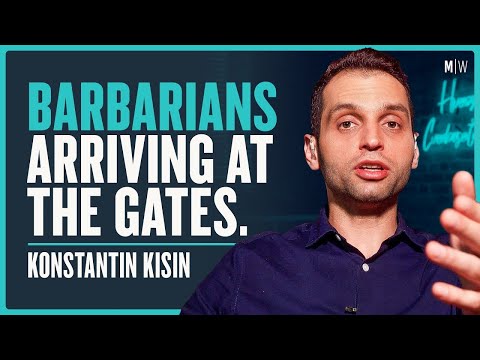
The West Is Under Attack By Woke Culture - Konstantin Kisin
Konstantin Kisin (guest), Chris Williamson (host)
In this episode of Modern Wisdom, featuring Konstantin Kisin and Chris Williamson, The West Is Under Attack By Woke Culture - Konstantin Kisin explores immigrant comedian warns West: woke dogma weakens civilization’s defenses Konstantin Kisin argues that contemporary ‘woke’ politics and online censorship mirror aspects of Soviet-era political correctness, where speech is policed to enforce an ideological party line rather than truth or politeness.
Immigrant comedian warns West: woke dogma weakens civilization’s defenses
Konstantin Kisin argues that contemporary ‘woke’ politics and online censorship mirror aspects of Soviet-era political correctness, where speech is policed to enforce an ideological party line rather than truth or politeness.
He contends that Western societies are uniquely free and tolerant by historical standards, yet have cultivated a culture of self‑hatred, racialized thinking, and institutionalized double standards that erode social cohesion and resilience.
Kisin links this internal cultural fragmentation to external geopolitical risk, claiming that adversaries like Russia and China exploit Western distraction and division, and that such weakness emboldened moves like Russia’s invasion of Ukraine.
Despite this, he believes the West can recover by re‑centering moderation over extremes, restoring free speech norms, reforming institutions and education, and rekindling appreciation for Western achievements and shared identity.
Key Takeaways
Modern ‘wokeness’ echoes Soviet political correctness by prioritizing ideology over truth.
Kisin argues that political correctness was designed in the USSR and Maoist China to enforce the party line; today’s bans for ‘deadnaming’ or misgendering reflect the same logic—punishing factually accurate statements if they conflict with prevailing ideology.
Get the full analysis with uListen AI
Twitter’s speech rules shape broader cultural norms and real‑world censorship.
He maintains that because elite discourse and media narratives are driven by Twitter, platform moderation decisions cascade into news agendas, institutional policies, and people’s willingness to allow or disinvite controversial voices offline.
Get the full analysis with uListen AI
The West is historically exceptional for minority rights, yet is taught to see itself as uniquely racist.
Drawing on his own experience of mild racism and broad acceptance in Britain, Kisin insists that Anglosphere countries remain the best places for minorities, but conceptual inflation and professionalized ‘DEI’ industries magnify and redefine racism to sustain a crisis narrative.
Get the full analysis with uListen AI
Uncontrolled or undemocratically managed immigration undermines public trust in democracy.
He supports modest, skills‑based, legal immigration chosen by citizens (citing Australia) and humane refugee support near conflict zones, but warns that mass illegal entries and ignored voter preferences fuel resentment and political backlash.
Get the full analysis with uListen AI
Extremes on both left and right are dangerous, but currently the far left is more institutionally empowered.
Kisin fears the far right more if both sides were equally strong due to its comfort with violence, yet says today the radical left is backed by major corporations and institutions, driving overreach that may provoke a harsh right‑wing reaction.
Get the full analysis with uListen AI
Adversaries weaponize Western cultural conflict and information overload.
Referencing Yuri Bezmenov, Kisin and Williamson suggest Russia and China amplify internal divisions via bots, propaganda, and support for destabilizing movements, while the sheer volume of conflicting information leaves citizens confused, passive, and easier to influence.
Get the full analysis with uListen AI
Western survival depends more on internal cultural strength than external threats.
Kisin believes barbarians at the gate are inevitable, but not fatal to a united, confident, and functional West; the real danger is a civilization that no longer believes in itself, cannot converse across differences, and abandons shared identity for fragmented tribalism.
Get the full analysis with uListen AI
Notable Quotes
“Political correctness is saying to people, 'Yes, what you're saying may be factually correct, but it is inconvenient to the party line. It is politically incorrect.'”
— Konstantin Kisin
“We live in one of the most welcoming, tolerant, open societies in the history of the world. Maybe we should just pause for a moment and appreciate that before we beat ourselves up.”
— Konstantin Kisin
“Most of the culture war consists of people sneering at the other side's extremists.”
— Chris Williamson
“No great society can survive the destruction of its own culture from within.”
— Konstantin Kisin
“If we continue down this path, we're gonna end up in a bad place… but if we can bring the pendulum back to a sensible moderate position, we have absolutely nothing to fear from anybody.”
— Konstantin Kisin
Questions Answered in This Episode
To what extent is it fair to equate contemporary ‘woke’ norms with Soviet-style political correctness, and where does that analogy break down?
Konstantin Kisin argues that contemporary ‘woke’ politics and online censorship mirror aspects of Soviet-era political correctness, where speech is policed to enforce an ideological party line rather than truth or politeness.
Get the full analysis with uListen AI
How should liberal democracies balance protecting vulnerable groups from harassment with preserving robust free speech and open debate online?
He contends that Western societies are uniquely free and tolerant by historical standards, yet have cultivated a culture of self‑hatred, racialized thinking, and institutionalized double standards that erode social cohesion and resilience.
Get the full analysis with uListen AI
If Western societies are historically exceptional on minority rights, what explains the powerful narrative that they are uniquely racist and oppressive?
Kisin links this internal cultural fragmentation to external geopolitical risk, claiming that adversaries like Russia and China exploit Western distraction and division, and that such weakness emboldened moves like Russia’s invasion of Ukraine.
Get the full analysis with uListen AI
What concrete reforms in education and institutions could rebuild a shared civic identity without erasing legitimate grievances of minorities and dissenters?
Despite this, he believes the West can recover by re‑centering moderation over extremes, restoring free speech norms, reforming institutions and education, and rekindling appreciation for Western achievements and shared identity.
Get the full analysis with uListen AI
How can individuals practically filter information and resist manipulation by both domestic culture warriors and foreign propaganda in a hyper‑connected media environment?
Get the full analysis with uListen AI
Transcript Preview
Political correctness is saying to people, "Yes, what you're saying may be factually correct, but it is inconvenient to the party line. It is politically incorrect." And that is one of the reasons that I've been so troubled by many of the developments we've seen in the Western world in recent times. (wind blows)
Konstantin Kisin, welcome to the show.
It's good to be back, man.
Jordan Peterson and Dave Rubin are banned from Twitter. What's going on?
Well, (laughs) nothing new there, really. (laughs) It's just, uh, more of the same, I think. Uh, no, it, I was, uh, talking to, with my co-host for Triggernometry, Francis, about this in the studio today, and I was saying, can you imagine that- that they've- we've got to a point where to- to state a historical fact about someone's biography is now a crime, essentially, es- at least in Twitter's eyes. You're gonna get banned from a social media platform for- for stating historical fact about a- an individual, which is what both, uh, Jordan and Dave have done here. Uh, and it- I think it speaks to the situation that we're in, which is, uh, the ideology behind all of this has just become so perverse and has been allowed to run amok so far that we live in this clown world, uh, and unless E- Elon Musk is able to take over and change some of this, I don't s- I don't really see how- how we're gonna get out of it.
Do you think Twitter's that important as a... Is it still the town square for public discourse?
I do think that, and of course, you could say, well, only whatever percent of the public, even in- in Western countries are on Twitter, and it's true. But then that is where the discourse happens, 'cause most people aren't on Twitter 'cause they don't wanna be part of the discourse. They actually have, you know, jobs and kids and- and things they actually wanna achieve in their life instead of getting angry with each other. So, I do think it's the public square and I do think it's really important, and I also think it's essential that correct principles are modeled in the space, because the sort of high culture discourse then leaks out into the rest of society, and you see it, you know, in my former career of comedy, people now f- happily getting up in the middle of a gig and shouting stuff at comedians. Not in the old way where it used to be a sort of heckling and battling, and that used to be fun. I really used to enjoy that. But it's like, no, they'll go to complain to the people who run the club afterwards and demand that this comedian's never allowed to perform. So it- I think the sort of behavior that's modeled in this type of public square is actually really important, and of course, the rules they impose then get filtered down to other areas as well. And other people feel, well, you know, if Twitter's gonna shut these people down, well, we're allowed to shut them down in real life, where they, you know, not invite them to speak or ban them from speaking and so on. So I do think it's really, really important actually, yeah.
Install uListen to search the full transcript and get AI-powered insights
Get Full TranscriptGet more from every podcast
AI summaries, searchable transcripts, and fact-checking. Free forever.
Add to Chrome