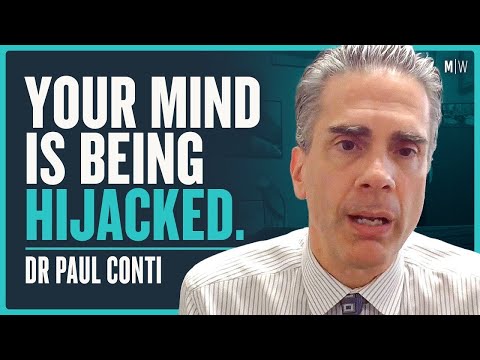
How To Fix Your Negative Inner Thoughts - Dr Paul Conti
Chris Williamson (host), Dr. Paul Conti (guest)
In this episode of Modern Wisdom, featuring Chris Williamson and Dr. Paul Conti, How To Fix Your Negative Inner Thoughts - Dr Paul Conti explores rewriting Trauma: How to Disarm Your Negative Inner Voice Dr. Paul Conti explains how the unconscious mind, driven by safety and salience, shapes our perceptions, memories, and inner narratives—especially after trauma. He distinguishes acute, chronic, and vicarious trauma, showing how each can rewire brain chemistry, heighten vigilance, and even alter our remembered past. The conversation explores how guilt and shame act as powerful but often maladaptive survival mechanisms that keep people from seeking help and cement negative self-beliefs. Conti emphasizes that these patterns are scientifically understandable, reversible over time, and best addressed through insight, storytelling, and curiosity about our inner voice.
Rewriting Trauma: How to Disarm Your Negative Inner Voice
Dr. Paul Conti explains how the unconscious mind, driven by safety and salience, shapes our perceptions, memories, and inner narratives—especially after trauma. He distinguishes acute, chronic, and vicarious trauma, showing how each can rewire brain chemistry, heighten vigilance, and even alter our remembered past. The conversation explores how guilt and shame act as powerful but often maladaptive survival mechanisms that keep people from seeking help and cement negative self-beliefs. Conti emphasizes that these patterns are scientifically understandable, reversible over time, and best addressed through insight, storytelling, and curiosity about our inner voice.
Key Takeaways
Safety and salience drive what the unconscious prioritizes.
The brain is wired to keep us alive first, so anything tied to potential danger—especially negative or traumatic events—gets disproportionate attention and automatic processing, long before conscious thought kicks in.
Get the full analysis with uListen AI
Trauma often rewrites your story about who you’ve “always” been.
After trauma, people commonly misremember their past as if they were always anxious, unconfident, or avoidant; this is the brain painting with a broad safety brush, not an accurate biography, and it can be challenged and revised.
Get the full analysis with uListen AI
Guilt and shame are survival tools that easily become self-sabotaging.
Originally meant to correct dangerous behavior in small groups, guilt and shame now frequently lock trauma away, prevent people from seeking help, and maintain destructive inner narratives about worthlessness or blame.
Get the full analysis with uListen AI
Chronic and vicarious trauma can be as damaging as a single ‘big’ event.
Long-term denigration, background stress (like poverty), and constant exposure to others’ suffering (e. ...
Get the full analysis with uListen AI
The negative inner voice is learned, over-practiced—and changeable.
Repeated self-criticism lays down strong neural patterns much like repeating a word thousands of times; they don’t vanish overnight, but with time, insight, and alternative self-talk, they can weaken and recede from consciousness.
Get the full analysis with uListen AI
Curiosity about your thoughts is a powerful antidote to being controlled by them.
By noticing a harsh inner statement, asking whether you actually believe it, and allowing an internal ‘counter-voice’ to respond, you begin to treat that negativity as something separate and optional rather than as truth.
Get the full analysis with uListen AI
Narrative work—journaling, talking, structured reflection—exposes unconscious patterns.
Turning swirling thoughts into words, on paper or with a trusted person or therapist, recruits new brain systems, reveals hidden assumptions, and often leads to insight and symptom relief even before formal techniques are applied.
Get the full analysis with uListen AI
Notable Quotes
“Trauma does not have to have this kind of control over us.”
— Dr. Paul Conti
“Our memories don't have meaning in and of themselves; they're brought to life by the emotion that's attached to them.”
— Dr. Paul Conti
“No one comes out of the womb thinking abuse is okay for me.”
— Dr. Paul Conti
“The greatest external control mechanism upon us is the one we don’t see that alters even our memory so we don’t recollect accurately.”
— Dr. Paul Conti
“Be curious. It’s interesting what’s going on in our minds.”
— Dr. Paul Conti
Questions Answered in This Episode
How can someone practically distinguish between a genuine safety signal and a trauma-driven overreaction in day-to-day life?
Dr. ...
Get the full analysis with uListen AI
What are some concrete first steps for a person who suspects that a long-standing belief about themselves was actually formed by trauma?
Get the full analysis with uListen AI
How might healthcare systems realistically integrate insight-oriented mental health approaches into brief primary-care visits?
Get the full analysis with uListen AI
To what extent can epigenetic trauma effects be reversed within a single lifetime through psychological or environmental change?
Get the full analysis with uListen AI
How can we balance staying informed through news and social media with protecting ourselves from vicarious trauma and chronic stress?
Get the full analysis with uListen AI
Transcript Preview
What are people talking about when they refer to the unconscious mind?
A lot of times, people are talking about a- a mystery that they kind of know is within them because it gets talked about, but they're not sure how much of an influence does that have over me. Like, is that me, but I'm not aware? Do I know who I am consciously, but then there's other things in the background? And- and I think often, it can be confusing and even scary if we don't understand, what does that mean? How does it have control over us if we think, like, us is the conscious part of us, and how can we have control over it?
Yeah. It's strange to think, what does it mean that there's a part of me I'm basically entirely unaware of that somehow influences me in ways that I can become aware of?
Right. Right. Right. And that's why the sort of height of- of understanding ourselves through the- the- the lens of understanding all aspects of the mind, including the unconscious mind, includes an awareness of some of what's going on there, but also an awareness that we're not aware of it all.
(laughs) Yeah. It's a little bit of a paradox. Why- why is it so important? Is there an analogy? Is it- is it like the surface web and the dark web? Is it 99% of ourselves are unconscious and only 1% of us is conscious?
Well, far more of us is unconscious than conscious. Far, far more of us. The- the iceberg model where the- our conscious mind is a little part of the iceberg that's above the water, but the vast majority of it is underwater. We need that in order to be able to move through time. You know, just like, say, a car engine might be, you know, rotating several thousand, uh, revolutions per minute, right? We're not aware of all those revolutions, but that needs to happen for us to seamlessly be able to maneuver the car forward. Right? So in a far more complicated way, that's going on inside of us, where there are thousands upon thousands upon thousands of c- of calculations that are going on so that we can sum things and come up to the consciousness where we can then make conscious decisions. So- so even the idea of, say, walking down the street and seeing someone walking towards you, right? There's so much that then goes on. What does that person look like? Does that person... Is the person looking at you or are they looking down? If they're looking at you, do they look happy? Do they look not happy? Do you recognize them? Do you not recognize them? Are there markers of threat? Are there not markers of threat? You're- you know, we're doing all sorts of things. And let's say, that person looks like someone who had been aggressive before, but is not that person. Then we're triggered to, like, have this- an extra sense of anxiety and tension that all that happens automatically. Then we have to say, "Okay, but it's- but it's not a person who's been aggressive before." But it all goes on in us in a way of kind of bringing us up to speed with that moment so that we can make whatever conscious decision we're making. So the conscious decision could be walk to the other side of the street or say hello or look down. You say, "Oh, you're just doing one thing." You're only- you're doing one thing because it's riding atop thousands upon thousands of things that let you, i- in the conscious world, so to speak, do the one thing that there- that choice that there is to make.
Install uListen to search the full transcript and get AI-powered insights
Get Full TranscriptGet more from every podcast
AI summaries, searchable transcripts, and fact-checking. Free forever.
Add to Chrome