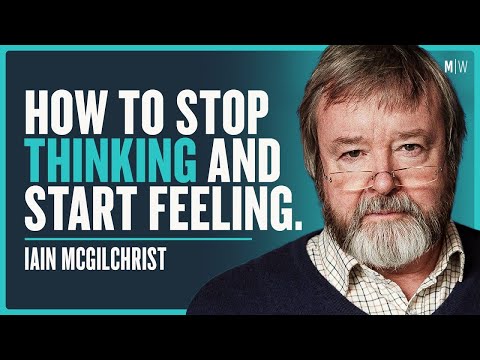
The Wisdom Of Intuition - Iain McGilchrist
Iain McGilchrist (guest), Chris Williamson (host)
In this episode of Modern Wisdom, featuring Iain McGilchrist and Chris Williamson, The Wisdom Of Intuition - Iain McGilchrist explores iain McGilchrist: Recovering Intuition, Wisdom, And The Sacred World Iain McGilchrist explains his life’s project: challenging the mechanistic, soulless view of reality and arguing that the world is rich, meaningful, and spiritually alive. Drawing on neuroscience, philosophy, and cultural history, he contrasts the narrow, grasping left-hemisphere mode with the contextual, intuitive, meaning-oriented right hemisphere. He contends that modern civilization has become dangerously lopsided toward left-hemisphere thinking, amplified by technology, bureaucracy, and reductive rationalism, leading to a loss of wisdom, tradition, and a sense of the sacred. McGilchrist argues for rehabilitating intuition, rebalancing ways of knowing, and recognizing the inherently moral nature of attention and human life.
Iain McGilchrist: Recovering Intuition, Wisdom, And The Sacred World
Iain McGilchrist explains his life’s project: challenging the mechanistic, soulless view of reality and arguing that the world is rich, meaningful, and spiritually alive. Drawing on neuroscience, philosophy, and cultural history, he contrasts the narrow, grasping left-hemisphere mode with the contextual, intuitive, meaning-oriented right hemisphere. He contends that modern civilization has become dangerously lopsided toward left-hemisphere thinking, amplified by technology, bureaucracy, and reductive rationalism, leading to a loss of wisdom, tradition, and a sense of the sacred. McGilchrist argues for rehabilitating intuition, rebalancing ways of knowing, and recognizing the inherently moral nature of attention and human life.
Key Takeaways
Rebalance how you know: don’t rely solely on rational analysis.
McGilchrist argues that wisdom comes from integrating science, reason, intuition, and imagination rather than privileging one mode (especially narrow rationalism). ...
Get the full analysis with uListen AI
Cultivate and trust mature intuition, especially in expert domains.
As skills deepen, real mastery becomes less consciously controlled and more intuitive, like the pilot landing on the Hudson or the racehorse tipster making snap judgments. ...
Get the full analysis with uListen AI
Guard against left-hemisphere reductionism in how you see the world.
The left hemisphere creates simplified maps and treats them as the territory, seeing reality as discrete, manipulable “stuff. ...
Get the full analysis with uListen AI
Use tradition as a living resource, not something to discard.
He likens tradition to a river or a plant: always changing yet continuous, and essential to organic growth. ...
Get the full analysis with uListen AI
Recognize that attention itself is a moral choice.
How we attend to the world alters both what we find and who we become. ...
Get the full analysis with uListen AI
Be wary of technological power without corresponding wisdom.
Technology greatly amplifies our capacity to control and destroy while our wisdom has not kept pace. ...
Get the full analysis with uListen AI
Recenter your life around higher values: beauty, goodness, truth, the sacred.
He argues that modern culture has inverted the hierarchy of values, glorifying greed, pleasure, and manipulation while explaining away beauty, truth, and the divine as mere byproducts. ...
Get the full analysis with uListen AI
Notable Quotes
“What I've hoped to have done is to give people confidence in intuitions they often have themselves, that this way of looking at the world is intellectually impoverished, morally bankrupt, and spiritually dead.”
— Iain McGilchrist
“Schizophrenia is not a condition in which people have lost their reason, but have lost everything but their reason.”
— Iain McGilchrist
“As we master things, they become less conscious to us. The more we understand and the more we know, the more we can allow that to fall below the level of explicit consciousness.”
— Iain McGilchrist
“The rational mind is a faithful servant and the intuitive mind a precious gift. We live in a society which honors the servant but has forgotten the gift.”
— Iain McGilchrist (paraphrasing Einstein)
“How we attend is a moral act, because it changes what it is you find in the world. And equally, it changes you.”
— Iain McGilchrist
Questions Answered in This Episode
How can individuals practically strengthen their right-hemisphere style of attention in daily life without abandoning rational analysis?
Iain McGilchrist explains his life’s project: challenging the mechanistic, soulless view of reality and arguing that the world is rich, meaningful, and spiritually alive. ...
Get the full analysis with uListen AI
What specific educational or institutional reforms would McGilchrist prioritize to rebalance our culture’s overreliance on left-hemisphere thinking?
Get the full analysis with uListen AI
Where is the line between trusting intuition and indulging in wishful thinking or bias, and how can we tell the difference?
Get the full analysis with uListen AI
How might emerging technologies like AI be designed or governed to support wisdom, context, and the sacred rather than further entrenching mechanistic control?
Get the full analysis with uListen AI
If attention is inherently moral, what practices could help us become more ethically responsible in how we look at people, nature, and ourselves?
Get the full analysis with uListen AI
Transcript Preview
As we master things, they become less conscious to us. The more we understand and the more we know, the more we can allow that to fall below the level of explicit consciousness.
(wind blowing) Iain McGilchrist, welcome to the show.
Oh, thank you very much, Chris. Delighted to be here.
What is the vision that you've got for your work? Because you've spent, uh, decades, multiple decades researching and writing. I'm interested by what the outcome is that's driven you to do this much work.
Well, the outcome remains to be seen. But what, what has, um, uh, driven me, if you like, uh, and it is almost like feeling that I've been possessed by a demon that's driving me to write (laughs) , um, against my will at times, um, and to complete exhaustion at times. But, uh, I think the, the serious point, and it's an enormous project, these two very long books, but the point is, can be said relatively simply, that all my life, and I mean, you know, certainly all my, um, life since my early teens, I've felt that much of the picture that we are taught about the world or, or not so much taught as it were in school, but just received from pundits and media and so on, is, is completely wrong. This idea that the world is, um, completely unresponsive, a lump of stuff for us to grab when we need it, do what we please with, and that none of this actually has any meaning, so we might as well just get on and be greedy. Um, (laughs) , this seems to me to, um, miss just about every significant (laughs) point, um, that, that I, that I can feel about the business of existence, which is extraordinary mysterious. I mean, first of all, why is there anything? What are we doing here? And it's these questions, who are we actually? And I think at the moment, just as an aside, um, I think there's a very worrying, extremely worrying and very rapid tendency to accentuate something that's been going on all my lifetime, which is the idea of man as a machine. W- what is the natural world, um, and the universe that surrounds it, and what are we doing here in it? I mean, what's the relationship between us and whatever else there is? So these are pretty fundamental questions. You wouldn't expect me to give a (laughs) very short answer, but that's the... What I've hoped to have done, um, is at least to have given people a lot to think about and very good confidence in intuitions they often have themselves, that this way of looking at the world is, uh, intellectually impoverished, morally bankrupt, and spiritually dead. Uh, and that it's not something that they feel is at all, um, like the experience they have of being alive. So it's, it's, it's on that sort of a scale, I'm afraid, which is why the second book that I've just published, The Matter with Things, is, is, as you know, a rather long book.
Install uListen to search the full transcript and get AI-powered insights
Get Full TranscriptGet more from every podcast
AI summaries, searchable transcripts, and fact-checking. Free forever.
Add to Chrome