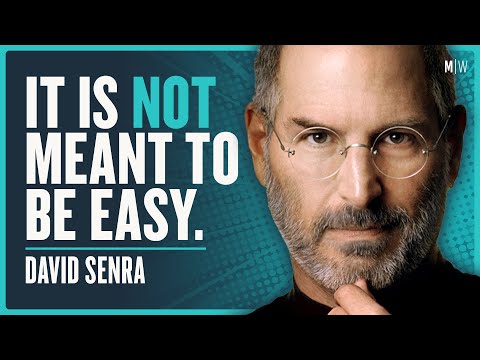
Insights From History's Greatest Thinkers - David Senra
David Senra (guest), Chris Williamson (host), Narrator, Chris Williamson (host)
In this episode of Modern Wisdom, featuring David Senra and Chris Williamson, Insights From History's Greatest Thinkers - David Senra explores learning From Legends: Ambition, Obsession, Regret, And Enduring Mastery Chris Williamson and David Senra discuss lessons from hundreds of biographies of entrepreneurs, athletes, and historical figures to understand what truly drives high performance and a meaningful life.
Learning From Legends: Ambition, Obsession, Regret, And Enduring Mastery
Chris Williamson and David Senra discuss lessons from hundreds of biographies of entrepreneurs, athletes, and historical figures to understand what truly drives high performance and a meaningful life.
They explore themes of obsession, practice, endurance, and optionality, contrasting people who over-optimized for work and died full of regret with rare examples who built wealth while preserving health, family, and fun.
The conversation ranges from Steve Jobs, Bezos, Dyson, Vanderbilt, Jordan, Kobe, and Ed Thorp to ideas from Paul Graham, Naval, Munger, and Jocko, extracting repeatable principles rather than one-off tactics.
A recurring message is that mastery comes from long-term, painful practice aligned with genuine interests, while consciously defining "enough" to avoid sacrificing family, health, and joy on the altar of achievement.
Key Takeaways
Use others’ lives as cautionary tales, not just inspiration.
Stories like Larry Miller (rich, owned an NBA team, missed his kids and fun) and Ingvar Kamprad (IKEA) show that maximizing wealth while sacrificing family, health, and joy leads to deep regret; biographies let you pre‑experience those mistakes and choose differently.
Get the full analysis with uListen AI
Endurance and consistency filter out almost all competitors.
Senra emphasizes that most people quit early—whether in business or podcasting—so simply staying in the game, practicing relentlessly, and doing 100+ high-quality reps puts you in a tiny top percentile where opportunities compound and “luck” appears.
Get the full analysis with uListen AI
Find work that feels like play but is valuable to others.
Echoing Paul Graham, Naval, and examples like Michael Jordan and Joe Rogan, the most successful people do things they’d do anyway for fun, then align that with market value; this makes it psychologically sustainable to work incredibly hard for decades.
Get the full analysis with uListen AI
Optimize for optionality, not rigid five-year plans.
Drawing on Henry Singleton, Buffett, Munger, and Jocko, they argue that the world is too complex for detailed long-range plans; instead, show up daily, steer the boat a bit, exploit what works, abandon what doesn’t, and leave room to seize unforeseeable opportunities.
Get the full analysis with uListen AI
Master fundamentals through painful, boring repetition.
From Jordan, Kobe, Dyson, and Tony Hawk, the pattern is the same: world-class performance comes from obsessive repetition of basics, not flashy tactics—whether that’s thousands of prototypes, thousands of shots, or thousands of early, bad podcast episodes.
Get the full analysis with uListen AI
Define “enough” and design a holistic blueprint for life.
Ed Thorp is highlighted as a rare genius who got rich, then deliberately capped his ambition to also be a good husband, father, and steward of his health, using simple systems (daily weighing, 40-hour weeks, turning down misaligned deals) to protect what mattered.
Get the full analysis with uListen AI
Treat reading and synthesis as a craft with serious practice.
Senra’s multi-pass system—physical books, margin notes, Post-its, repeated rereading, then storing and resurfacing highlights in Readwise—shows that deep retention and original insight come from working the material hard, not skimming or outsourcing the thinking.
Get the full analysis with uListen AI
Notable Quotes
“Excellence is the capacity to take pain.”
— Isadore Sharp (Four Seasons founder), as cited by David Senra
“By endurance we conquer.”
— Ernest Shackleton, as adopted by David Senra as a personal motto
“Shallow men believe in luck. Strong men believe in cause and effect.”
— Ralph Waldo Emerson, quoted by David Senra via Peter Thiel
“You’ll have to work harder than you ever have before in your life, but the tools will feel light in your hands.”
— Tim Cook, relaying advice about doing what you love (via Chris Williamson)
“The public praises people for what they practice in private.”
— David Senra
Questions Answered in This Episode
How would your life look different if you applied Bezos’s Regret Minimization Framework to your current big decision?
Chris Williamson and David Senra discuss lessons from hundreds of biographies of entrepreneurs, athletes, and historical figures to understand what truly drives high performance and a meaningful life.
Get the full analysis with uListen AI
Where are you unconsciously over-optimizing for professional success at the expense of family, health, or fun—and what would your Ed Thorp–style “enough” look like?
They explore themes of obsession, practice, endurance, and optionality, contrasting people who over-optimized for work and died full of regret with rare examples who built wealth while preserving health, family, and fun.
Get the full analysis with uListen AI
If you had to commit to one craft for 10–20 years, that feels like play to you but is valuable to others, what would it realistically be?
The conversation ranges from Steve Jobs, Bezos, Dyson, Vanderbilt, Jordan, Kobe, and Ed Thorp to ideas from Paul Graham, Naval, Munger, and Jocko, extracting repeatable principles rather than one-off tactics.
Get the full analysis with uListen AI
Are you treating survivorship bias as a rational critique—or as an excuse not to endure through your own difficult middle?
A recurring message is that mastery comes from long-term, painful practice aligned with genuine interests, while consciously defining "enough" to avoid sacrificing family, health, and joy on the altar of achievement.
Get the full analysis with uListen AI
What simple daily or weekly practices (reading, note-taking, physical training, relationship rituals) could become your version of Jordan’s or Dyson’s obsessive fundamentals?
Get the full analysis with uListen AI
Transcript Preview
He's writing the book as a cautionary tale, right? And he says, "Listen, if I could do it all over again, I would still try to get rich, but I would've, instead of making, you know, hundreds of millions, maybe make $10 million or $20 million," whatever the case is. "But the most devastating part is, if I could do it all over again, I wouldn't have missed my kids growing up and I would've had fun." What is the point of living in a 30,000 square foot house owning a NBA team and you didn't even have fun? As he's trying to write this book, his co-author is interviewing his wife and she says the most devastating thing that, "If my family said this about me, I don't care if I have a billion dollars, I'm a failure." And she goes, "I miss him, but it's not like he was here when he was alive anyways." When you read a book like that, you get to the end and it's like, "I'm not going out like that."
(wind blowing) I, last night, was with one of the first esports performance coaches. So, he is a mental performance coach that is employed by an esports organization to train their mental athletes, as they call them-
(laughs)
... to maximize their performance.
Yeah.
And the stuff that they're- the stuff that they are doing with these kids is so cool. Taking across all of the stuff that we've seen from physical training now and importing it across into something which is actually, I think, the most mentally taxing sport that's- that- that exists-
Yeah.
... because you can move your avatar on the screen significantly quicker than you can move your body, which means that you're basically overclocking your brain. Your brain was meant to move limited by the pace of your body moving when it comes to reaction times.
Yeah.
And what you're doing now is you've managed to overclock the physical world and you're now trying to catch up mentally. This guy was fa- uh, Thanksgiving dinner, nerded out with this guy for, like, two and a half hours. It was brilliant.
That industry is very fascinating. Do you know Blake Robbins by chance?
No.
Okay. Blake Robbins, he's a venture capitalist. He's over at, uh, Benchmark now, but he actually incubated 40 Thieves, that- that, uh, esports team and the brand and everything else. But his focus and why he's been, uh, invited to take part in one of maybe, you know, maybe the most prestigious or one of the most prestigious venture capital firms at a relatively young age, I think Blake's, like, late 20s, whatever the case is. He's obsessed with the edge of the internet and, um, he has this great line that has actually taught me a lot, that everything is a game. And his point is- is like if you look at g- uh, gaming as an industry, it's bigger than music, movies, and all- and a bunch of other things combined. Um, so I do think, like, it doesn't surprise me that they- they're at the cutting edge. Of course they're gonna have some kind of performance coaches. I think everybody does. Like, e- almost all the top performers have somebody that they actually want to bring in. In fact, I just re-read, um, so I've done, I've probably done, I don't know, 10 or 12 bi- uh, biography, uh, uh, ep- episodes on Steve Jobs. And then not only do I- do I reread, uh, like I read every single book I could find about him and then I would reread my favorite ones and then make episodes every new time, because the words on the page don't change, but, like, everything that you've learned since the last time you read it has changed, right? And then I would map out in the book, um, all of the people that he was inspired by, 'cause none of these ideas are new. And I- I wound up mapping it out and I did, like, a little bonus episode called- called, uh, Steve Jobs and His Heroes, and it just traces, I've done 39 episodes on Steve Jobs and the people he actually mentions, whether it's Da Vinci, Alexander Graham Bell, Edwin Land, the founders of HP, uh, all these people that, like, influenced the way he thinks about his work. And something Steve did on the second time he went to Apple, right? Uh, the time where he created all that value, c- um, 'cause if you think about it, he's kicked out of Apple, spends 13 years in the wilderness, right? From, like, age 30 to 43. Comes back and essentially the way you think about it is, like, Apple's in terminal decline. It's almost bankrupt, right? It's running out of money. They pay $500 million for NeXT, and you can think about it as, like, they paid half a billion dollars to rehire Steve Jobs and they got the deal of a fucking lifetime, right? Fast-forward, you know, now, what, uh, 20 years later, it's the most valuable company in the world. Worth, like, $2.4 trillion. But what he realized was it was very helpful and I actually heard a bunch of episodes you reference, me and you both share, uh, an admiration for Charlie Munger, he's like one of my personal heroes, and he says this. He's like, the role that he plays with Buffett, he's like, "It's very useful to have somebody else to organize your thoughts with professionally." Right? That's the role that he plays with Buffett. So, what Steve did is he hired this guy and he didn't have no official role inside of Apple. So he'd fly down, he lived in Seattle, he'd fly down to Cupertino on Sunday night. I think he would spend from Monday, Tuesday, and Wednesday all he would do is shadow Steve. He could not say, he had no authority inside of the company, he's just, he's with Sh- Steve a- all the time, and when they have a minute they'd have lunch together or they'd pull him to the side, they'd have one-on-one conversations. And it's that same thing. It's like, you might not call it a coach, but it's somebody that is not a part of your company, right? Doesn't technically work for you, but is very helpful to- to bounce ideas off of and to, like, organize your thoughts. So, whether you call it a coach, performance coach, you know, a friend, a confidant, I think that- that you see that idea over and over and over again.
Install uListen to search the full transcript and get AI-powered insights
Get Full TranscriptGet more from every podcast
AI summaries, searchable transcripts, and fact-checking. Free forever.
Add to Chrome