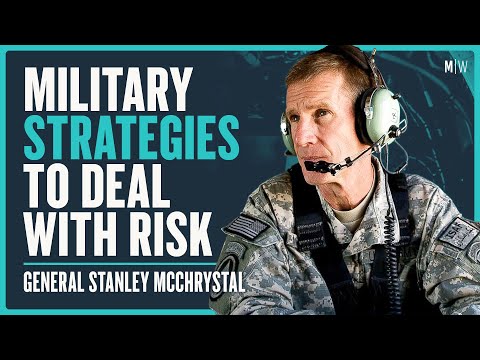
Military Strategies For Dealing With Risk - General Stanley McChrystal | Modern Wisdom Podcast 381
General Stanley McChrystal (guest), Chris Williamson (host)
In this episode of Modern Wisdom, featuring General Stanley McChrystal and Chris Williamson, Military Strategies For Dealing With Risk - General Stanley McChrystal | Modern Wisdom Podcast 381 explores general McChrystal Reveals How To Truly Understand, Prepare For Risk General Stanley McChrystal discusses why humans and organizations systematically misunderstand risk, arguing that the greatest risk is our own vulnerabilities rather than external threats.
General McChrystal Reveals How To Truly Understand, Prepare For Risk
General Stanley McChrystal discusses why humans and organizations systematically misunderstand risk, arguing that the greatest risk is our own vulnerabilities rather than external threats.
He reframes risk as "threat × vulnerability," emphasizing resilience, adaptability, communication quality, and structural design as core levers leaders can actually control.
Drawing on military operations, Afghanistan, and corporate examples, he explains how diversity of perspective, overcoming inertia, and clear accountability improve decision-making under uncertainty.
The conversation also explores personal adaptability, values, and integrity, including how McChrystal rebuilt his life and identity after resigning from the Army.
Key Takeaways
Focus less on predicting threats and more on reducing vulnerabilities.
McChrystal argues you can rarely control or accurately forecast external threats, but you can strengthen your own and your organization’s weak points—communication, leadership, blind spots—so that whatever happens, you’re more likely to withstand it.
Get the full analysis with uListen AI
Train for adaptability, not perfection, by making things go wrong on purpose.
Special operations units became more resilient by rehearsing scenarios where the plan immediately failed—key people ‘died,’ lights went out, conditions changed—so teams learned to solve problems in real time instead of relying on a brittle, idealized script.
Get the full analysis with uListen AI
Risk analysis should inform decisions, not eliminate risk altogether.
The goal is to understand the real level of risk versus payoff so leaders can make conscious tradeoffs, rather than chasing an impossible zero-risk world or blindly accepting risks they don’t understand, as in the 2008 financial crisis.
Get the full analysis with uListen AI
Diversity is an operational necessity, not just a moral slogan.
He distinguishes equality of opportunity (moral) from diversity of perspective (operational), noting that teams that include and surface different viewpoints avoid groupthink and arrive at better options, even if this creates short-term friction.
Get the full analysis with uListen AI
Clarity, accountability, and follow‑through are essential to overcoming inertia.
To move from intention to action, leaders must assign specific tasks to specific people, set timelines, and then open the next meeting by checking what was actually done—otherwise everyone assumes “someone else” will feed the dog.
Get the full analysis with uListen AI
Modern communication problems are about quality and judgment, not just technology.
Although the technical barriers are low, organizations now face noise, misinformation, and impulsive communication (“we can communicate faster than we can think”); leaders must design systems and habits that surface accurate, timely, digestible information.
Get the full analysis with uListen AI
Red teaming and war‑gaming expose blind spots before reality does.
Inviting an independent group to actively attack your plan, or running it through simulated execution, is uncomfortable but reveals hidden weaknesses and lets you strengthen your strategy before it’s tested in the real world.
Get the full analysis with uListen AI
Notable Quotes
“The frustrating reality is that the greatest risk to us is us.”
— Stanley McChrystal
“Risk is threat times vulnerability. We can’t control the threats, but we can control our vulnerabilities.”
— Stanley McChrystal
“If three people are tasked to feed the dog, the dog’s gonna starve.”
— Stanley McChrystal (quoting a friend)
“Diversity is not a moral imperative; equality of opportunity is a moral imperative. Diversity is an operational imperative.”
— Stanley McChrystal
“If you sell your integrity, you can’t buy it back.”
— Stanley McChrystal
Questions Answered in This Episode
How could I practically map out my own or my organization’s key vulnerabilities and start systematically reducing them?
General Stanley McChrystal discusses why humans and organizations systematically misunderstand risk, arguing that the greatest risk is our own vulnerabilities rather than external threats.
Get the full analysis with uListen AI
What concrete steps can leaders take to encourage dissenting views without losing cohesion once a decision is made?
He reframes risk as "threat × vulnerability," emphasizing resilience, adaptability, communication quality, and structural design as core levers leaders can actually control.
Get the full analysis with uListen AI
In my team, where has inertia silently won—what important actions are we endlessly talking about but never executing?
Drawing on military operations, Afghanistan, and corporate examples, he explains how diversity of perspective, overcoming inertia, and clear accountability improve decision-making under uncertainty.
Get the full analysis with uListen AI
How might I implement a simple ‘red team’ or war‑game process around major decisions in a non‑military or small‑business context?
The conversation also explores personal adaptability, values, and integrity, including how McChrystal rebuilt his life and identity after resigning from the Army.
Get the full analysis with uListen AI
When have I allowed audience capture, external approval, or short‑term gain to pull me away from my core values—and what would it look like to correct that now?
Get the full analysis with uListen AI
Transcript Preview
You're always got a percentage possibility, even in the least risky, of something going badly. And yet, often when something goes badly, we take it as a violation of the laws of nature. But if you go by probability, if something's got a 90% probability of success, 10% of the time it's going to go very badly, and we shouldn't be surprised, we shouldn't be upset. That should be in our mindset, but we don't do that very well. You know, if it's 70% chance of good weather, we don't carry an umbrella because... And yet, if I said, "Chris, it's 30% chance of rain today." You'd probably go back in the house, get your umbrella and a raincoat.
(wind blowing) General Stanley McChrystal, welcome to the show.
Well, Chris, thanks for having me and please call me Stan.
I was going to say, it's, it's kind of difficult to work out what to say. Calling a four star general "Stan" feels oddly informal.
I've been called a lot worse, Chris, so Stan would be great.
What, what does, what's the four stars mean? What does that mean in a general, for the non-initiates amongst us?
Sure. There are four levels of being a general. A brigadier general is one star, a major general is two stars, a lieutenant general is three stars, and then a plain general is four stars. And then, only occasionally in American history, we created a general of the army, which is five stars, but the last one was during the second World War.
All right, okay. So only in times of real necessity does anyone get above that?
Exactly.
Right. So that's a lot of pressure on your shoulders, then.
(laughs)
Given the fact that you spent so much time in Afghanistan, and the last few weeks and months we've seen some pretty crazy imagery coming out of there, what's it been like watching that from the sidelines having invested so much time in it?
Well, it's difficult. Not just because of the investment, but more because I got very close to the Afghan people. I believed very much that they had the ability and the, um, all the things necessary to pull their society forward. And the fact that it, it has now been at least put on hold is disappointing.
Mm. Yeah, it's, uh, I heard you speaking a while ago, I think it was at a live event where the Trump midterm elections were going on, and someone brought up Afghanistan and the withdrawal, and you identified the sort of prisoner's dilemma that's going to happen, that if any president decides to do it and then you have Taliban and ISIS retaking control, it's sort of this, this odd game of chicken that they're playing, and it seems like that kind of played out.
I think it did. And to review that, generally every president had the opportunity to do more, do less, or do the same, and there was political risk to do more, domestic resistance, and there was real risk in doing less, i.e. pulling out, because if Al-Qaeda or ISIS establishes a safe haven again, then any decision-maker connected to that will be criticized. Which meant that in the middle was typically the safe. It didn't make it the wrong option, but it made it the safe one. So, I've got a lot of sympathy for decision-makers. You know, we all sit on the sidelines and we criticize this decision-maker for doing that and this decision-maker for doing something else, but unless you've been down on the field making those decisions, I think we've got to be a little bit more forgiving.
Install uListen to search the full transcript and get AI-powered insights
Get Full TranscriptGet more from every podcast
AI summaries, searchable transcripts, and fact-checking. Free forever.
Add to Chrome