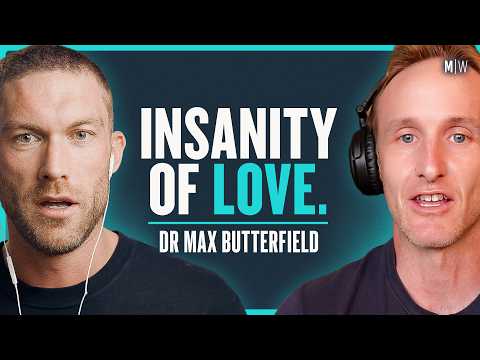
The Internet is Clueless About Relationships - Dr Max Butterfield
Chris Williamson (host), Dr. Max Butterfield (guest)
In this episode of Modern Wisdom, featuring Chris Williamson and Dr. Max Butterfield, The Internet is Clueless About Relationships - Dr Max Butterfield explores evidence-based relationship science: breakups, signaling interest, and online advice pitfalls The conversation opens with a viral example of a public “grand gesture” (an Olympian confessing infidelity on camera) to illustrate how dysregulation and shame can drive misguided attempts to repair relationships.
Evidence-based relationship science: breakups, signaling interest, and online advice pitfalls
The conversation opens with a viral example of a public “grand gesture” (an Olympian confessing infidelity on camera) to illustrate how dysregulation and shame can drive misguided attempts to repair relationships.
Butterfield argues that after relational rupture, “trying harder” often backfires; instead, people need self-regulation, gradual trust-building, and better allocation of effort.
They explore breakup recovery (healthy distraction, routine disruption), why rumination persists (uncertainty intolerance, reinforcement loops), and emerging research on self-compassion as a protective skill.
The episode also covers modern flirting and signaling amid ambiguity, indirect aggression and intrasexual competition, and the importance of direct, context-sensitive communication over viral red-flag/green-flag heuristics.
Key Takeaways
Grand gestures often scare people further away after rupture.
Butterfield likens grand romantic moves to grabbing a frightened cat under a car—too sudden and intense signals “unsafety,” especially to someone already guarded from being hurt.
Get the full analysis with uListen AI
After a breakup, don’t try harder—try better.
Effort should shift from dramatic persuasion to calm, incremental contact and self-regulation; chasing and intensity can amplify perceived instability and reduce receptivity.
Get the full analysis with uListen AI
Self-regulation is the first repair step.
When people are dysregulated (fight/flight), they make clumsy relational bids; simple, low-pressure outreach (“coffee? ...
Get the full analysis with uListen AI
Healthy distraction is a legitimate breakup recovery tool.
Work, exercise, friends, hobbies, and new routines help restore sleep and baseline functioning—without the costs of numbing strategies like heavy drinking.
Get the full analysis with uListen AI
Rumination persists because it’s reinforcing and reduces uncertainty (even via catastrophizing).
They discuss rumination as both a “mistake-prevention” mechanism and a self-rewarding loop; the mind would rather land on a terrible conclusion than tolerate ambiguity.
Get the full analysis with uListen AI
Interrupting routines can interrupt thought loops.
Changing small defaults—phone placement, morning path, new locations—breaks well-worn cognitive grooves and reduces automatic triggers for rumination.
Get the full analysis with uListen AI
Red flags are more about patterns than phrases.
Single statements (“you’re out of my league”) aren’t diagnostic; reliable indicators include behavior–intention gaps, secrecy/incongruence, and poor emotional recovery time after stress.
Get the full analysis with uListen AI
Direct communication is a learnable skill—and avoidance fuels “shadow sentences.”
Indirect bids (“leave me alone” meaning “chase me”) can be self-protective but force partners to guess; clarity reduces resentment and prevents passive-aggressive cycles.
Get the full analysis with uListen AI
Women’s appearance signaling often targets other women as much as men.
They argue clothing and grooming can function as intrasexual competition and mate-guarding signals; men frequently miss the “status” details women assume they notice.
Get the full analysis with uListen AI
Online relationship discourse overproduces fake certainty.
Viral rules and decontextualized clips create simplistic heuristics; people generalize from incompatibility (“cheese tried to date chalk”) into universal claims about all men/women.
Get the full analysis with uListen AI
Notable Quotes
“This is not a situation where you wanna try harder. This is a situation where you wanna try better.”
— Dr. Max Butterfield
“Grand gestures… are like diving under a car to grab a scared cat by the tail—you’re never gonna see that cat again.”
— Dr. Max Butterfield
“Fake it until you regulate it.”
— Chris Williamson
“Rules offer certainty, and relationships are inherently uncertain.”
— Dr. Max Butterfield
“Invest in the people that invest in you.”
— Dr. Max Butterfield
Questions Answered in This Episode
In the Olympian’s case, what would “repairing the damage” practically look like in the first 72 hours after a public confession?
The conversation opens with a viral example of a public “grand gesture” (an Olympian confessing infidelity on camera) to illustrate how dysregulation and shame can drive misguided attempts to repair relationships.
Get the full analysis with uListen AI
How can someone tell the difference between healthy “calm confidence” after a breakup and emotionally avoidant detachment?
Butterfield argues that after relational rupture, “trying harder” often backfires; instead, people need self-regulation, gradual trust-building, and better allocation of effort.
Get the full analysis with uListen AI
You mentioned approach–avoidance: what are the most common behaviors that signal someone is stuck in that loop during reconciliation attempts?
They explore breakup recovery (healthy distraction, routine disruption), why rumination persists (uncertainty intolerance, reinforcement loops), and emerging research on self-compassion as a protective skill.
Get the full analysis with uListen AI
What are the most effective, evidence-backed ways to reduce rumination when the core trigger is uncertainty (e.g., waiting for a text, ambiguous breakup reasons)?
The episode also covers modern flirting and signaling amid ambiguity, indirect aggression and intrasexual competition, and the importance of direct, context-sensitive communication over viral red-flag/green-flag heuristics.
Get the full analysis with uListen AI
What do you consider the clearest behavioral markers of emotional instability vs. normal short-term dysregulation under stress?
Get the full analysis with uListen AI
Transcript Preview
Dr Max Butterfield, welcome to the show
Chris, thank you for having me. Please call me Max
D- no, Dr Max Butterfield.
[laughs]
You, rip.
Oh.
I absolutely love your content.
Thank you.
I think you're so fantastic.
Oh, I, I really appreciate it. I, I am shocked every day when somebody tells me that because I'm nobody, you know? I just have been telling people who I am every day for the last year-
[laughs]
... and it kinda started to take hold, I guess
Mm. Yeah, man, there's very few people doing evidence-based relationship advice, uh, especially on, in short form on social media-
Totally. Totally
... so it, it, it, it doesn't surprise me that it's going well. PhD in experimental psychology, masters in clinical psych, masters in experimental psych, bachelors in psych, and some additional work in religion, law, and languages. Let's go back.
Just a couple, couple things. I really, you know, in, in first grade I decided I liked school and I was never gonna leave, so still here 30 years later.
All right. I'm gonna get you to, I'm gonna get you to react to something straight off the bat. Norwegian biathlete Sturla Holm Laegreid. Have you seen this?
Yep.
Okay. So it-
He's good
... this 28-year-old guy chose the Olympics as the place to shoot his shot with his ex after he won the bronze in the men's 20-kilometer biathlon. In a viral post a- a- after his win, in the interview-
Yeah
... this guy confessed to cheating on the love of his life, revealing that she dumped him after he came clean a week ago, and said he was committing social suicide in the hopes of winning her back. Seems like his plan backfired since his ex, who has remained anonymous, reportedly told Norwegian tabloid VG that it's hard to forgive even after a declaration of love in front of the whole world. So for the people that haven't seen it, Dean will cut it in now.
Six months ago, I met the love of my life, the world's most beautiful, wonderful person in the world, and three months ago, I made the biggest mistake of my life and cheated on her.
As you can see, that guy used probably the crowning moment of his entire career, may- maybe his entire life, right?
Right. Right
You've went from a child to do this thing. Biathlon's the rifle shooting with the skiing thing, I think.
That's... I believe so, yeah.
Right. Um, way more of an expert on relationships than on fucking biathlons.
[laughs] All right.
Um, uh, he chose that moment, the crowning moment, as he gets to do the interview. Could have thanked his mom, could have thanked God, could have thanked all the hard work. Used it as the opportunity to try and do th- ... D- dissect this from a science-based lens for me, please. What's going on?
Yeah. Well, I mean, the first thing I wanna know is, was this planned? You know, did he think this through? 'Cause to me, that is very different. If he's like, "Okay, I know what I'm gonna do. I'm gonna try to get her back," and he's rationally, you know, got some reasons, or if this was just like, "Hey, I'm in front of the camera. I'm all excited. I don't know what to say. I don't know how to regulate myself. Let me just let this fly." I, I think the results are gonna be the same regardless, but the feedback I would have for him would be very different depending on whether he did this on, on the fly-
Install uListen to search the full transcript and get AI-powered insights
Get Full TranscriptGet more from every podcast
AI summaries, searchable transcripts, and fact-checking. Free forever.
Add to Chrome