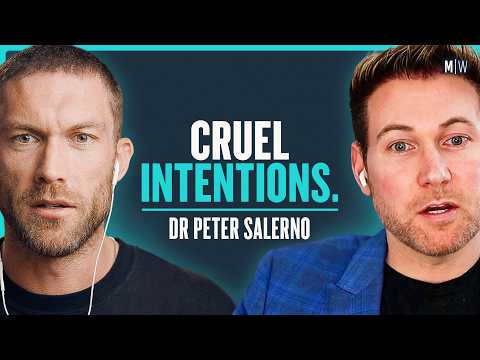
How Narcissists Hijack Your Brain - Dr Peter Salerno
Chris Williamson (host), Dr. Peter Salerno (guest)
In this episode of Modern Wisdom, featuring Chris Williamson and Dr. Peter Salerno, How Narcissists Hijack Your Brain - Dr Peter Salerno explores how Cluster B personalities manipulate, evolve, and resist change therapeutically Salerno describes his work helping people recover “reality confidence” after toxic relationships, framing the aftermath as traumatic cognitive dissonance created by sustained deception and coercive narrative control.
How Cluster B personalities manipulate, evolve, and resist change therapeutically
Salerno describes his work helping people recover “reality confidence” after toxic relationships, framing the aftermath as traumatic cognitive dissonance created by sustained deception and coercive narrative control.
He argues that Cluster B disorders (narcissistic, borderline, histrionic, antisocial/psychopathic traits) are major drivers of chronic interpersonal conflict and that genetics/biology contribute at least as much as environment—often more—contrary to the popular “hurt people hurt people” explanation.
The discussion covers evolutionary and neurobiological angles: fear-learning deficits, reward sensitivity, and why punishment often fails while empathy can be exploited—especially in therapy via transference/countertransference effects.
They also differentiate narcissism from psychopathy, outline why some disorders are highly treatment-resistant, and give practical markers for early detection—especially noticing contradictions after an idealized “seduction/love-bombing” phase.
Key Takeaways
Salerno’s clinical focus is rebuilding a victim’s grasp of reality.
He frames recovery as restoring “reality confidence” after prolonged manipulation that forces victims to hold contradictory stories at once (traumatic cognitive dissonance). ...
Get the full analysis with uListen AI
Cluster B conflict often centers on antagonism, not just “narcissism.”
He treats antagonism as a broad bucket that includes triangulation, hostility, deceit, entitlement, and chronic obligation failures. ...
Get the full analysis with uListen AI
Personality pathology is frequently more heritable than people want to admit.
Citing twin research, he notes psychological traits average ~50% heritability and claims pathological personality traits often exceed that. ...
Get the full analysis with uListen AI
The “hurt people hurt people” story is compelling because it implies control.
If environment caused it, environment can fix/prevent it—making the world feel safer and more manageable. ...
Get the full analysis with uListen AI
Neurobiology matters: some individuals don’t learn from punishment via fear.
He describes proactive aggression linked to low fear-learning/consequence sensitivity—so “ratcheting up punishment” can backfire or do nothing. ...
Get the full analysis with uListen AI
Empathy can become a liability with severe Cluster B traits.
He claims increased nurturance can make some severe personalities more exploitative because it supplies leverage and lowers scrutiny. ...
Get the full analysis with uListen AI
Ego-syntonic disorders reduce motivation to change.
Cluster B patterns are often experienced as “me” rather than a distressing symptom, so change is rarely internally motivated. ...
Get the full analysis with uListen AI
Narcissism isn’t primarily low self-esteem; it’s image-investment over authenticity.
He defines narcissism as excessive investment in a preferred image at the expense of a true self, leading to thin-skinned defensiveness without a deep shame core. ...
Get the full analysis with uListen AI
Narcissistic relating follows an all-or-nothing utility logic.
He explains idealization–devaluation–discard as a dichotomous system: people are either “everything” or “useless. ...
Get the full analysis with uListen AI
Psychopathy is best managed, not cured; grandiosity is practically hardest day-to-day.
He states there is no known effective treatment that changes psychopathic personality structure—only containment/management. ...
Get the full analysis with uListen AI
Early detection hinges on inconsistencies after the ‘perfect’ phase.
He warns the initial “love-bombing/seduction” relies on mimicking pro-social emotions to drop defenses. ...
Get the full analysis with uListen AI
Victims aren’t a single ‘type’; persistence often comes from resilience and timing.
He argues Cluster B individuals “vet everyone” like salespeople and stay with those who tolerate repeated boundary violations. ...
Get the full analysis with uListen AI
Some capacities are reliably limited: accountability and sustained collaboration.
He suggests they can perform agreeableness briefly, but sustained responsibility-taking and genuine collaboration tend to break down. ...
Get the full analysis with uListen AI
Notable Quotes
“I help people restore their reality confidence following a toxic relationship.”
— Dr. Peter Salerno
“Most people who get accused of being narcissistic, what they're actually being accused of is antagonism.”
— Dr. Peter Salerno
“All psychological traits… show measurable average heritability of, like, about fifty percent… [and] those percentages actually increase… for pathological personality traits.”
— Dr. Peter Salerno
“More nurture and empathy for them actually makes them more exploitative.”
— Dr. Peter Salerno
“Narcissists see human beings and relationships as far as utility, not… worth.”
— Dr. Peter Salerno
Questions Answered in This Episode
You describe “traumatic cognitive dissonance” in victims—what are the most reliable signs someone is experiencing it, and what does recovery look like week-to-week?
Salerno describes his work helping people recover “reality confidence” after toxic relationships, framing the aftermath as traumatic cognitive dissonance created by sustained deception and coercive narrative control.
Get the full analysis with uListen AI
You claim pathological personality traits can exceed 50% heritability—what specific studies or meta-analyses are you relying on, and how do they operationalize ‘pathology’ vs ‘normal-range’ traits?
He argues that Cluster B disorders (narcissistic, borderline, histrionic, antisocial/psychopathic traits) are major drivers of chronic interpersonal conflict and that genetics/biology contribute at least as much as environment—often more—contrary to the popular “hurt people hurt people” explanation.
Get the full analysis with uListen AI
If empathy can increase exploitation in severe cases, how should partners, families, and clinicians calibrate compassion without enabling manipulation? What does a “safe” boundary protocol look like?
The discussion covers evolutionary and neurobiological angles: fear-learning deficits, reward sensitivity, and why punishment often fails while empathy can be exploited—especially in therapy via transference/countertransference effects.
Get the full analysis with uListen AI
You argue narcissism is not shame-based but image-based—how do you interpret research that links narcissistic vulnerability to insecurity or affective instability?
They also differentiate narcissism from psychopathy, outline why some disorders are highly treatment-resistant, and give practical markers for early detection—especially noticing contradictions after an idealized “seduction/love-bombing” phase.
Get the full analysis with uListen AI
You said vulnerable narcissism is ~90% identical to borderline traits in some studies—what should clinicians and laypeople do differently with that information?
Get the full analysis with uListen AI
Transcript Preview
How do you describe what you do? Someone hasn't met you before, they don't know much about you, you're at a cocktail party. How do you describe what you do?
I mean, my work focuses on, um... I mean, I'm a psychotherapist. That's kind of like my trade. I'm licensed as a psychotherapist. I have a, a doctorate in psychology, so my background is in psychology and, and mental health. I would say what I do specifically is, um, I do extensive research on the etiology or cause of personality disorders. Like, that's the, that's the type of diagnosis that I specialize in assessing, understanding. But one of the reasons I do it is actually not necessarily to treat personality disorders. I do it so that I help people understand, um, in relationships where there's, uh, a personality disorder, there's often toxicity and conflict and strife and, um, abuse, right? And so what I do is I help people, uh, restore their, what I would call their reality confidence following a toxic relationship. Because in these relationships, what happens is the individual who is the victim of somebody who is intentionally manipulative, deceptive, um, controlling, what happens is the, the victim loses their sense of what's actually true and real and what's actually, um, being manipulated. Okay? And so I, I help people following these types of high conflict or problematic abusive relationships kind of get their reality confidence back. And one of the ways I do that is by resolving what I call, uh, traumatic cognitive dissonance, which is what happens to the brain when you're forced to hold two contradictory realities at the same time because someone is trying to convince you that two things could be true at the same time when they can't be. Um, and so when I'm consulting with people, uh, professionally, I'm helping them regain their understanding of what's actually real, what happened to them, and what was-- what they were convinced happened to them because it was convenient for somebody else if they believed that.
So it's almost like people that have spent a good bit of time intimately close to these other people-
Mm-hmm
... their reality gets warped around them to the point where it's difficult for them to reenter normal reality without the old, uh, version creeping back in.
Correct. Yeah. Yeah, and one of the reasons for that is because the individual who is the manipulative person has done such an exceptional job of making a lot of the, the deception and the evidence invisible. So it's not like there's somebody overtly trying to manipulate you and you're aware of it, right? Like, it's not like there's somebody saying, "Hey, I want you to buy this product from me. Here's why I think it'll improve your life," and then they pressure you. It's actually more like, "No, I'm not actually up to anything. I mean, you're free to come and go as you please in this arrangement," all while underneath the surface, covertly trying to gain an advantage over this person for selfish reasons, exploitative reasons. And so even if the relationship has ended, they still might perceive the relationship even years or decades later in a way that's not accurate because they were, um, their reality was distorted.
Install uListen to search the full transcript and get AI-powered insights
Get Full TranscriptGet more from every podcast
AI summaries, searchable transcripts, and fact-checking. Free forever.
Add to Chrome