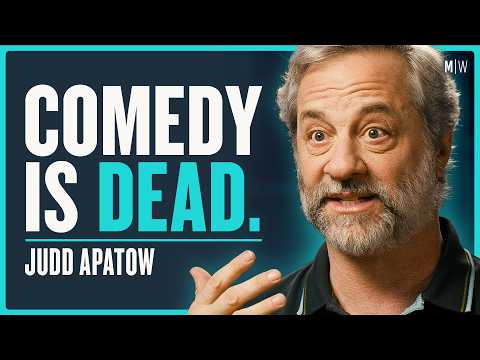
Why Comedies Suck Now - Judd Apatow (4K)
Chris Williamson (host), Judd Apatow (guest)
In this episode of Modern Wisdom, featuring Chris Williamson and Judd Apatow, Why Comedies Suck Now - Judd Apatow (4K) explores judd Apatow Dissects Comedy, Trauma, Obsession, And Why Movies Falter Judd Apatow and Chris Williamson explore how childhood pain, hypervigilance, and abandonment issues can fuel creativity, work ethic, and obsessive control in comedy and filmmaking. They contrast the instant, public feedback loop of standup with the decade-long judgment cycle of movies, and unpack why modern studio comedies rarely break through culturally like Anchorman or The 40-Year-Old Virgin. Apatow details his evolution from insecure young comic among future superstars to writer‑director, emphasizing mentors, honest feedback, and the need to separate creative flow from self‑critique. They also examine the business realities of DVDs vs. streaming, the social physics of live performance, and why edgy jokes depend less on content than on the perceived heart and intent behind them.
Judd Apatow Dissects Comedy, Trauma, Obsession, And Why Movies Falter
Judd Apatow and Chris Williamson explore how childhood pain, hypervigilance, and abandonment issues can fuel creativity, work ethic, and obsessive control in comedy and filmmaking. They contrast the instant, public feedback loop of standup with the decade-long judgment cycle of movies, and unpack why modern studio comedies rarely break through culturally like Anchorman or The 40-Year-Old Virgin. Apatow details his evolution from insecure young comic among future superstars to writer‑director, emphasizing mentors, honest feedback, and the need to separate creative flow from self‑critique. They also examine the business realities of DVDs vs. streaming, the social physics of live performance, and why edgy jokes depend less on content than on the perceived heart and intent behind them.
Key Takeaways
Personal pain can sharpen observation and fuel creative obsession.
Apatow links his parents’ messy double divorce to a lifelong hypervigilance and need for safety, which he channeled into obsessively learning both the art and business of comedy.
Get the full analysis with uListen AI
Your strongest professional traits often have a dark flip side.
Traits like hyperindependence, workaholism, and control can drive early success but later damage relationships, family life, and collaboration unless you learn to dial them back.
Get the full analysis with uListen AI
Standup is ‘practicing in public,’ and bombing is R&D, not failure.
Because you can only learn standup in front of an audience, eating it onstage becomes research: new bits get tested, bad ones are killed early, and the act slowly improves through exposure.
Get the full analysis with uListen AI
Audience trust hinges more on your energy and intent than any one joke.
Crowds sense desperation, nervousness, or meanness; once they lose faith in you—or in a film’s tone—multiple jokes or scenes can die in a row, while confident, grounded personas remain ‘bulletproof’.
Get the full analysis with uListen AI
Separate creation from critique to overcome paralysis and self‑doubt.
Apatow free‑writes without judging, then returns later in ‘editor mode’ to evaluate; trying to be brilliant and critical simultaneously blocks the flow of ideas.
Get the full analysis with uListen AI
The economics of comedy films changed when DVDs disappeared.
DVD sales once doubled a comedy’s revenue and justified mid‑budget risks; with streaming not replacing that money and comedy not traveling globally like action or horror, studios make far fewer big comedies.
Get the full analysis with uListen AI
Mentors and brutally honest collaborators are force multipliers.
Figures like Garry Shandling gave Apatow confidence and sharp notes; similarly, he values collaborators who will tell him, without flattery, when a script, joke, or idea simply isn’t working.
Get the full analysis with uListen AI
Notable Quotes
“You get rewarded for your worst qualities. If you’re obsessive or you’re a workaholic, it does work for you, but it doesn’t work for your life.”
— Judd Apatow
“Practicing in private doesn’t exist in standup. There’s only practicing in public.”
— Chris Williamson
“My relationship was not with the audience, my relationship was with the joke.”
— Norm Macdonald, as quoted by Judd Apatow
“Every comedy is an experiment. It’s not like one working helps the next one ever.”
— Judd Apatow
“If you have a good heart, you can say almost anything.”
— Judd Apatow
Questions Answered in This Episode
How can ambitious people maintain their obsessive drive without letting it damage their personal relationships?
Judd Apatow and Chris Williamson explore how childhood pain, hypervigilance, and abandonment issues can fuel creativity, work ethic, and obsessive control in comedy and filmmaking. ...
Get the full analysis with uListen AI
What practical steps can a new comedian take to emotionally reframe bombing as research instead of humiliation?
Get the full analysis with uListen AI
In a streaming‑dominated world, what would a ‘new wave’ model for breakthrough comedy films or series realistically look like?
Get the full analysis with uListen AI
How can audiences better distinguish between jokes that are edgy but well‑intentioned and those that are simply mean‑spirited or lazy?
Get the full analysis with uListen AI
What structures or habits can creatives build to ensure they receive—and actually act on—honest feedback rather than flattery?
Get the full analysis with uListen AI
Transcript Preview
You said your parents' divorce bought your house and cars.
That's true.
How so?
It's funny 'cause when I first started doing standup, I remember writing in a notebook, and this is years, actually years before I ever got on stage, you know, some joke about how Richard Pryor's, like, grandmother ran a brothel. Like he grew up in a brothel. And all I had to work with to be a comedian was my parents getting divorced. Like, it wasn't enough to be a genius, it was just enough damage (laughs) to get you in the game, that I wished my grandmother ran a brothel, and then maybe I would be more messed up.
You wanted more trauma.
I needed more trauma. But it was enough. It certainly was enough. But back then, when people got divorced in the, in the early '80s, uh, people just, you know, fought. They, like, really, like, fought. It... People weren't aware that you should, uh, keep it away from the kids.
Oh, it was all out in the open.
Yeah, too much i- i- involvement. Too much of us-
This was trench, trench warfare and you were in the middle of it.
Exactly. Too much of us knowing what was going on. And I... We had really thin walls. I remember I would hear them arguing, so I knew they were gonna get divorced way before they told me.
It was a protracted dispute.
Yeah.
Right.
And the funny part was they sat us all down, I remember, like, sitting, me and my, my, my brother and sister down, like, on the brick next to the fireplace and telling us they were getting divorced, and then six months later, they got back together, and then a year and a half later, they sat us down (laughs) again.
Oh my God.
And so I had the double, the double divorce.
They got divorced twice?
Uh, yeah, I mean, they broke up and then they finally-
Yeah, yeah, yeah.
... they finally did.
Yep. Yeah, a false start and then a, a small whatever, uh, treaty between the two and then-
Yeah.
... and then back again. Uh, certainly a lot of the comedian friends that I see or working with, and actually this is the same for music as well, um, discomfort and pain seems to be a real creative catalyst.
Yeah.
Uh, some people turn it into trying to earn money and make a business.
Mm-hmm.
Some people turn it into trying to make people laugh, some people turn it into beautiful chords and lyrics that make people cry, or... Is it a prerequisite to be a funny comed- is it difficult to be a funny comedian without a ton of trauma?
There was a really funny conversation, uh, that Garry Shandling had about this with Jerry Seinfeld, and, you know, they were talking about, you know, "Do you need pain to be funny?" And Jerry Seinfeld says, "Well, what about talent? What about just talent?" And Garry went, "Why are you so angry?" (laughs)
Install uListen to search the full transcript and get AI-powered insights
Get Full TranscriptGet more from every podcast
AI summaries, searchable transcripts, and fact-checking. Free forever.
Add to Chrome