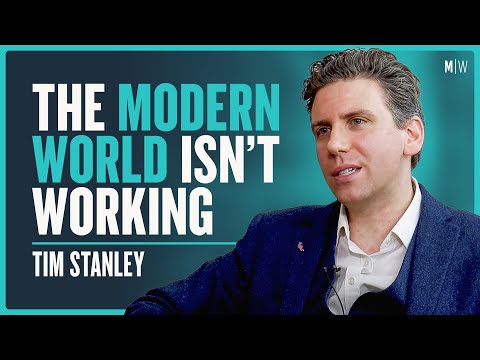
Why Are We Yearning For Tradition In 2021? - Tim Stanley | Modern Wisdom Podcast 391
Tim Stanley (guest), Chris Williamson (host)
In this episode of Modern Wisdom, featuring Tim Stanley and Chris Williamson, Why Are We Yearning For Tradition In 2021? - Tim Stanley | Modern Wisdom Podcast 391 explores yearning For Tradition: Liberalism, Identity, And Meaning In Modernity Historian Tim Stanley and Chris Williamson explore why many people in the modern West feel a growing pull toward tradition amid hyper‑novelty, information overload, and liberal individualism. Stanley argues that liberalism’s relentless focus on autonomy and skepticism has weakened the institutions and narratives that once grounded people in family, faith, and shared history. They examine how culture, technology, and changing gender roles have eroded roots, and why nostalgia, ritual, and inherited practices still meet deep human needs for belonging and purpose. The conversation closes with the case for deliberately seeking traditions, communities, and long‑term projects as antidotes to pointlessness and isolation.
Yearning For Tradition: Liberalism, Identity, And Meaning In Modernity
Historian Tim Stanley and Chris Williamson explore why many people in the modern West feel a growing pull toward tradition amid hyper‑novelty, information overload, and liberal individualism. Stanley argues that liberalism’s relentless focus on autonomy and skepticism has weakened the institutions and narratives that once grounded people in family, faith, and shared history. They examine how culture, technology, and changing gender roles have eroded roots, and why nostalgia, ritual, and inherited practices still meet deep human needs for belonging and purpose. The conversation closes with the case for deliberately seeking traditions, communities, and long‑term projects as antidotes to pointlessness and isolation.
Key Takeaways
Tradition offers stability and identity in a hyper-novel world.
In a culture obsessed with what’s new and created in the last 24 hours, older practices, ideas, and rituals provide a consistent reference point that helps people feel rooted in something larger and more enduring than themselves.
Get the full analysis with uListen AI
Liberalism’s strength—maximizing freedom—can undermine itself.
By elevating individual autonomy and skepticism above all else, liberalism erodes shared institutions, moral frameworks, and communal obligations, eventually weakening the very conditions that make stable freedom and open inquiry possible.
Get the full analysis with uListen AI
Erasing or simplifying the past hands power to present-day revolutionaries.
When societies teach that their history is purely wicked and must be discarded, they clear the way for ideological movements to design a ‘new order,’ often recreating old power hierarchies in different forms while stripping away long-evolved rights and local protections.
Get the full analysis with uListen AI
Masculine and feminine archetypes can be oppressive yet still necessary.
Rigid gender expectations can harm those who don’t fit them, but completely dissolving masculine and feminine virtues removes socially recognized paths to dignity, self-respect, and responsibility—especially for men who already feel culturally devalued.
Get the full analysis with uListen AI
Identity is largely inherited, not purely self-invented.
Language, family, culture, genetics, and early rituals (from circumcision to childhood ‘career’ ceremonies) shape who we become long before conscious choice, challenging the modern myth that individuals fully create themselves from scratch.
Get the full analysis with uListen AI
Nostalgia can be morally useful when it selectively remembers virtues.
While it isn’t precise history, nostalgia often focuses on admirable aspects of the past—like solidarity or courage—helping societies write moral stories that inspire better behavior today without needing to idealize everything that actually happened.
Get the full analysis with uListen AI
Meaning requires commitment to something worth sacrificing for.
Stanley contends that life feels hollow without a cause, faith, family or community one would suffer or even die for; such commitments turn ordinary tasks into significant acts and counter the sense that modern life is shallow or pointless.
Get the full analysis with uListen AI
Notable Quotes
“Some of us are looking for the novelty of consistency.”
— Tim Stanley
“Liberalism has very good intentions. It wants us to be free… but in constantly pushing freedom, it slowly begins to erode the basis for its own existence.”
— Tim Stanley
“If you can discredit the past, then you can say that the present order is broken, therefore we need a new one.”
— Tim Stanley
“There is no point to your life unless you have something to die for.”
— Tim Stanley
“It seems paradoxical that some people want to totally tear down and reconstruct modern society, and then other people kind of just want nothing to change—but with both of them, the implication is that neither of them are very happy with how things are going right now.”
— Chris Williamson
Questions Answered in This Episode
To what extent can liberal societies reintroduce binding traditions without betraying their commitment to individual freedom?
Historian Tim Stanley and Chris Williamson explore why many people in the modern West feel a growing pull toward tradition amid hyper‑novelty, information overload, and liberal individualism. ...
Get the full analysis with uListen AI
How do we distinguish between traditions worth preserving and those that primarily perpetuate injustice or stagnation?
Get the full analysis with uListen AI
What practical steps can an irreligious person take to gain the psychological benefits of tradition, ritual, and community?
Get the full analysis with uListen AI
Are current portrayals of masculinity in culture harming young men’s ability to develop healthy, prosocial male identities?
Get the full analysis with uListen AI
Could a serious attempt to revive tradition in the West avoid sliding into reactionary politics or exclusionary nationalism?
Get the full analysis with uListen AI
Transcript Preview
Liberalism has very good intentions. It wants us to be free. And over the course of a few hundred years, it builds strong institutions that allow us to be free. So it both has a good intent, and it also has a rational way of going about it. The problem with liberalism is that in constantly pushing freedom, and in placing so much weight upon reason as the way that we reach conclusions, it slowly begins to erode the basis for its own existence.
I've just got back from Italy, and I've managed to evade all of the culture war stuff. Basically, not been on Twitter or social media for a full week. And I've arrived back to find out that Ted Cruz is being accused of apologizing for Nazi salutes at a teachers meeting, and that Rishi's budget is racist or some other horse shit. So I've descended-
(laughs)
... descended back into the muck and the mire, but you're here with me, so we're- we're both going into it today.
It's a pleasure. It's a pleasure.
Why are you interested in tradition?
I'm interested in tradition because I'm trying to find different ways to live. Uh, I think one of the problems with the modern world is we're encouraged to live in the present and we're encouraged to live for ourselves. And one of the great things about tradition is it- it does the complete opposite. It- it compels you to look backwards, to root your identity in the past rather than the here and the now. But it also compels you to submit some- to something other than yourself. Now, uh, that might all sound creepily medieval, and many people just hearing that will think, "I don't want any of that." Uh, but that's what so radical and revolutionary about it. And living in a democratic consumer society as we do, one of the things is you can choose the past you look back to and you can choose the things to submit to. But either way, I'm just interested in- in living beyond the here and the now, and all those things you've just described, which are- are so temporary and fleeting and- and very often distracting.
There's a blog post by a friend called David Perell, and he identified that the Lindy effect, which is how long certain ideas and pieces of art and books and stuff stay around, you can presume that however long they've been around for, they're going to be around for that much longer. So the classics are the classics for a reason. 1984 has been around for, whatever, 80 years or so now. That may continue, we can expect, for at least another 80 years moving forward. But he identified that almost all of the content that everybody consumes on a daily basis has been produced within the last 24 hours. That it's the most-
(laughs)
... un-Lindy world that you could imagine. (laughs)
Install uListen to search the full transcript and get AI-powered insights
Get Full TranscriptGet more from every podcast
AI summaries, searchable transcripts, and fact-checking. Free forever.
Add to Chrome